II Vessels and forms · Plate 025
Mealheiro (money box)
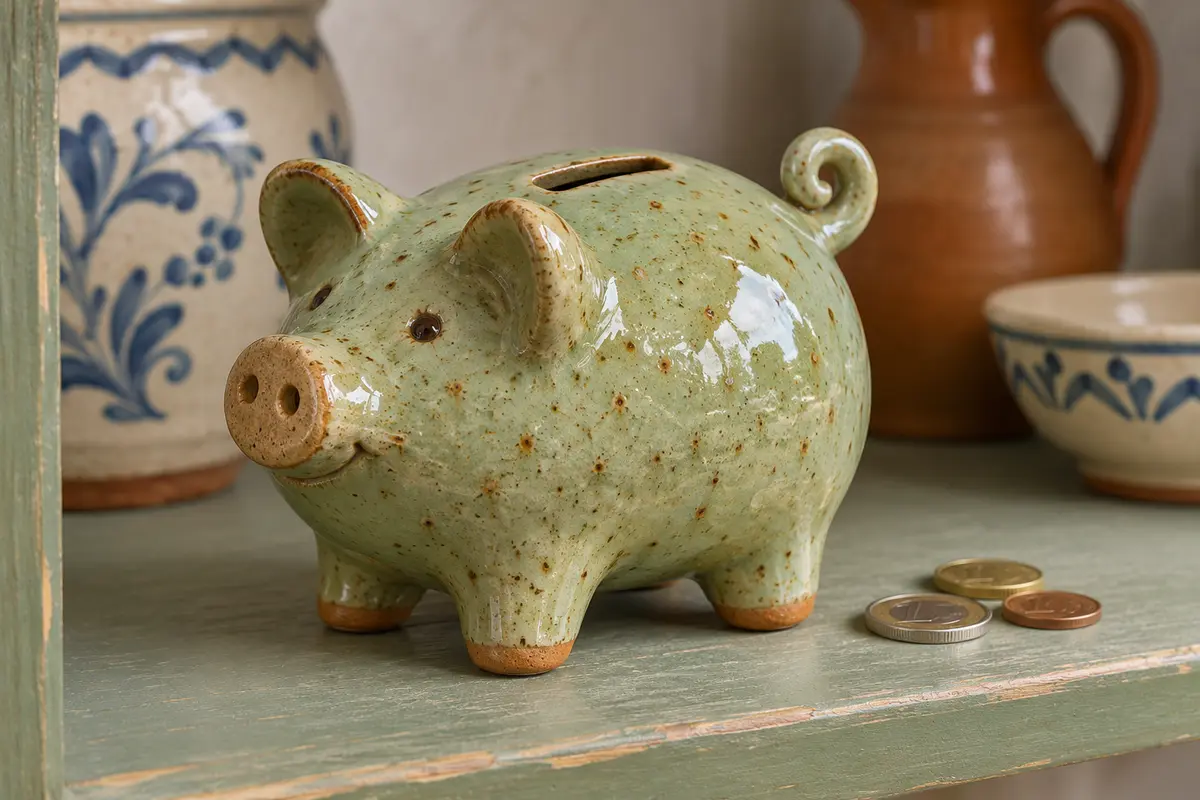
A hollow object with a narrow slot for dropping in savings. In clay it is a common pottery piece, often shaped like a pig.
Priberam defines the mealheiro as a hollow vessel or object with a thin opening through which coins or notes are dropped in over time. The word is also used for a donation box, such as one for alms, and for the sum a person has put aside, for which the dictionary gives pé-de-meia and pecúlio as synonyms. As an adjective, mealheiro means made up of mealhas, small coins. Many modern banks have a rubber plug underneath for taking the money out; others have no opening, so the owner has to break the bank, which discourages spending. Temples and churches use them to collect donations.
Money boxes are old. The oldest Western find is a 2nd-century BC box from Priene, in Asia Minor, shaped like a small temple with a slit in the pediment. A red earthenware box from Bruges dates to 1250-1350, and Germany's oldest pig-shaped bank was recovered in Thuringia from the 13th century. The earliest known pig-shaped containers come from 12th-century Java, where cèlèngan, 'likeness of a wild boar', means both savings and piggy bank. In Mafra, a pottery makes pig money boxes to order on the wheel, by hand, 'as in the old days'.
This is a general description, not confirmed to a single source.
Source: dicionario.priberam.org, en.wikipedia.org, dn.pt
AI-generated illustration in the manner of the tradition, not a photograph of a specific object.