V Ceramics in place · Plate 022
Stacked roof tiles
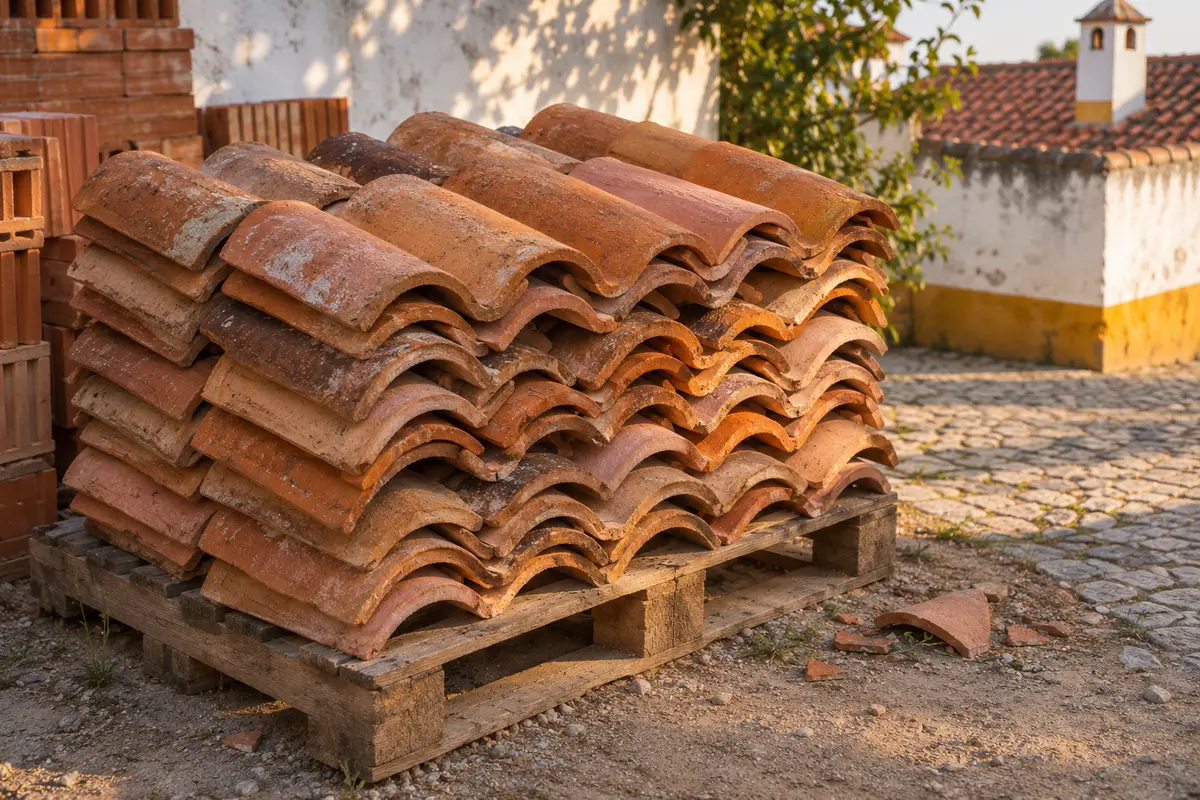
On traditional roofs, curved clay tiles are laid in overlapping rows that carry rain away.
The Portuguese roof tile, telha portuguesa or aba-canudo, is used for wavy roofs when a project calls for a historical style or a rounded roofline. A technical description on Portuguese Wikipedia says assembly is simple because each piece is uniform and interlocks, with a symmetrically defined undulation. It gives the dimensions as 22 by 40 centimetres, weighing about 2.4 kilograms a piece, 17 pieces per square metre, which is about 40.8 kilograms per square metre, and a maximum water absorption of 14 percent. The same page lists the telha romana and the capa e canal (colonial) tile.
Strength depends on the firing. English Wikipedia says the breaking strength of a clay tile depends on firing temperature, clay composition and the length of the firing cycle, and that low firing temperatures tend to raise porosity and lower strength. Interlocking tiles needed a tile press, whereas many traditional profiles could be made by hand. A pantile merges the pan and cover into one piece, covering more area with fewer tiles and leaving fewer cracks that could leak, and is traditionally formed with an extruder. These are general facts, not a Portuguese-only account.
This is a general description, not confirmed to a single source.
Source: pt.wikipedia.org, en.wikipedia.org
AI-generated illustration in the manner of the tradition, not a photograph of a specific object.