II Vessels and forms · Plate 054
Alcatruz (noria pot)
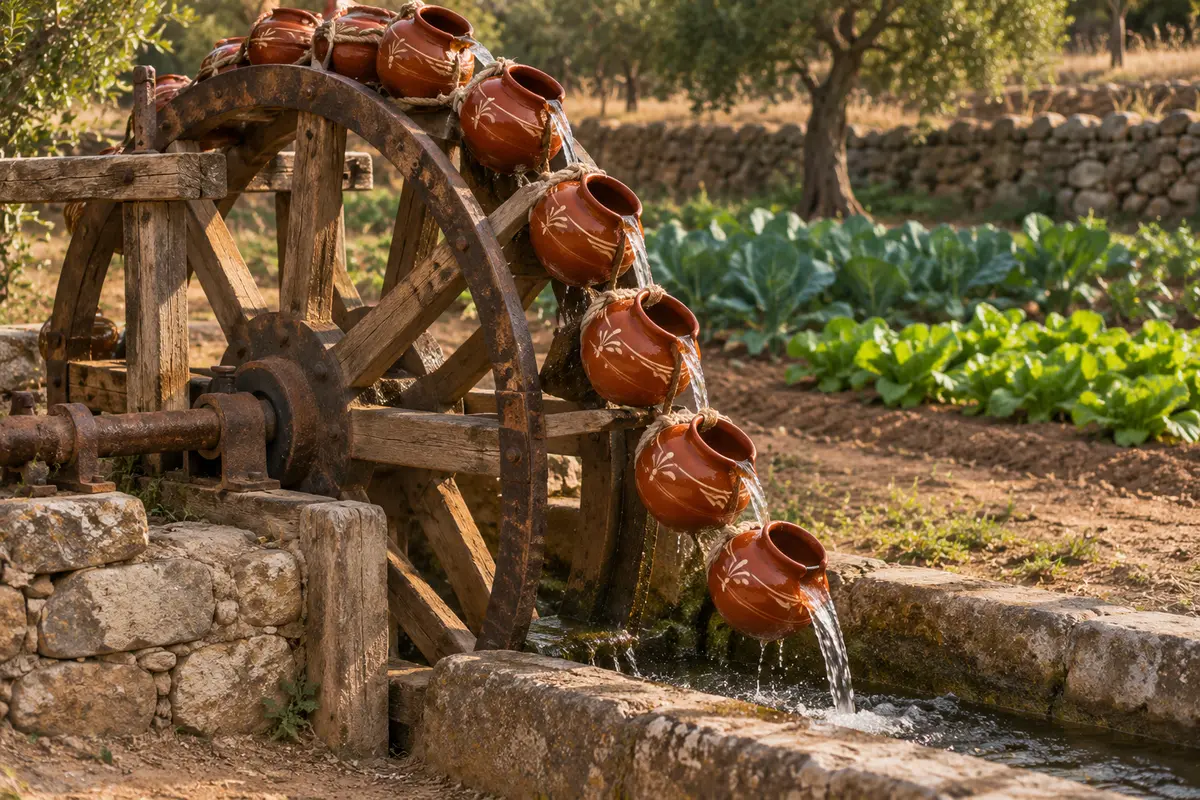
Each of the vessels that lift water in a nora (water wheel). In the Algarve the word also names a clay pot used to catch octopus.
The alcatruz is the working part of the nora, the water-lifting wheel. Priberam defines it as each of the vessels that draw water from the nora. On the wheel Wikipedia calls a noria, pots or buckets are fixed to the rim and discharge their water sideways into a channel, which carries it off for irrigation or to supply towns and villages. Unlike a watermill, the wheel gives no power to any other process; it only lifts water. Wikipedia says the pots can be ceramic, and its photograph of a noria at Tomar, Portugal, shows paired ceramic pots along the wheel.
The word comes from Arabic, al-qadus, according to Priberam. Wikipedia says that around 300 CE the Romans replaced wooden compartments with separate ceramic pots tied to an open-framed wheel, creating the noria, and that Muslim engineers later improved the design. Ibn Bassal, in 11th-century al-Andalus, is credited with using the flywheel in norias. Al-Andalus had many of them, and the one at Alcantarilla near Murcia, built in the 15th century, still works. In the Algarve, Priberam records a second meaning for alcatruz: a clay pot used to catch octopus.
Source: dicionario.priberam.org, en.wikipedia.org
AI-generated illustration in the manner of the tradition, not a photograph of a specific object.