V Ceramics in place · Plate 001
Tiled church nave
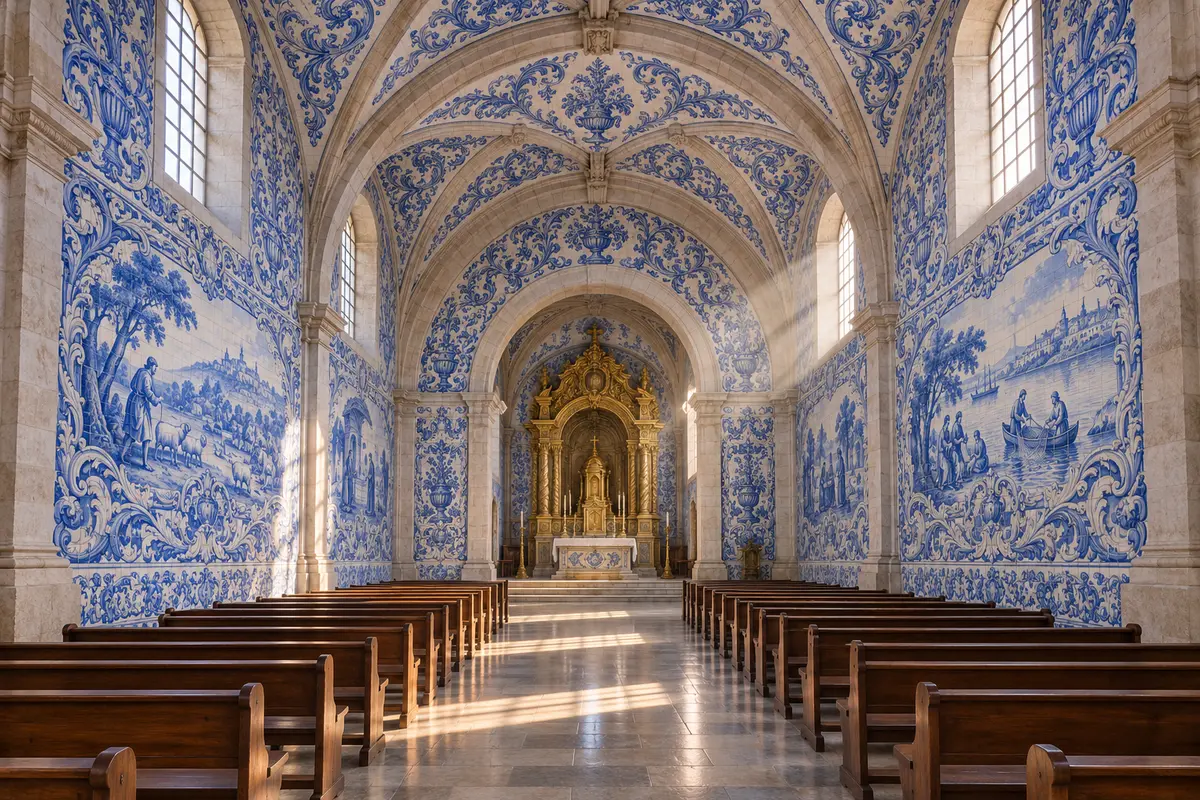
Blue-and-white tile panels covering the walls of a nave are a common sight in Portuguese churches, often telling religious scenes.
Church walls were among the first places where Portuguese tilework was dated and signed into the record. The Miracle of St Roque, in the church of São Roque in Lisbon, is described as the first dated Portuguese azulejo composition and is by Francisco de Matos, in 1584. In the 17th century the walls of churches such as Santa Maria de Marvila in Santarém received polychrome framing, while the Salvador in Évora and the university chapel in Coimbra were given carpet-like compositions that repeat one pattern across a whole wall. Some panels even imitate altar cloths, as altar fronts.
The look changed with the money and the date. The Portuguese article on azulejo says Brazilian gold under João V paid for Baroque panels with elaborate frames, and the English one dates a panel set by Willem van der Kloet in the church of Nossa Senhora da Nazaré to 1708. After the 1755 earthquake the Museu Nacional do Azulejo says pattern tiles returned as an efficient, low-cost way to cover interiors of new buildings, a solution still used into Maria I's reign, to 1816. A nave in blue and white is therefore one period among several.
This is a general description, not confirmed to a single source.
Source: en.wikipedia.org, pt.wikipedia.org, artsandculture.google.com
AI-generated illustration in the manner of the tradition, not a photograph of a specific object.