V Ceramics in place · Plate 009
Tiled townhouse on a hill street
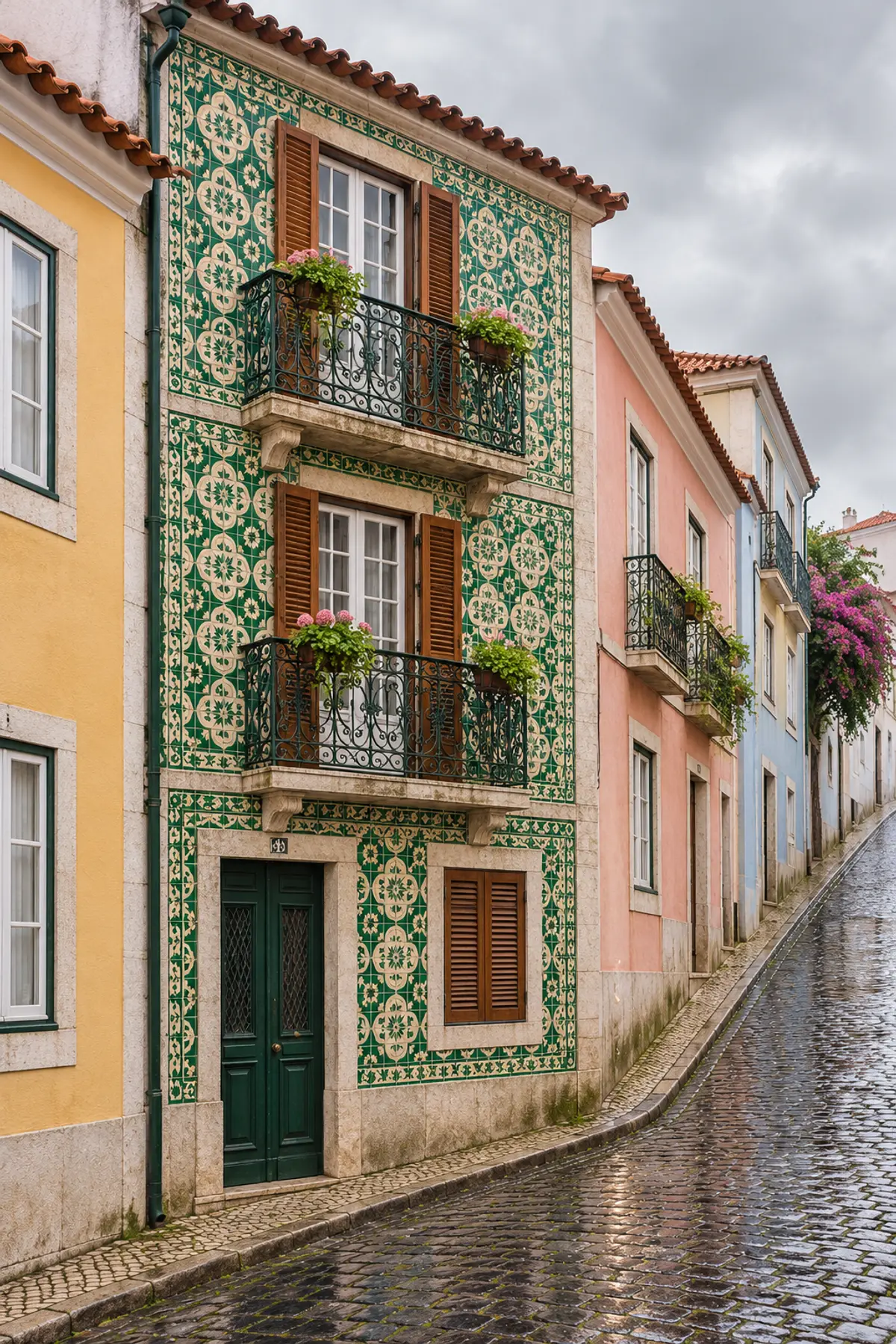
Since the 19th century many Portuguese towns have whole facades faced in tile, which gives each street a mosaic of colours.
Lisbon's Casa das Bolas shows what a whole building of tiles could contain. According to the civil engineering laboratory LNEC, it was put up in 1871 and 1872 for a member of the Roseira family from parts of an earlier building, and is named after trompe-l'oeil spheres on its ground-floor facade tiles. Inside, under window sills and in service areas, over fifty patterns are laid in apparently random order. The Roseira factory in Lisbon was, in the second half of the 19th century, one of the most important makers of facade tiles used in Portugal and in Brazil.
The Museu Nacional do Azulejo explains why tiles spread to street fronts. From the mid-19th century, cities were growing, industrial manufacture had made ceramics ordinary, and a more status-minded outlook made owners want to tell similar buildings apart. The museum adds that some factories in the north began to stand out for relief forms, which give sharper light and shadow than the tiles found in Lisbon. Visit Lisboa says the cheaper pattern tile covered thousands of facades. The Portuguese azulejo article names Roseira, Calçada do Monte and Viúva Lamego in Lisbon, and Massarelos, Carvalhinho and Devesas in the Porto area, as major factories.
Source: repositorio.lnec.pt, artsandculture.google.com, visitlisboa.com, pt.wikipedia.org
AI-generated illustration in the manner of the tradition, not a photograph of a specific object.