V Ceramics in place · Plate 019
Street-name tile, blank
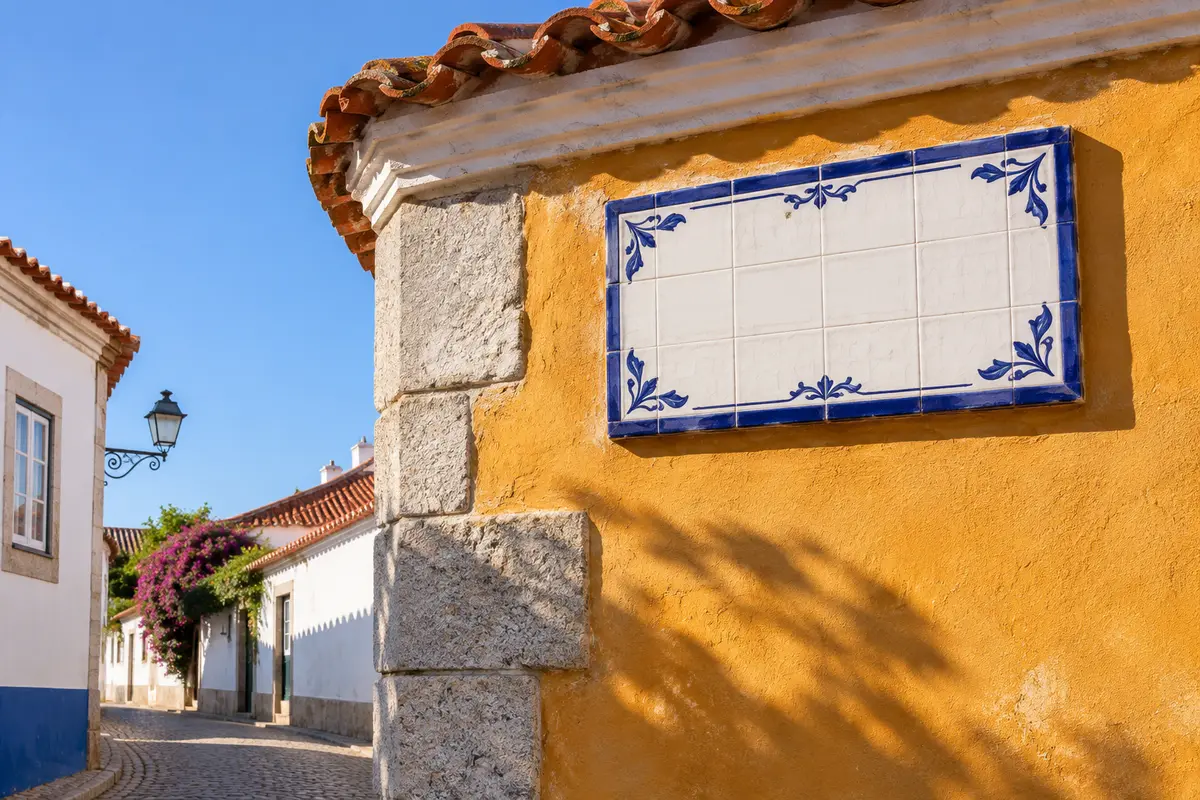
In several Portuguese towns, street names appear on tile plaques. In this illustration the centre is left blank.
Street names in Lisbon were once passed on by word of mouth. A guide to the city's plaques says that after the 1755 earthquake the first official ordinance naming downtown streets was published in 1760, and the first official plaques appeared then, as engraved stone on corner stones. Black plaques with white lettering, painted directly on walls in the early 19th century to support mail and police house numbering, are mostly in Alfama and Castelo. The guide dates the white tile with blue lettering and a thin frame from the 1930s, common in Campo de Ourique, Bairro Alto and Bica.
The same guide lists later types: lioz stone plaques from the 1940s, framed tiled plaques of the 1980s showing a boat with crows, the city's symbol, and blue plaques on aluminium poles after Expo 98. It says the framed tile type was discontinued. A different case is Avenida de Madrid, where hand-painted tiles signed by R. Del Olmo show Madrid landmarks and copy plaques Madrid began placing in its historic centre in the 1930s; Time Out calls them unique in the city. Their origin as a gift from Madrid is likely but not proven.
This is a general description, not confirmed to a single source.
Source: getlisbon.com, timeout.pt
AI-generated illustration in the manner of the tradition, not a photograph of a specific object.