V Ceramics in place · Plate 004
Station-style panel hall
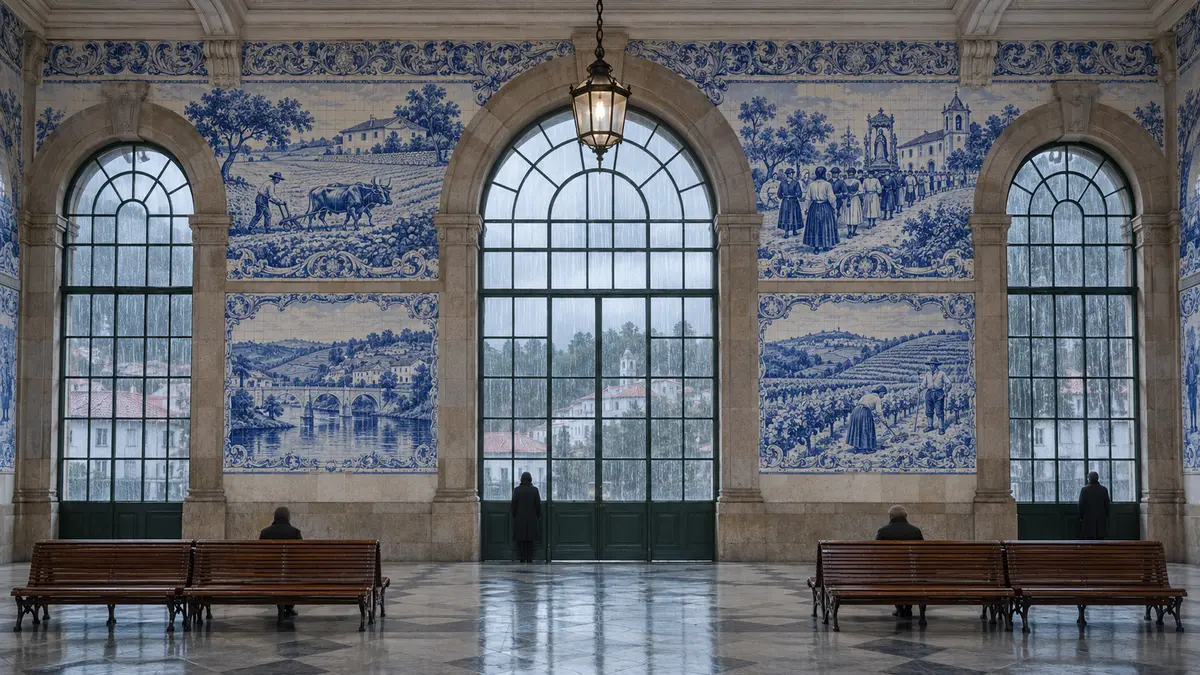
Large tile panels decorate Portuguese railway stations, such as São Bento in Porto, with some 20,000 tiles by Jorge Colaço from the 1930s.
São Bento station in Porto was designed by the local architect José Marques da Silva and officially inaugurated on 5 October 1916, according to Infraestruturas de Portugal and Portuguese Wikipedia. English Wikipedia says the site was occupied by the Benedictine convent of São Bento da Avé Maria, ordered by Manuel I in 1518, which was destroyed by fire in 1783 and demolished in 1892. It also says Marques da Silva got his contract in 1899 and was removed from the project in 1909. The station is classified as a Property of Public Interest, since 1997 in Wikipedia and December 1997 for Infraestruturas de Portugal.
The tiles are by Jorge Colaço and were made at the Sacavém factory. Infraestruturas de Portugal counts more than 20,000 tiles, and English Wikipedia gives about 551 square metres. Scenes include the Battle of Valdevez, Egas Moniz before Afonso VII, João I entering Porto and the conquest of Ceuta in 1415, with rural work scenes and a frieze on the history of transport. Sources disagree on dates: English Wikipedia says the first tiles were placed on 13 August 1905 and the project lasted 11 years, while Portuguese Wikipedia says 1905 to 1906. A restoration of the panels won the 2013 SOS Azulejo prize.
Source: en.wikipedia.org, pt.wikipedia.org, infraestruturasdeportugal.pt, infraestruturasdeportugal.pt
AI-generated illustration in the manner of the tradition, not a photograph of a specific object.