V Ceramics in place · Plate 032
Museum case of tiles
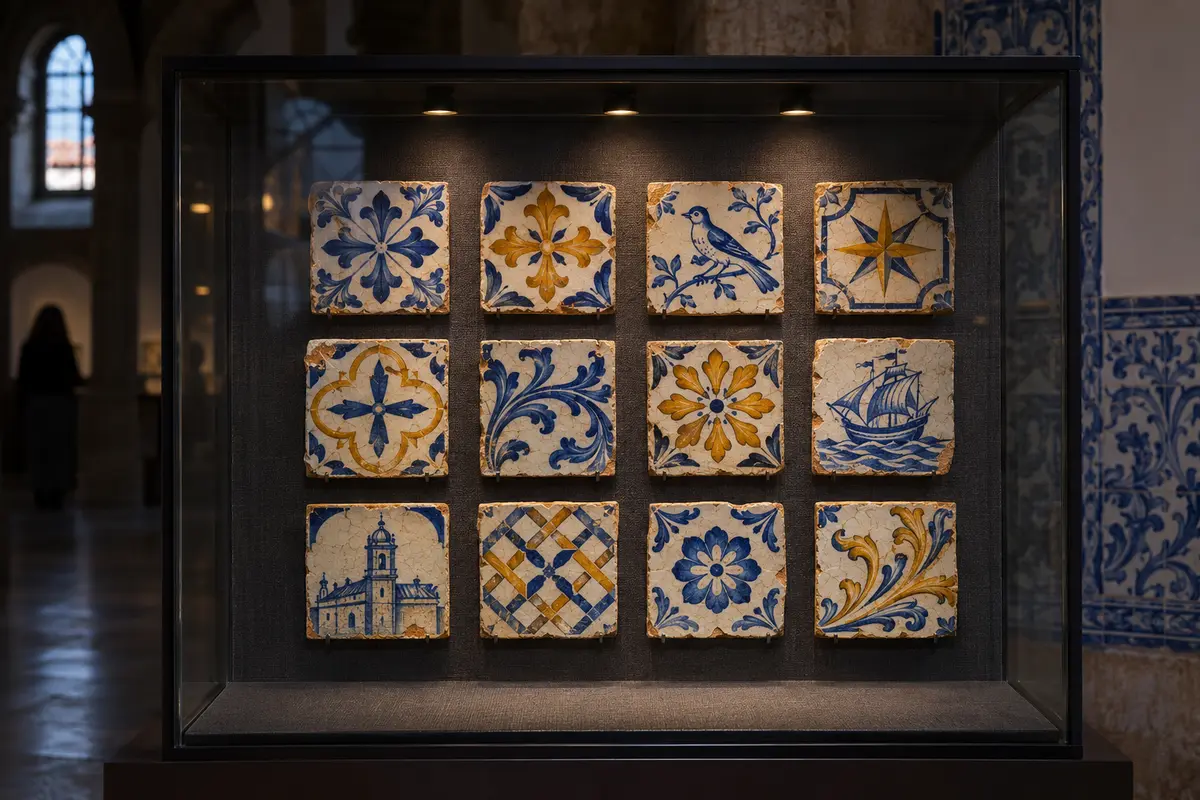
Museums show azulejos in cases and on walls. The Museu Nacional do Azulejo, in Lisbon, is devoted entirely to the art.
The Museu Nacional do Azulejo occupies the former Convento da Madre de Deus, founded in 1509 by Queen D. Leonor (1458-1525), wife of D. João II and sister of D. Manuel, and first home to Franciscan Poor Clares. D. João III ordered a major rebuilding by the architect Diogo de Torralva, with a new church and cloister. In the late 17th century D. Pedro II had the church decorated, including Dutch tile panels installed in 1686. The 1755 earthquake damaged the church, and after religious orders were abolished in 1834 the complex became the Asilo D. Maria Pia, with restoration work beginning in 1896.
The tile panels were first kept in crates and later moved to the convent, where the museum opened in 1965 as an annex of the Museu Nacional de Arte Antiga; it became an independent national museum in 1980. João Miguel dos Santos Simões organised the collection. It covers decorative tiles from the second half of the 15th century to the present, together with 19th- and 20th-century ceramics, porcelain and faience. A panoramic panel of Lisbon before the 1755 earthquake, the Great View of Lisbon dated around 1700, is among its best-known pieces. In the church, the Chapel of Saint Anthony keeps 18th-century Baroque decoration and canvases by André Gonçalves.
Source: en.wikipedia.org, pt.wikipedia.org
AI-generated illustration in the manner of the tradition, not a photograph of a specific object.