V Ceramics in place · Plate 039
Tile crates on a quay
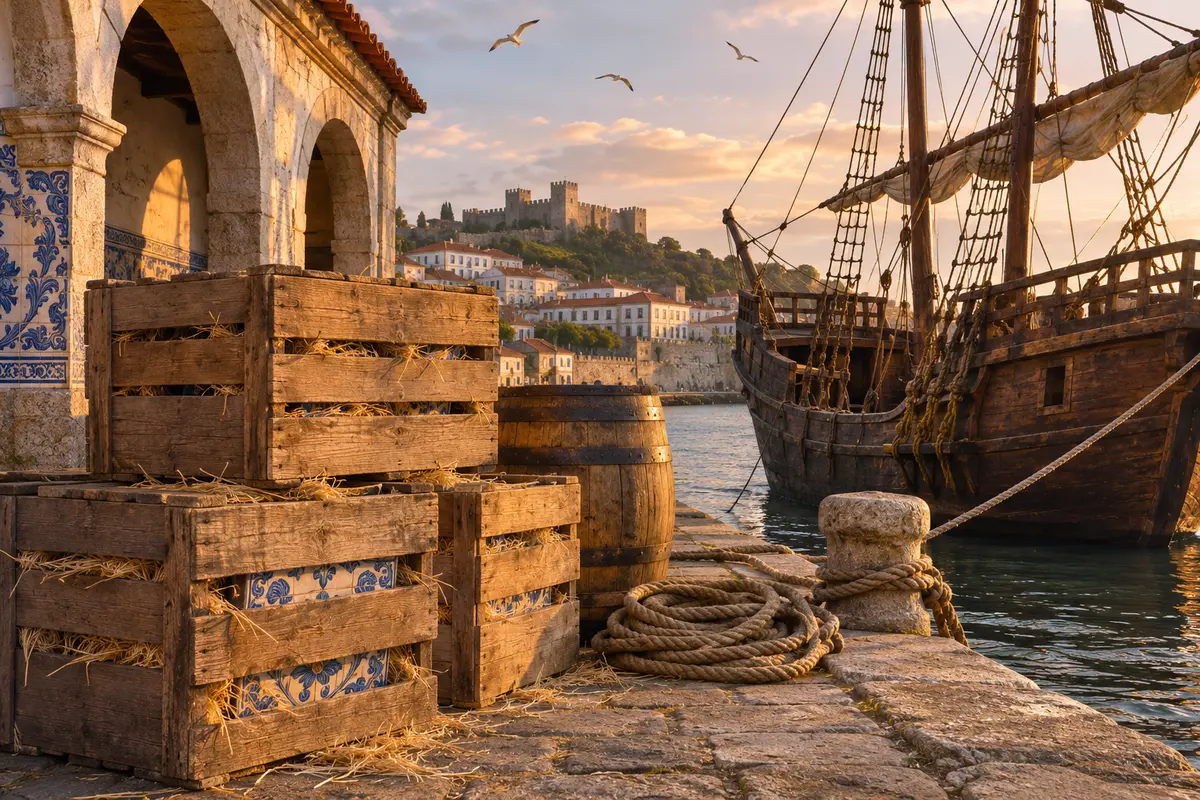
Azulejos travelled by sea, and large orders went to Brazil.
In the 18th century large orders came from the Portuguese colony of Brazil, and they helped drive mass production of azulejos. São Luís, in Maranhão, preserves the largest urban group of 18th- and 19th-century azulejos in Latin America, and its historic centre became a UNESCO World Heritage Site in 1997. The same article cites a convent in Salvador da Bahia dated 1702. Later, after the French invasions, the Portuguese court took refuge in Brazil, and the production of tiles for royal works in Portugal stagnated in the early 19th century.
The trade in the 19th century is more debated than it looks. Studies cited by Portuguese Wikipedia indicate that the first tiled façades in Brazil used Portuguese tile, with rare exceptions, and that foreign influence came afterwards. The model was copied above all by Portuguese emigrants, who turned to factories in Portugal. The older thesis of Santos Simões, that Portuguese production revived after 1834 to supply Brazilian orders, is described as a fallacy by Ana Margarida Portela Domingues and Dora Alcântara, who argue that the decisive demand was Portuguese. A study of the Lisbon Roseira factory nevertheless calls it one of the most important makers of façade tiles used both in Portugal and in Brazil in the second half of the 19th century.
Source: en.wikipedia.org, pt.wikipedia.org, repositorio.lnec.pt
AI-generated illustration in the manner of the tradition, not a photograph of a specific object.