V Ceramics in place · Plate 003
Chapel dado by candlelight
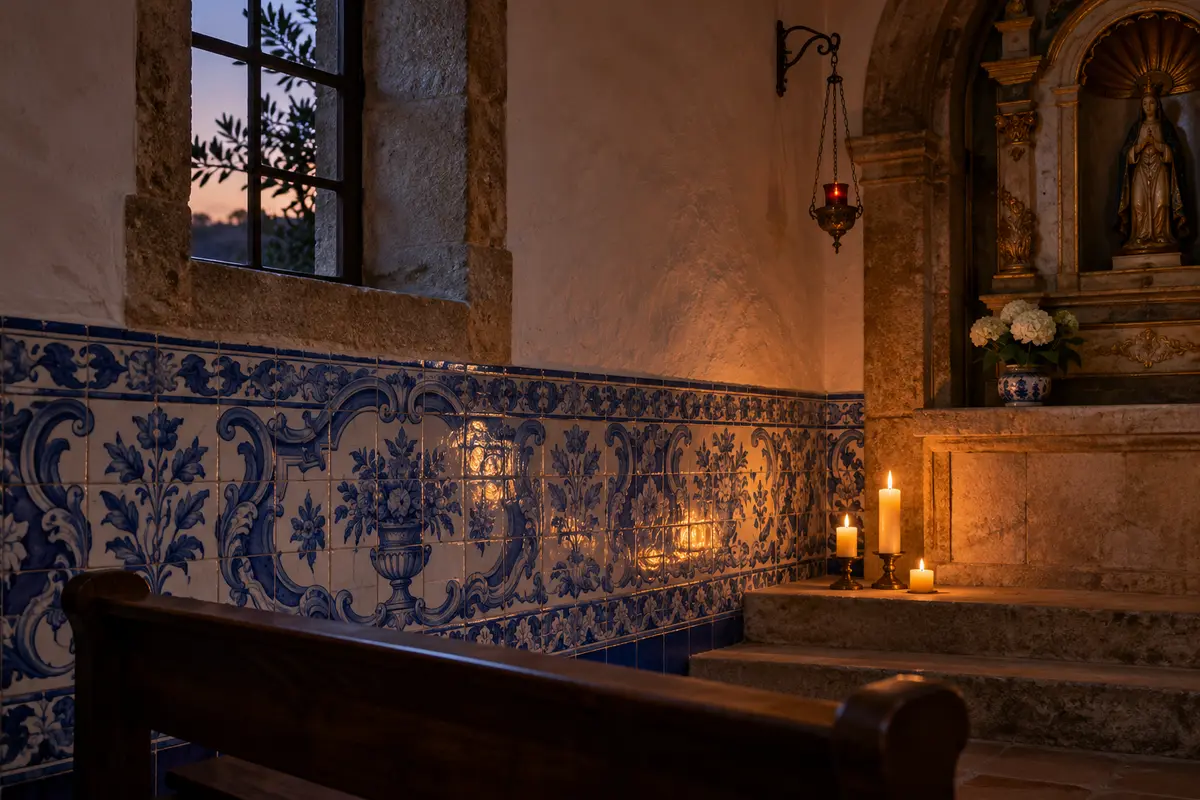
The silhar is the band of tiles covering the lower part of a wall.
Silhar is the word for a wall dado, and the Portuguese article on azulejo gives its usual height as 10 to 12 tiles. Chapels and sacristies used it to wrap the lower wall in colour, leaving the upper part to plaster, paint or stone. The same article records an 18th-century technique called esponjado (sponged), used on skirting and stair runs. From the 16th century Portuguese tiles were standardised at about 13.5 to 14.5 cm square, a size that lasted until the 19th century, which is why old dados fit together so evenly.
Chapels also held tiles with a devotional job. Altar frontals, called antependia in the English article, imitated altar cloths in tile and survive at the Hospital de Santa Marta in Lisbon, the convent of Almoster and Buçaco. Alminhas are panels showing souls in purgatory, often marked P.N. or A.V. at the base. The English article adds that after the 1755 earthquake small devotional panels began to appear on buildings as protection against future disasters. A chapel wall of tile is therefore a place where the practical band of the dado and the sacred image sit side by side.
This is a general description, not confirmed to a single source.
Source: pt.wikipedia.org, en.wikipedia.org
AI-generated illustration in the manner of the tradition, not a photograph of a specific object.