V Ceramics in place · Plate 017
Tiled doorway on a calçada street
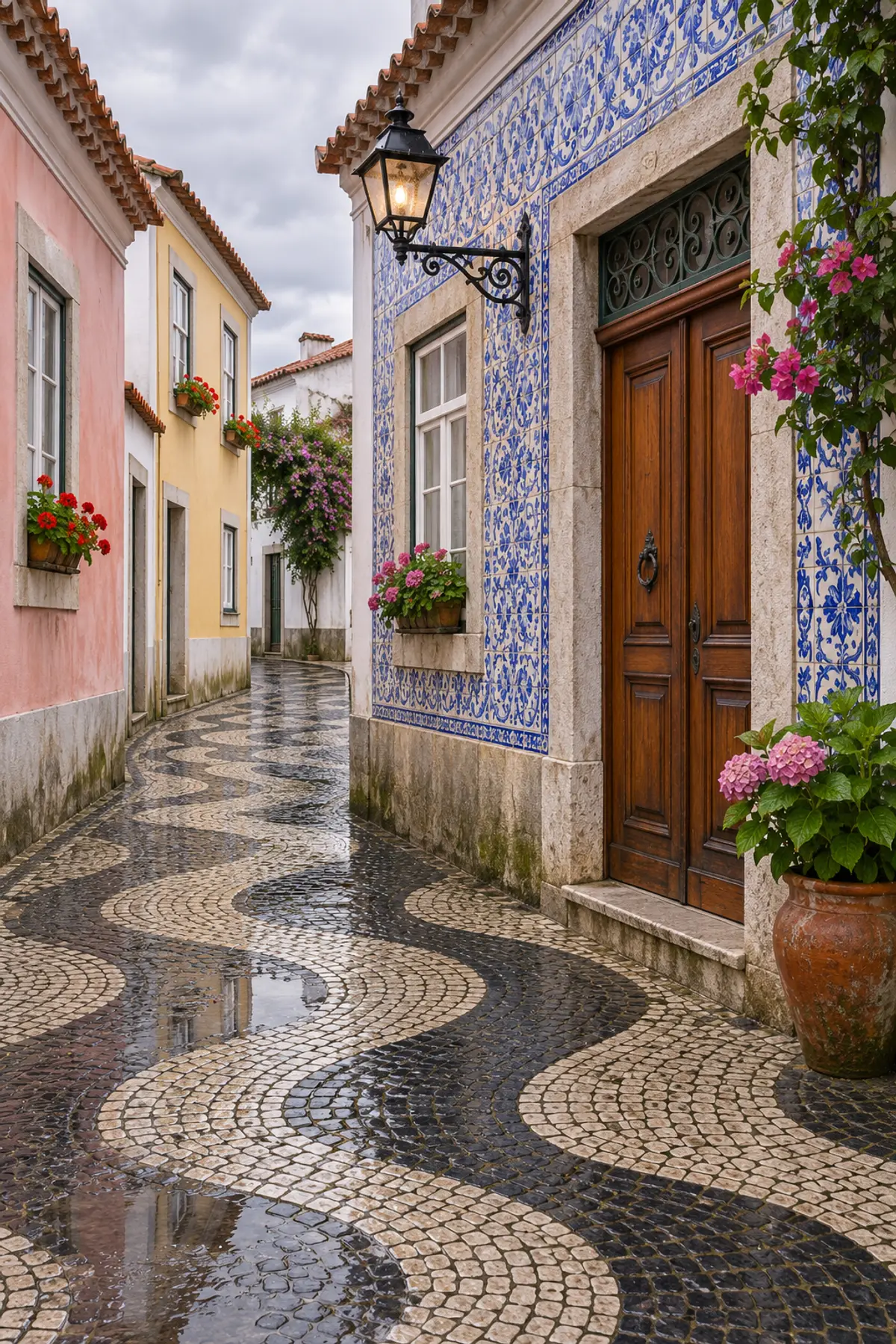
Calçada portuguesa is paving of small limestone and basalt cubes. Beside it, a tiled doorway is a typical detail of old Portuguese streets.
Calçada portuguesa has a dated beginning. According to Portuguese Wikipedia, the first known black-and-white pavement in Lisbon was laid in 1842 at the Castelo de São Jorge by prisoners under Eusébio Pinheiro Furtado, with a wave-like sea design. Work on the Rossio, now Praça D. Pedro IV, began in August 1848 and covered about 8,712 square metres, finishing at the end of the following year. The style then spread across Portugal and its colonies. Visit Lisboa describes it as one of Lisbon's trademarks, made of limestone cubes.
The stones are small, typically 3 to 7 centimetres, in white and black limestone or basalt, with other colours in brown, red, blue-grey and yellow. Calceteiros, called mestres calceteiros in Portugal, use the limestone's natural joints and a hammer to shape stones, and use moulds to mark colour zones. Motifs repeat as friezes or two-dimensional patterns, and the article lists techniques such as malhete, sextavada and mar largo, the most iconic design. A school for calceteiros was founded in Lisbon in 1986 and the craft entered Portugal's intangible heritage inventory in 2021, while several cities replaced historic paving for safety.
Source: pt.wikipedia.org, visitlisboa.com
AI-generated illustration in the manner of the tradition, not a photograph of a specific object.