02 Clay & fire · Making
From a lump of clay to a fired pot: the wheel, the drying shelf and the kiln
A Barcelos potter starts the wheel with a foot, and most of what decides whether the pot survives happens after the hands let go.
A wheel started with the foot
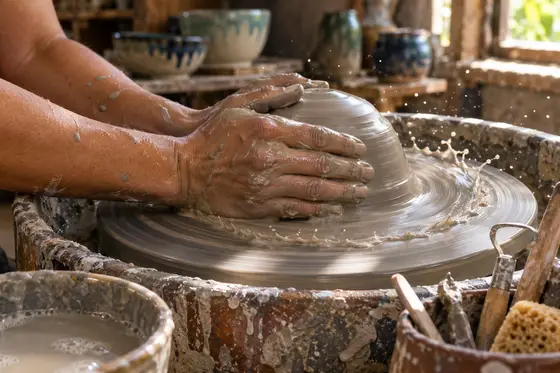
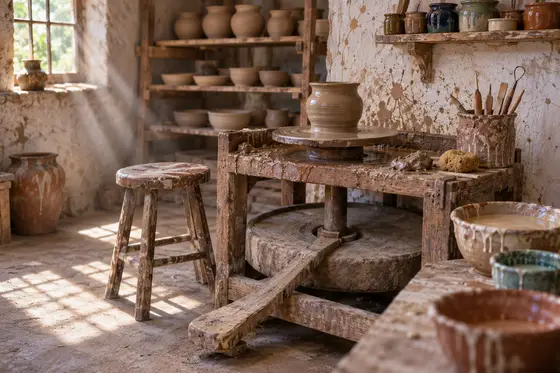
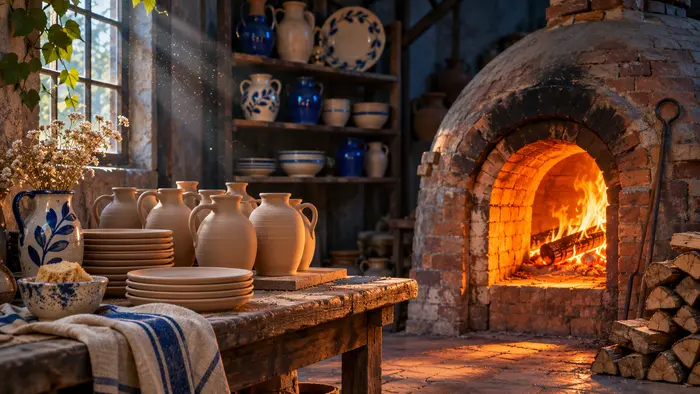
The traditional foot-driven wheel described in Barcelos’s pottery certification file is made of two wheels on one axle. The lower one, about a metre across, sits near the floor. The upper one, the rodalho, is where the clay goes. The potter sets the lower wheel turning with a foot until the rodalho reaches a working speed, then puts the clay down, wets the hands and shapes the piece. The rodalho turns anticlockwise. Beside the seat there is a basin of water for the hands.
The same document says that in the past Barcelos pieces were made exclusively on the foot wheel. Output pushed potters towards electric wheels, which are often a foot wheel fitted with a motor, and towards other forming methods. Even so, the document says, today’s potters there still choose the foot or electric wheel as their main method.
Centring, opening, pulling
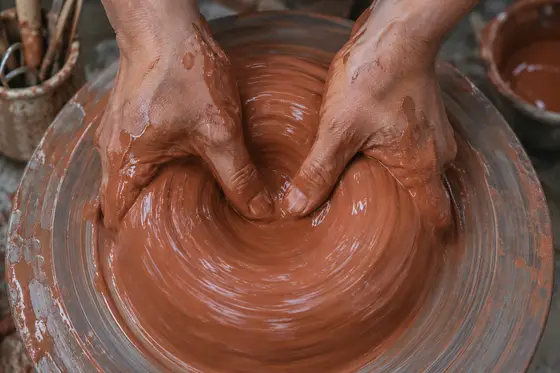
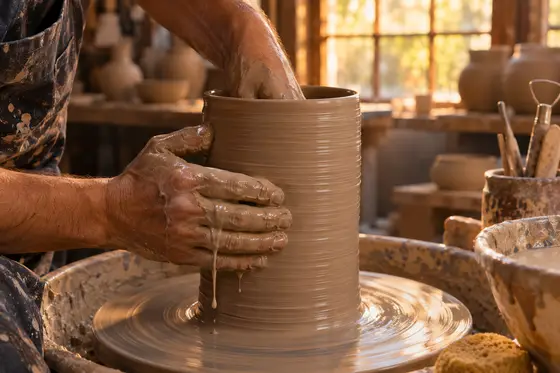
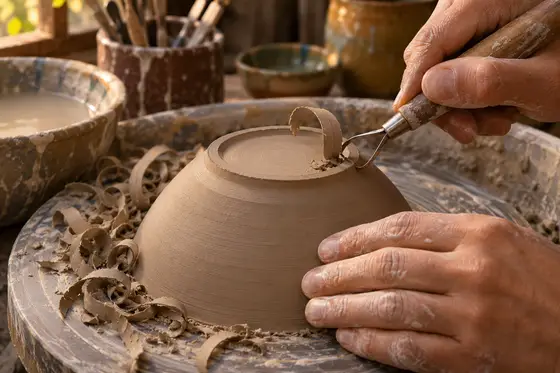
The Barcelos document names three phases: centring the clay, opening it, and giving the piece its form. That is all it says about technique, and we will not claim more than it does. In general terms, centring means getting the lump to spin without wobble; opening means making the hollow; the form comes from drawing the walls up and out. The tools it lists are plain. A bowl of water. A flat metal blade for smoothing and for pulling clay up. A cloth for the rims. A pointed stick for marking the base. A wooden handle with a long metal point, used to prick air bubbles in the clay and to mark and cut off excess. And a fishing line with a cloth toggle at each end, drawn under the pot to cut it from the wheel.
The clay matters too. The document says the common red clays are plastic and easy to shape on the wheel, and fire to the colour of brick. Potters often leave clay outdoors to age, which it says helps its plasticity develop. The paste is usually a mixture of two clays, put through a pug mill to even it out, and some potters now buy it ready to use.
Drying: where the damage starts
The Barcelos document is unusually blunt about drying: it calls it one of the most decisive phases for a successful firing, and asks for careful, perfect drying. Potters used to dry in the sun. Today some still do, some use dryers, and some use the kiln itself.
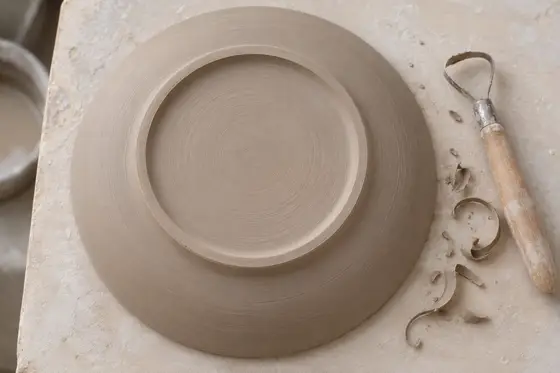
A ceramics reference library, Digitalfire, explains what is at stake. Clay shrinks as it dries, and it cracks mainly because it dries unevenly, not because it dries fast. On a thrown plate with a thick base and a thin rim, the rim dries first and pulls away from the base. Uneven wall thickness, sharp angles, poor joins and badly prepared clay all add risk. Its fix is to dry slowly under cloth and plastic, and to make the cross-section as even as possible. It gives about 7.5% drying shrinkage for a terracotta that rarely cracks, because strong dry clay survives that pull.
Chacota, glaze and the second firing
In the Museu Nacional do Azulejo’s glossary, the chacota is the already-fired, unglazed piece that is coated with tin glaze, painted and fired a second time. That is the two-firing route. It is not the only one in Portuguese pottery. In Barcelos the glazed red ware is decorated with engobe, left to dry, then dipped in a glaze bought as powder and mixed with water. The document says most potters use a single firing for clay and glaze together, at about 970 °C. We did not find a sourced firing temperature for a first, chacota firing.
Glaze changes how the kiln is loaded. Matt pieces can touch each other. Glazed ones cannot, because the melting glaze would fuse them together. The glaze bought today has to meet legal limits for lead and cadmium.
Shrinkage continues in the kiln. Digitalfire gives about 3–4% or less for earthenware, measured from dry to fired. Glaze can fail on top of that: crawling, where the molten glaze draws back into islands and leaves bare clay, happens in part when a glaze layer is too thick or shrinks too much. These are general potters’ rules, not Portuguese findings.
Wood, gas, smoke
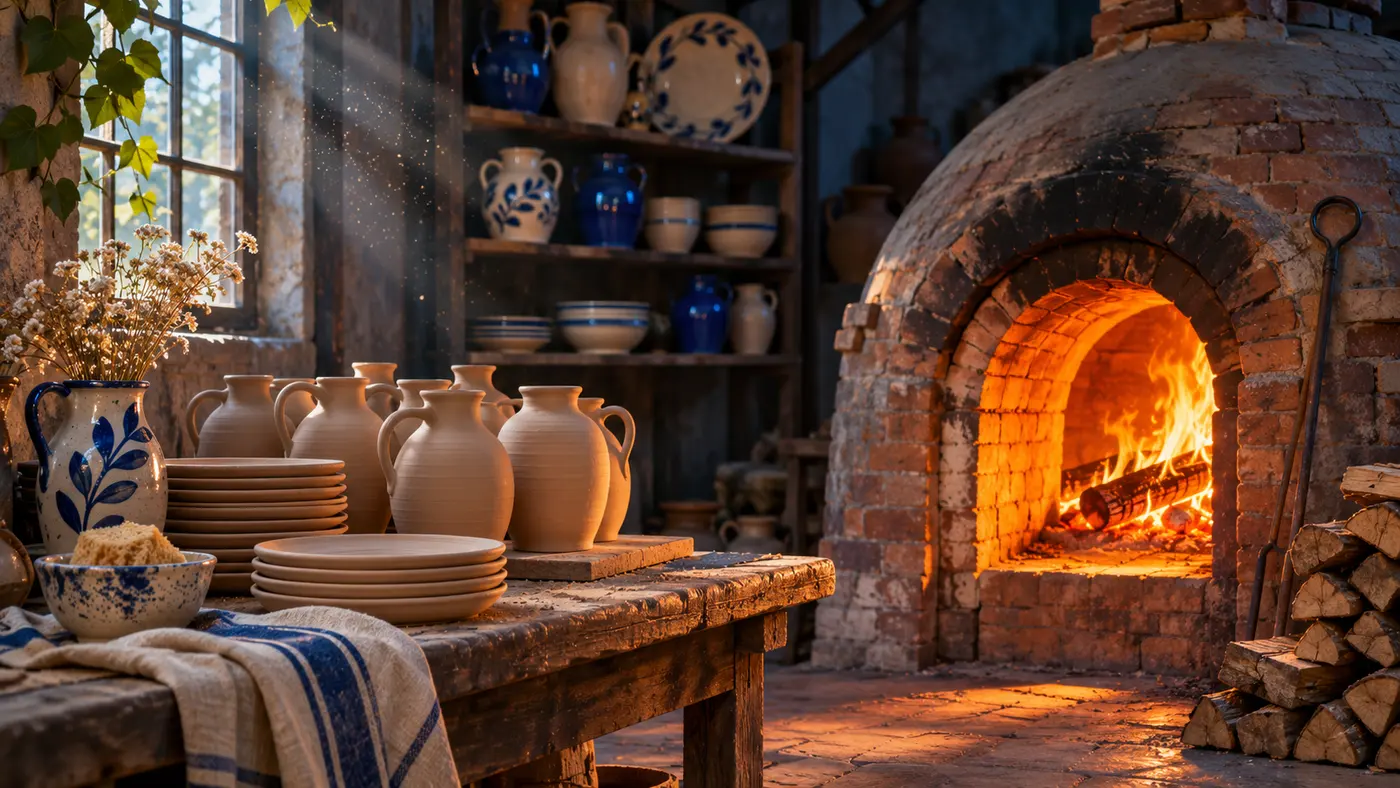
According to the Barcelos document, every pottery once had a wood-fired kiln. From the 1980s some potters switched to gas, mainly to produce more. A few still run their wood kilns. Loading one is slow and difficult, because the raw pieces are fragile, and a small opening is left so the potter can see inside. There are no instruments: the potter judges time and fuel by watching the colour of the pieces and of the kiln interior. Gas kilns, by contrast, have wagons on rails and a programmer that sets time and temperature to suit the paste and the thickness of the pieces. The document says electric kilns are not used for pottery there today.
Black pottery changes the firing, not the wheel. The Barcelos black ware is fired much like the red, except that at peak temperature the kiln is fed with wood and then completely closed. With no oxygen entering, carbon is deposited in the pieces and turns them black. Between 2005 and 2007, researchers visited what they described as the last European potters still firing black pottery this way: at Bisalhães and Vilar de Nantes the potters were still very active, while at Fazamões the last one died during the visits and at Molelos the only one no longer worked. They found the potters gathered twigs under 2 cm thick, not branches, for a rapid rise in temperature before the door was closed. UNESCO lists Bisalhães pottery as needing urgent safeguarding (2016), and notes that its clay now comes from local tile factories.
What goes wrong, and what we cannot say
We could not open a source that describes the wood-fired forno of other regions, or gives firing times and temperatures for them, so we leave those out. The Pottery Wheel on this site lets you try the shaping yourself.
- Air bubbles in the clay. The pricker exists for this.
- A thick base under a thin wall, which dries unevenly and cracks.
- Raw pieces damaged while loading a wood kiln.
- Glazed pieces left touching, so they fuse.
- A glaze that draws back and leaves bare clay.
- A kiln with no instruments, judged by eye. The document says experience makes this easy for the potter, which is another way of saying it has to be learned.
Not confirmed: The wheel, drying, kiln and single-firing details are from one Barcelos source, so they describe that town, not all of Portugal. The shrinkage and cracking figures are from a general ceramics reference, not Portuguese sources. We found no sourced temperature for a chacota firing and no sourced description of wood kilns in other regions.
Sources
- Câmara Municipal de Barcelos: Caderno de Especificações para a Certificação da Olaria de Barcelos (2nd ed., 2010)
- Museu Nacional do Azulejo, collection record for a jar (glossary entry for faiança)
- Digitalfire: Cracking of clays during drying
- Digitalfire: Firing shrinkage
- Digitalfire: Crawling
- Durand, Thiriot, Abraços & Maggiori: Os oleiros e a gestão da lenha nas cozeduras redutoras (Estudos do Quaternário 16, 2017)
- UNESCO: Bisalhães black pottery manufacturing process
Related plates