04 Makers · Caldas da Rainha
The cartoonist who built a pottery
Rafael Bordalo Pinheiro drew Portugal’s best-known satirical figure, then spent his last twenty years modelling frogs, lizards and dragonflies in clay.
A jug that nobody bought
In 1898 a very large jug, decorated with a figure of Beethoven, was shown in Lisbon. José Relvas had commissioned it and then declined to buy it, because of its size. The next year it travelled to Brazil, where it still found no buyer. A raffle of 1,000 tickets did not sell out, and in the end the jug was offered to the President of Brazil, Campos Sales, for the Palácio do Catete.
The jug is a fair summary of its maker. Rafael Bordalo Pinheiro (born in Lisbon on 21 March 1846) made things that were ambitious, a little too big and not always easy to sell. The museum in Lisbon that carries his name keeps the story in its chronology.
Zé Povinho first, clay later
Clay came late. By the time he turned to it Bordalo Pinheiro was already a working journalist and caricaturist. On 15 May 1875 he founded the weekly A Lanterna Mágica with Guilherme de Azevedo and Guerra Junqueiro, and the first drawing of Zé Povinho, the Portuguese everyman, appeared in its fifth issue on 12 June. He then worked in Brazil from 1875 to 1879, mainly on illustrated papers, and launched O António Maria in Lisbon on 12 June 1879. The Álbum das Glórias, three series of 42 sheets published from 1880 to 1902, followed.
The caricature never stopped. Even on ceramic, the same sense of humour turns up: a 1904 box called “Caixa Toma” shows Zé Povinho making a rude gesture from a barrel, according to the museum’s chronology.
The factory in Caldas
In 1883 the project for a faience factory in Caldas da Rainha was printed and Rafael was invited to be its technical director; the statutes were approved on 24 October. The company was a joint-stock company (sociedade anónima) formed in the summer of 1884. His brother Feliciano ran management and administration, and Rafael took charge of technical and artistic matters. The museum’s own pages disagree on the day the deed was signed: one gives 30 June 1884, another 9 August 1884, so we say only “summer 1884”. Construction of the complex began that year; the museum’s chronology has production starting in September.
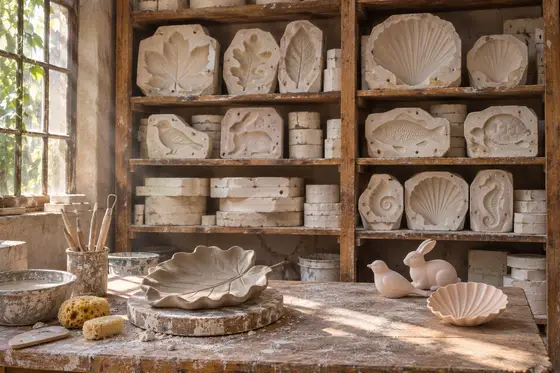
Bricks, glazed roof tiles and wall tiles came first, from 1884, and were used to build the factory’s own offices and shops. Decorative faience appeared from mid-1885, mostly in the Palissy style, and tableware was added in 1888, the same year that machines and kilns for everyday ware were inaugurated in August and a professional school opened. The factory’s mark was “FFCR”.
Frogs on plates, dragonflies in bowls
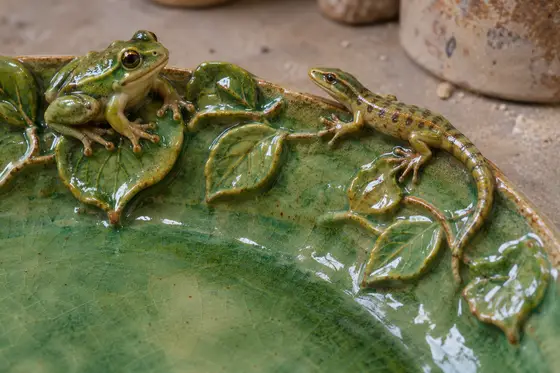
The look of the factory is naturalistic. According to the museum, the modelled relief often carried living animals, such as birds, insects, amphibians and reptiles, and dead ones presented as food, such as fish, shellfish and game. It lists frogs and lizards on the pieces from the Bordalo years, a monkey on the lid of a loquat box, and dragonflies and grasshoppers on the Art Nouveau pieces. A bowl with dragonflies is dated 1901. The Lisbon museum writes that nature motifs were treated “de uma forma muito próxima ao real”, close to reality.
Caldas da Rainha already had a tradition of this kind of work, and a museum source ties his pieces to the international revival of Bernard Palissy’s ware. His own range was wider than frogs: the museum also lists a censer in Arab style from 1896 and a posthumous bust from 1899. In 1889 he designed the decoration of the Portuguese pavilion at the Paris World’s Fair and received the Legion of Honour.
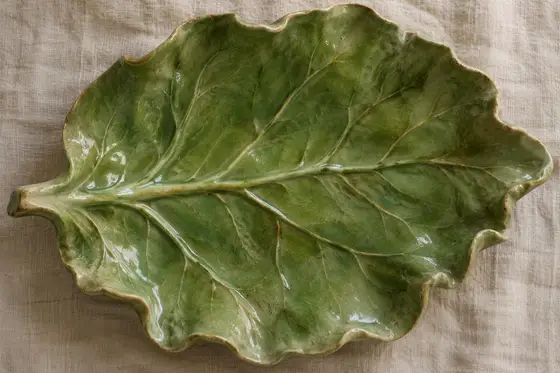
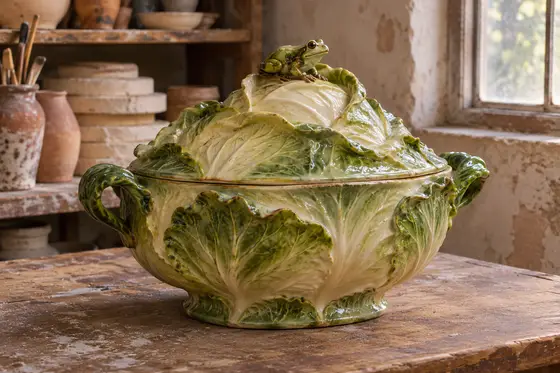
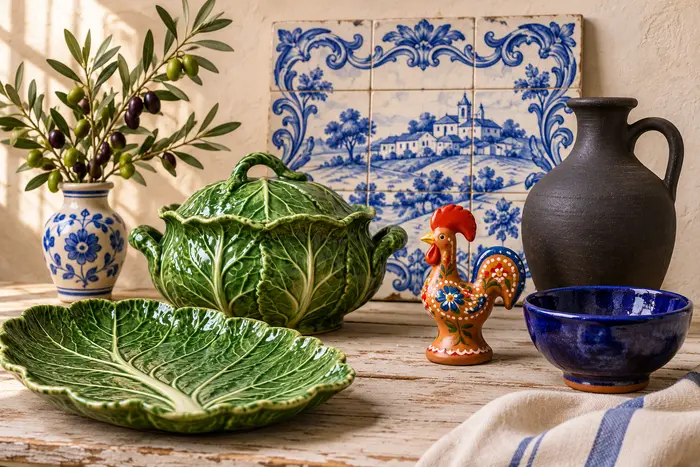
The cabbage is a harder case. Today the Bordallo Pinheiro company sells a “Cabbage” collection in green, white and pink, and describes the cabbage as a metaphor for “the rusticity of a Portugal that Bordallo so often satirized”. The museum pages we could open do not describe a cabbage-leaf piece, and we could not confirm from a primary source which cabbage models date from Rafael’s lifetime. We would rather say that than guess.
Money, death and a son
The factory struggled. The chronology records a grave financial crisis in 1891 and a mortgage in June 1892, and in 1898 it was still described as deep in trouble. In 1904, with his son’s help, it took part in the St. Louis Universal Exhibition and won a medal. Rafael died on 23 January 1905 at his house in Lisbon, aged 58, and was buried in the Prazeres cemetery.
His son, Manuel Gustavo Bordalo Pinheiro (1867–1920), was a humorous draughtsman, illustrator and ceramicist, and directed the satirical paper A Paródia. The museum says he took charge of the factory between 1906 and 1908, and that he did not carry on his father’s experiments with ceramic materials and technologies. His own page adds that he held exhibitions showing his father’s models next to his own designs, and wrote in a 1909 catalogue that he hoped to reach “os grandes centros da Europa e da América”. He is credited with joining the Caldas naturalist tradition to Art Nouveau.
The museum and the brand today
The Museu Bordalo Pinheiro in Lisbon opened to the public in 1916. It grew from the collection of Arthur Ernesto Santa Cruz Magalhães (1864–1928), a collector, poet and admirer of Rafael, who founded it as a tribute and directed it until he died. In 1913 the architect Álvaro Augusto Machado was commissioned to design a villa at Campo Grande for the collection. Magalhães gave the collection and the villa to the city in 1924, and the museum reopened in 1926 under Lisbon City Council. It reopened in 2005 after structural repairs that began in 1999, and since 2016 it has been managed by EGEAC. The museum holds the most important collection of Rafael’s faience, about 1,000 pieces, and also shows work by other Caldas ceramicists, among them Maria dos Cacos and Manuel Cipriano Gomes, known as Mafra.
It is at Campo Grande 382 and, according to its site, open Tuesday to Sunday, 10:00 to 18:00, closed on Mondays and on some holidays. The brand that carries his name says it has been creating ceramics “since 1884” and sells from Caldas da Rainha. We did not find an official source for factory visits or a museum in Caldas, so we do not describe them here; ask the brand before you go.
Not confirmed: We found no museum or official page describing the cabbage-leaf ware or dating particular cabbage models, so the essay says so. The factory deed is dated 30 June 1884 on one museum page and 9 August 1884 on another. We could not open the brand’s press release on the cabbage collection, the Met Museum record or the heritage-authority records, and we found no official source for factory visits or for a museum in Caldas da Rainha. The brand’s current ownership is not stated on the pages we opened.
Sources
- Museu Bordalo Pinheiro: A National Ceramics Factory
- Museu Bordalo Pinheiro: essay on his ceramics
- Museu Bordalo Pinheiro: Ceramics collection
- Museu Bordalo Pinheiro: chronology of Rafael Bordalo Pinheiro
- Museu Bordalo Pinheiro: Manuel Gustavo Bordalo Pinheiro
- Museu Bordalo Pinheiro: Bordalo Decorador
- Museu Bordalo Pinheiro: exhibition "Um sonho. Bordalo e a Fábrica de Faianças"
- Museu Bordalo Pinheiro: The origins of the museum
- Museu Bordalo Pinheiro: The founder
- Museu Bordalo Pinheiro: visitor information
- Bordallo Pinheiro (brand): Raphael Bordallo Pinheiro
- Bordallo Pinheiro (brand): Cabbage collection
Related plates