04 Makers · Ílhavo
Vista Alegre: a chapel, a licence and a porcelain works
Portugal’s best-known porcelain began on a farm estate near the Aveiro lagoon, around a baroque chapel. What the company, a heritage association and the press say about 1824.
A chapel bought at auction
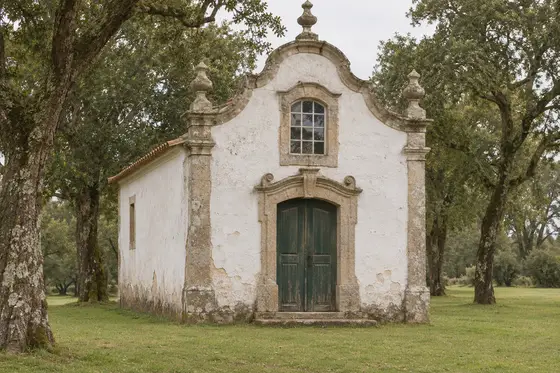
Before there was a factory there was a chapel. The Chapel of Nossa Senhora da Penha de França stands at Vista Alegre, in Ílhavo. A heritage-garden association says it was built around 1693 by Bishop D. Manuel de Moura Manuel, following a promise, and that it has been a National Monument since a decree of 16 June 1910. Its baroque façade has two bell towers that were added later.
José Ferreira Pinto Basto (1774–1839) was a merchant and a Knight of the Order of Christ. According to that association he bought the Quinta do Paço da Ermida in 1812, and in 1816 the neighbouring Quinta da Ermida de Nossa Senhora da Penha de França at public auction. The company’s own history agrees on 1816 and gives it as the year he acquired the chapel and its grounds. We found no second source for 1812, so treat it as one source’s date.
1824: the licence
The year is not in doubt. Every source we opened gives 1824, and the factory’s centenary was marked in 2024. The day is more specific. The company says a Royal Licence issued by King João VI on 1 July 1824 authorised Pinto Basto to build the factory, and another page about the bicentenary also dates the establishment to 1 July 1824.
What he asked for is worth noting. According to the company, he wanted to build the factory “for all his sons, as stakeholders on an equal basis”. The family business was a business of sons, in other words, and the company says his son Augusto visited the Sèvres factory in France. The company describes Vista Alegre as the first industrial unit dedicated to producing porcelain in Portugal; that is its own claim, which we repeat as such.
Glass first, porcelain after the clay was found
The licence was not only for porcelain. A Time Out Lisboa article on the bicentenary reports that the factory was first set up to make glass, and that porcelain came later, once kaolin was found at Vale Rico, in Santa Maria da Feira, in the 1830s. The sources differ on the date: the company links Augusto Pinto Basto to the discovery of kaolin deposits in 1832, while the heritage-garden association says kaolin was found in Outil in 1834, with porcelain production beginning then. We therefore say only the early 1830s.
The company says, and Homo Faber agrees, that King João VI gave the factory the title of Royal Factory (Real Fábrica); the company puts it about five years after the licence, which points to around 1829, and says it recognised its artistry and industrial success. We have only this company statement for the date and call it “c. 1829”. A second source, the Time Out article, reports that the first firing of porcelain was destined for the Infanta D. Isabel Maria, a daughter of João VI.
A works with a neighbourhood attached
Vista Alegre was more than a workshop. The heritage-garden association says Pinto Basto built a workers’ neighbourhood beside the factory, with housing, services, education and farmland, and that construction began in 1826; it calls this revolutionary for its time. A Centre of Portugal tourism page describes an industrial complex with a chapel, a workers’ neighbourhood, a theatre, a school and what it calls the first fire brigade in Portugal. We cite that last claim as theirs.
The family stayed. The company names João Theodoro Ferreira Pinto Basto as Deputy Director in 1924. The heritage-garden record says the founder’s son Augusto Ferreira Pinto Basto (1807–1902) administered the factory.
Services for palaces, and a museum
The Time Out article lists early commissions: a dinner service for the Marquês de Abrantes, the first personalised service the factory made, and later the wedding service of D. Carlos I. The company’s history says a dinner set was made for Queen Elizabeth II, which began a tradition of exclusive pieces, and that collaboration with contemporary artists then became more frequent. In 1985 it opened the Art and Development Centre (CADE) and created a Collectors Club, initially limited to 2,500 members.
The same article names artists and architects who worked with the brand, among them Cruzeiro Seixas, Pomar, Siza and Nery, and the British artist Clare Twomey, whose installation “Continuum” was part of the bicentenary exhibition at the Palácio Nacional da Ajuda, which ran until 25 May 2025. We have not checked individual pieces or dates, only that the article says so.
The company says the Vista Alegre Museum opened in 1964 and holds pieces that bear witness to the firm’s long history. The pages we could open give no opening hours or prices, so check before you go.
Not confirmed: Some sources we saw only in search results (a tourism page giving a different day in August 1824, and a report giving 1815 for the first land purchase) were not opened and are left out. The Vista Alegre dates come from the company’s own history and a heritage-garden association, not from the national heritage record (Património Cultural / SIPA), which we could not open. The date of the Real Fábrica title (c. 1829) is the company’s “five years later” and is not independently confirmed, and the first purchase (1812 vs 1815) and kaolin dates (1832 vs 1834) differ by source. The museum’s opening hours, the chapel’s opening hours and the collaborations are not verified beyond the single article that names them.
Sources
Related plates