IV Craft, clay and kiln · Plate 023
Burnishing with a stone
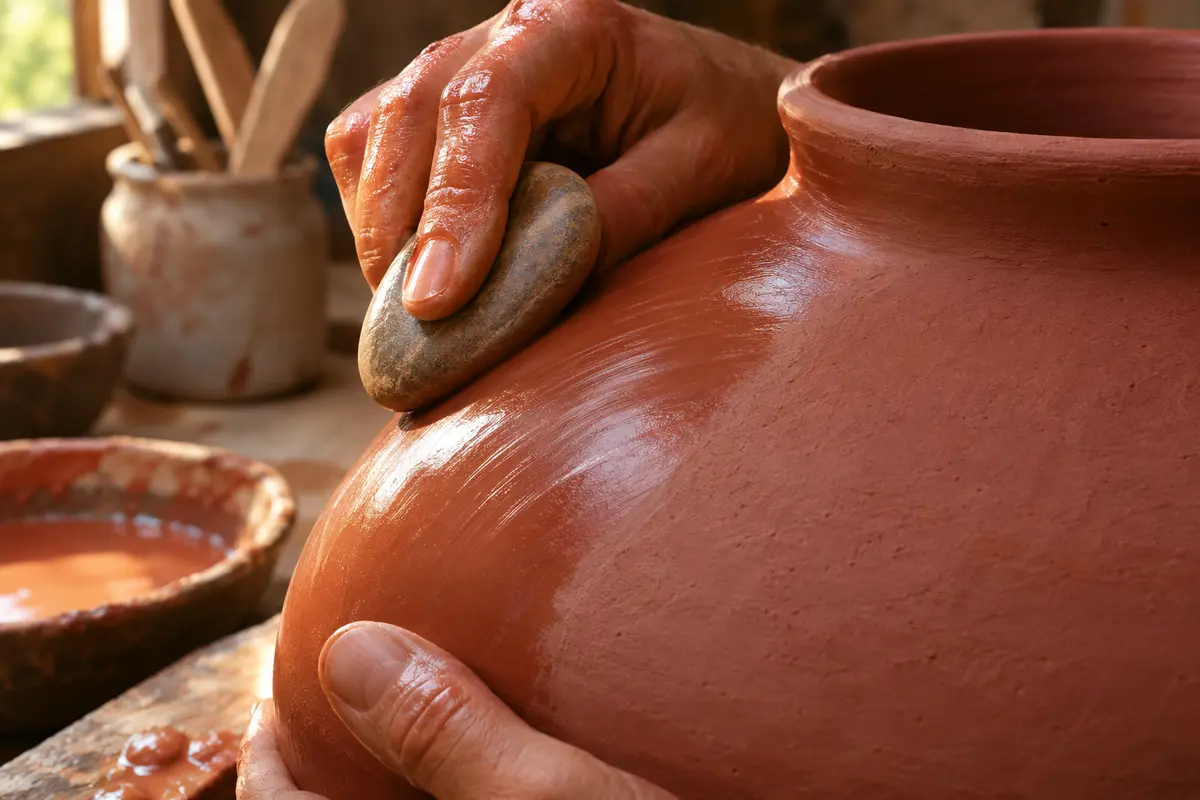
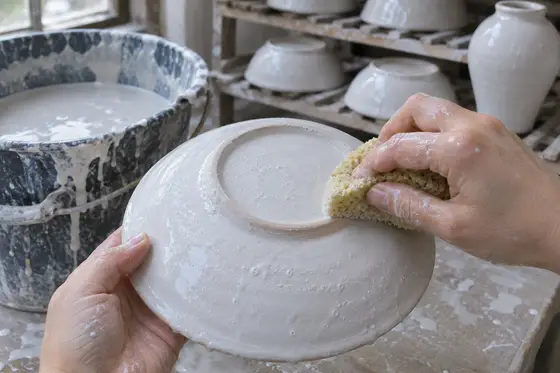
Burnishing is polishing leather-hard clay with a smooth object, such as a stone, until it gains a sheen. There is no glaze; the shine comes from polishing alone.
Priberam defines to burnish (brunir) as to polish with lustre. In the black pottery covered by the Saber Fazer programme, burnishing is done with gogos, rounded river pebbles, halfway through drying, when the piece is still soft but already firm; it is called gogar or brunir. It gives the surface a shine and makes it less permeable. In the same account, the plain burnishing of utilitarian pieces was done by the men, while decoration was traditionally the women's task.
Other workshops use other tools. In Barcelos, polishing is done on the wheel when the pieces are a little dry, with canivetes of metal or wood, until the surface is uniform and bright; both red and black ware can be polished, and the unpolished kind is matt. At Nisa, a piece slightly damp after dipping in red slip is burnished by rubbing repeatedly with wet hands to bring up a shine, often by the potter's wife or a worker. Nothing is glazed to get this effect.
This is a general description, not confirmed to a single source.
Source: dicionario.priberam.org, programasaberfazer.gov.pt, cearte.pt, museubordadoebarro.cm-nisa.pt
AI-generated illustration in the manner of the tradition, not a photograph of a specific object.