IV Craft, clay and kiln · Plate 022
Pounce transfer
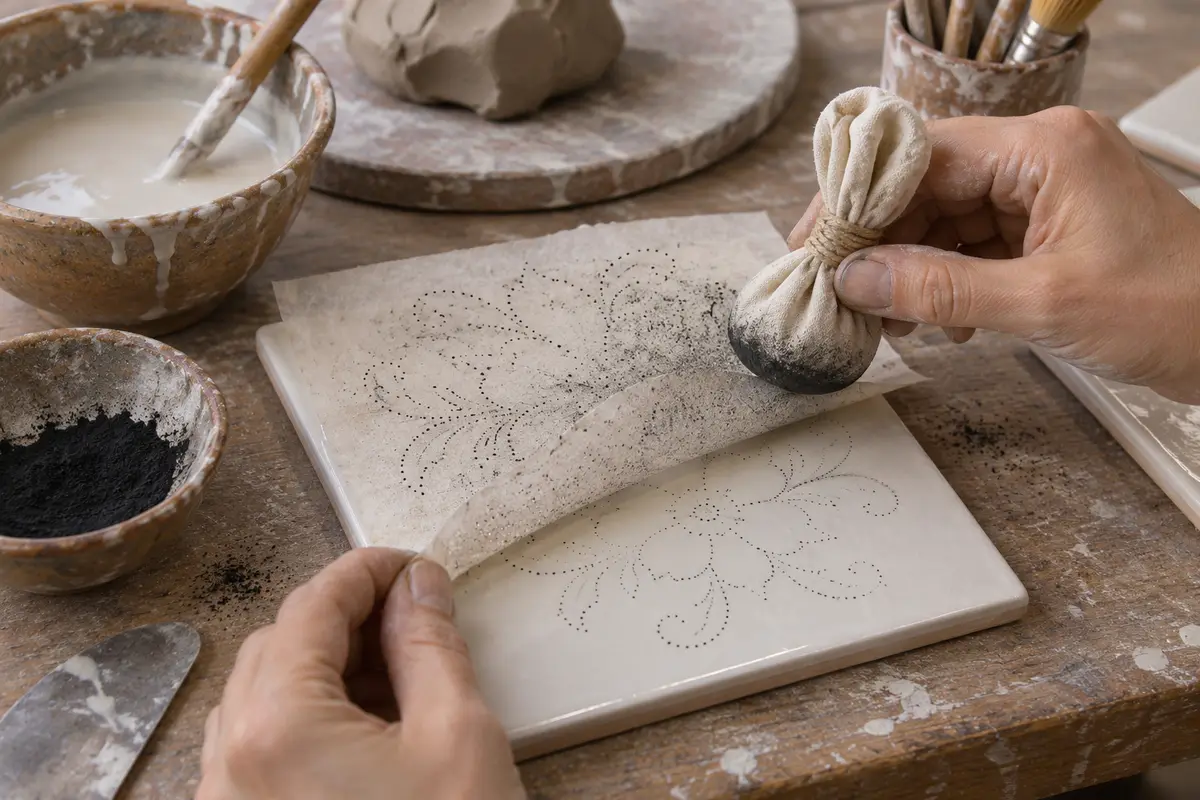
A drawing on paper is pricked along its lines and a charcoal-powder pad is passed over it, leaving dotted outlines on the tile. The painter then follows those marks.
The pricked-paper method is described in a Victoria and Albert Museum article on English delftware tiles. A design was drawn on paper and pricked with small holes. The paper was laid on the tile and a porous bag of charcoal was tapped over it, so that the charcoal passed through the holes and left the outline on the glaze. Painters then filled in the outline with coloured pigment, using a fine brush. The pricked sheets were called spons in Dutch. This account concerns English tiles, not Portuguese ones.
It suited tin-glazed tiles because the painting went straight onto the glaze. The Museu Nacional do Azulejo's terminology, summarised on Portuguese Wikipedia, says majolica painting reached the Iberian Peninsula in the mid-16th century and allowed direct painting on the glazed tile; the colours, from metal oxides such as cobalt for blue, copper for green, manganese for brown or black, iron for yellow and tin for white, show only after the second firing. The V&A adds that in 1750s Liverpool, transfer printing with engraved images sped decoration up considerably.
This is a general description, not confirmed to a single source.
Source: vam.ac.uk, pt.wikipedia.org
AI-generated illustration in the manner of the tradition, not a photograph of a specific object.