IV Craft, clay and kiln · Plate 050
Glaze crazing
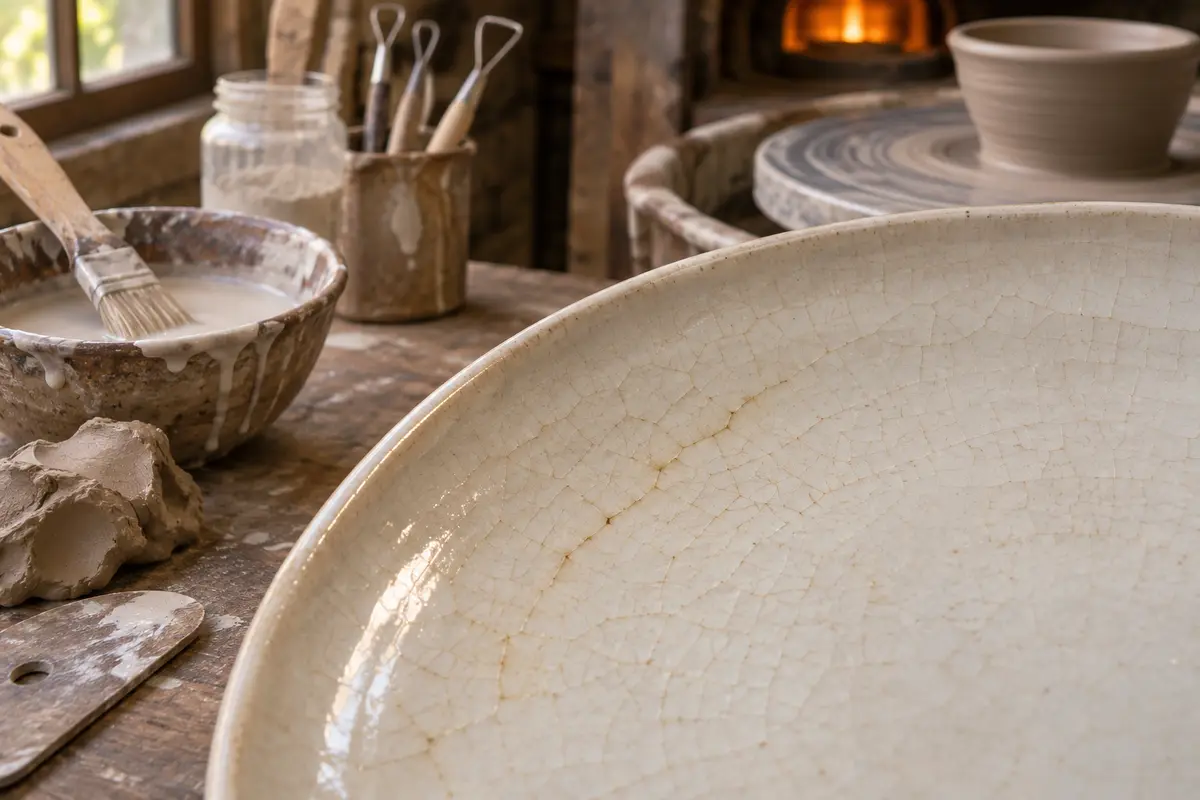
Crazing, or craquelê, is a network of fine cracks in the glaze, which appears when the glaze contracts more than the clay on cooling. It can be a sought-after effect, but otherwise it is a flaw.
Crazing is a network of fine cracks in a fired glaze. It may be visible after firing or appear later, and it is by far most often caused by a thermal expansion mismatch: when the glaze contracts more than the body on cooling, it is put under tension, and glass is among the most brittle ceramics. Digitalfire stresses that crazing profoundly affects strength, and reports measuring reductions of 300 to 400% in freshly fired ware. Cracks can also harbour bacteria in a porous body, a concern for food containers.
Whether it is a flaw depends on intent. For tiles, a Brazilian review says crazing is treated as a defect and a technical standard exists to ensure tiles do not show it, so makers must declare where the crackle effect is deliberate. The English glossary has both entries: crazing as a fault from high tensile stress and crackle glaze as one intentionally crazed for decoration. Fitting a glaze usually means lowering its expansion, for instance with finer silica, which dissolves into the melt better, or a frit of lower expansion.
Source: digitalfire.com, app.periodikos.com.br, en.wikipedia.org
AI-generated illustration in the manner of the tradition, not a photograph of a specific object.