IV Craft, clay and kiln · Plate 035
Pyrometric cones
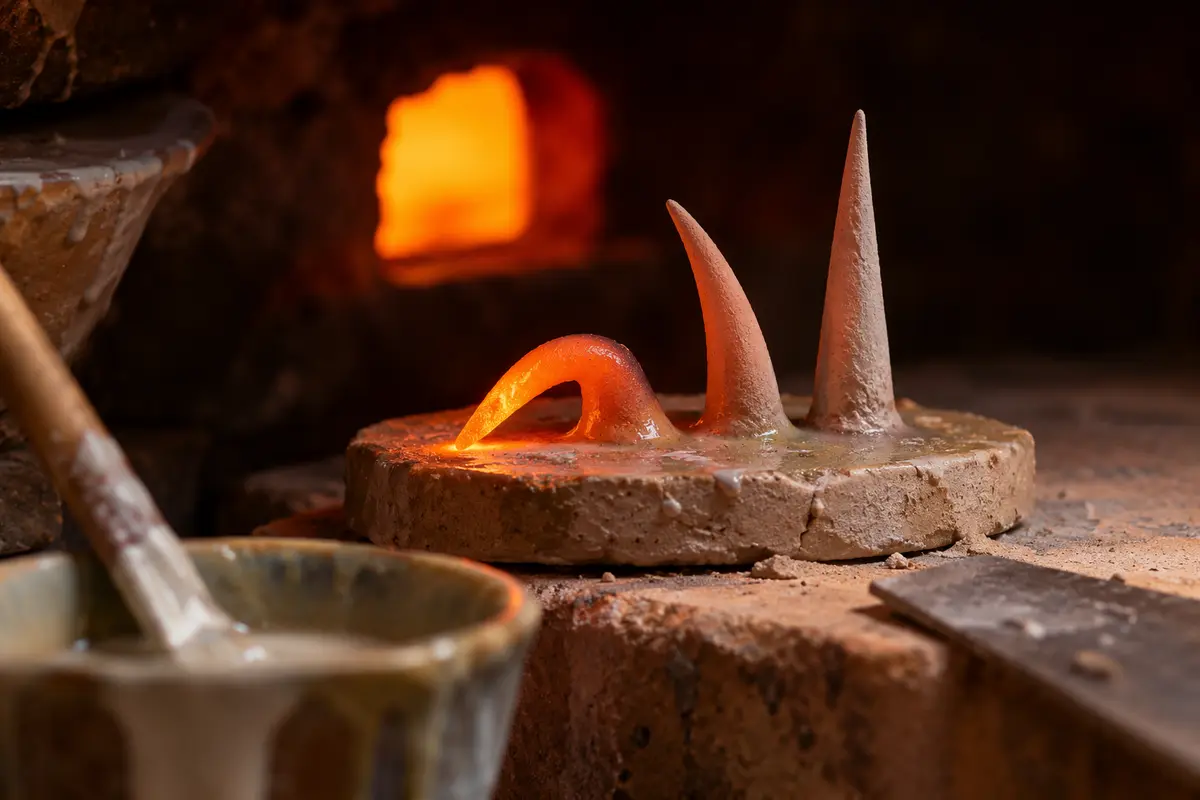
Small ceramic cones soften and bend at a set temperature and serve as a gauge. Seen through a spy hole, they show how far the heat has gone.
A pyrometric cone is a pyramid of ceramic materials tuned to bend gradually through a target temperature range. As it softens, the tip leans from upright, at 0°, until it touches the support, at 90°. Cones do not simply measure temperature; they register heatwork, the combined effect of time and temperature. Digitalfire credits Hermann Seger with studying the melting behaviour of oxide compounds and making the first cones, and Edward Orton with laying the groundwork for the cones used today. Small cones were also used in kiln sitters, devices that shut the kiln off when the cone bends.
In practice cones go in sets of three: a guide cone one number cooler than the firing cone, the firing cone recommended for the glaze, and a guard cone one number hotter. Placed on lower, middle and upper shelves, they reveal the temperature differences inside a kiln. They are read by their bend: a cone at 3 o'clock has travelled 80% of its range, so a cone 6 there is read as 5.8, and at 1 o'clock 5.5. In English bottle ovens, firemen watched Buller's rings through a spyhole. Most potters now use electronic controllers.
This is a general description, not confirmed to a single source.
Source: digitalfire.com, en.wikipedia.org, en.wikipedia.org
AI-generated illustration in the manner of the tradition, not a photograph of a specific object.