V Ceramics in place · Plate 042
Tiled alley stairs at night
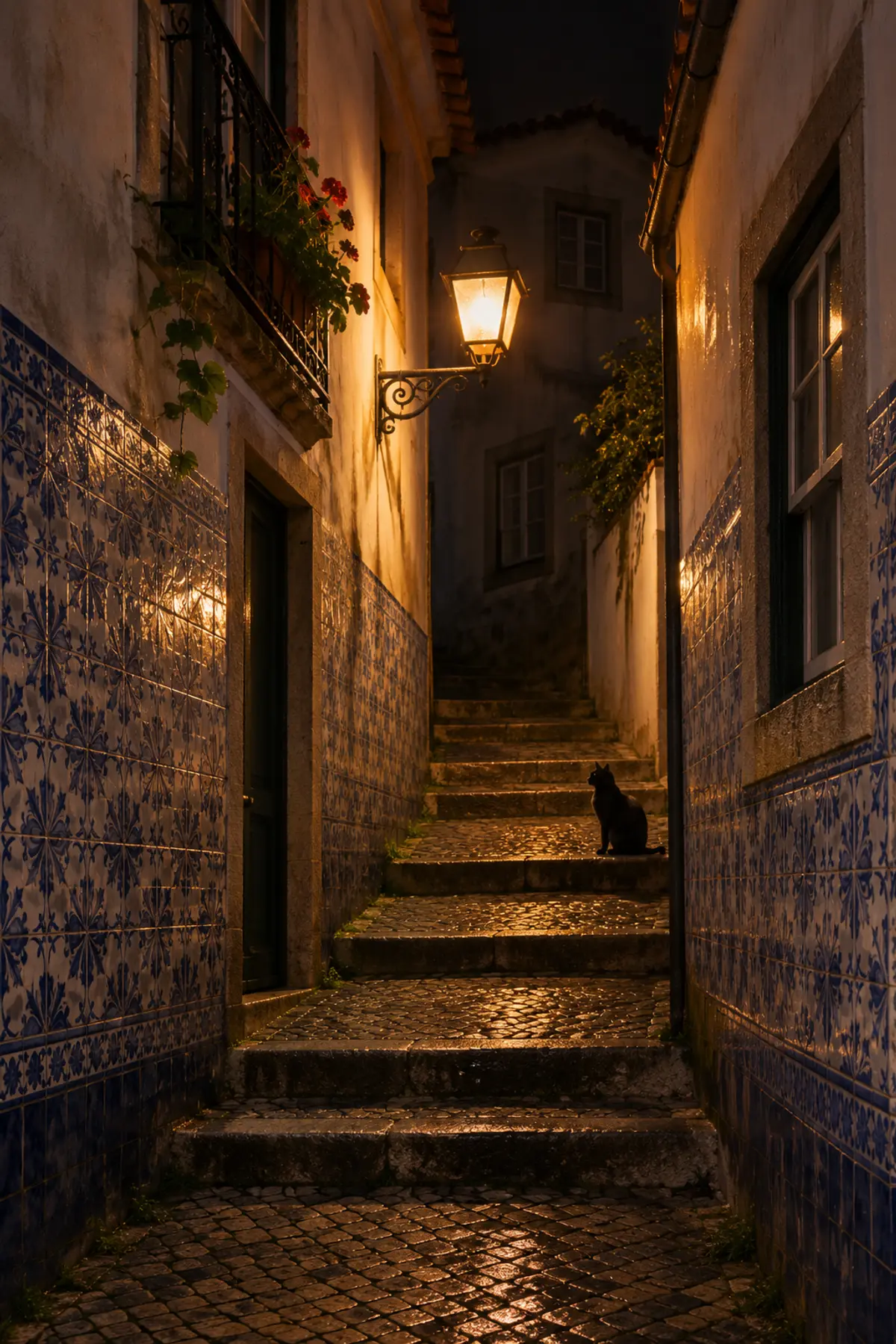
Narrow stairways between houses often have tiled walls.
Tiles outdoors are exposed to more than weather. English Wikipedia's article on the azulejo notes that they are vulnerable to theft and vandalism. SOS Azulejo, created in 2007 under the Polícia Judiciária, is credited with a decrease of around 80 percent in theft and vandalism up to 2013. Among exterior examples it cites are the Casa do Ferreira das Tabuletas façade in Lisbon, built between 1849 and 1865 with trompe-l'oeil tiles, and the Capela de Santa Catarina in Porto, whose façade was covered in 1929. Such cases show that street tiles were applied across many decades, not in one fashion.
The law has changed to protect them. Since 2013 it has been illegal in Portugal to demolish buildings with tile-covered façades, and a law of August 2017 also bars removing tiles during renovations, even inside buildings. The same source mentions the Banco do Azulejo, a tile bank holding around 30,000 tiles from demolished or condemned buildings, so that pieces which cannot stay in place are at least kept together. Separately, a 2026 report on railway-station panels lists vandalism and loss of adhesion to the supports as the problems found, which are the usual dangers of tiles fixed to walls open to the street.
This is a general description, not confirmed to a single source.
Source: en.wikipedia.org, echoboomer.pt
AI-generated illustration in the manner of the tradition, not a photograph of a specific object.