V Ceramics in place · Plate 006
Tiled palace salon
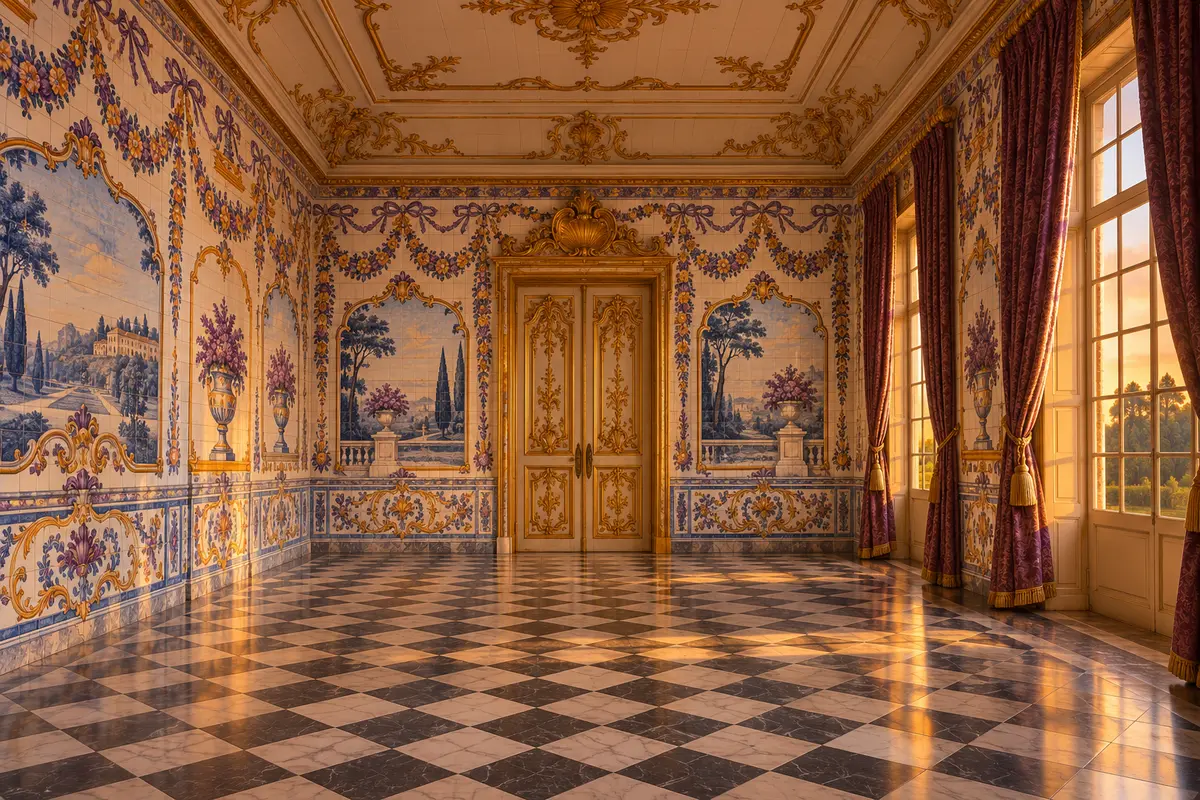
In grand salons, tile panels could be composed like pictures, with painted frames and garlands.
The Palácio dos Marqueses de Fronteira in Lisbon keeps its 17th-century tile panels in situ. According to Portuguese Wikipedia the palace was built around 1670 by the first Marquis, João de Mascarenhas, and his wife Madalena de Castro, and the main core went up in 1671 and 1672. Its Sala das Batalhas has walls covered in blue and manganese panels of about 1660 to 1670 showing eight battles of the Restoration War, with captions naming people and places. One panel shows the first Marquis fighting a Spanish general. The room was restored in 1915.
Older still is the Sala dos Árabes in the Sintra National Palace, whose Hispano-Moorish tiles are linked to Manuel I; the Portuguese azulejo article says tiles were imported from Seville in 1503 and the English one mentions armillary spheres, his emblem, on the Arab Room cuenca tiles. The Fronteira panels belong to a later tradition of tiles as pictorial wall coverings, and tile makers then used polychrome and blue-and-white Dutch influence. By the 18th century tile panels could be composed like pictures, with painted frames and garlands, as in the grand Baroque sets paid for by Brazilian gold under João V.
This is a general description, not confirmed to a single source.
Source: pt.wikipedia.org, en.wikipedia.org, pt.wikipedia.org
AI-generated illustration in the manner of the tradition, not a photograph of a specific object.