V Ceramics in place · Plate 034
Conservator's hands on a tile
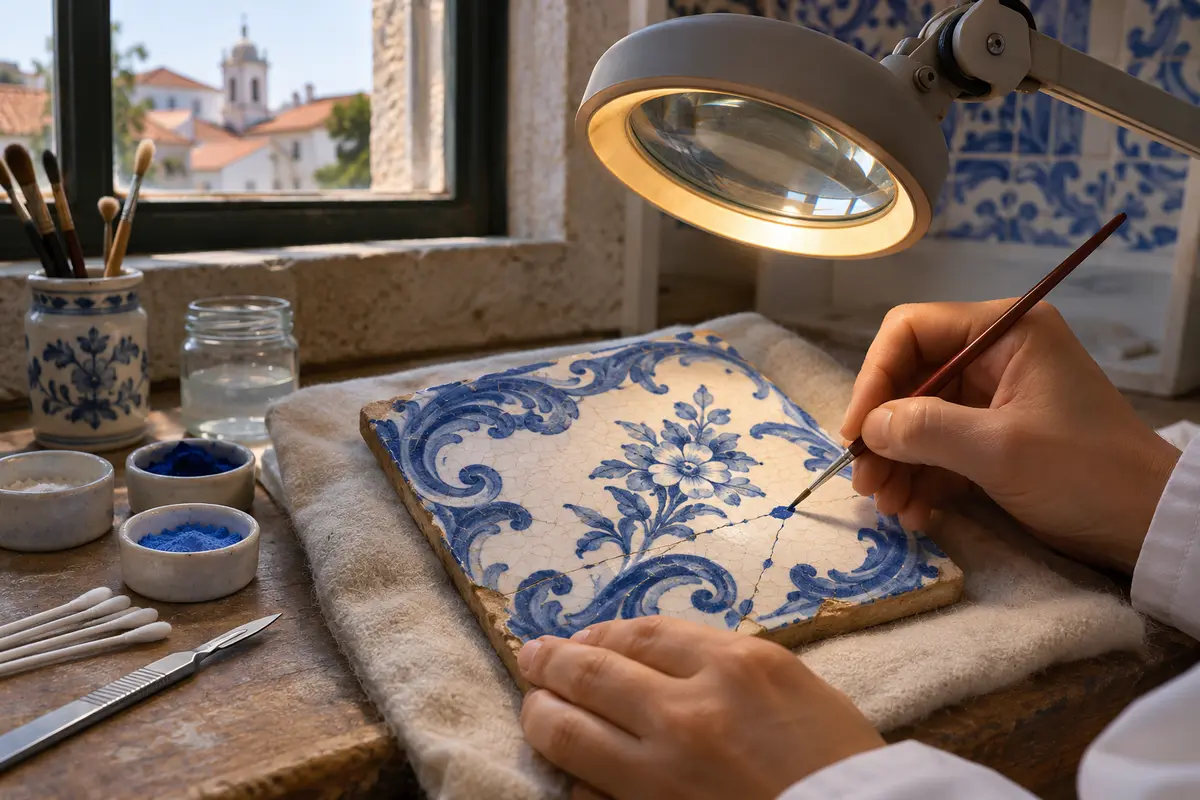
Restoring a tile can mean cleaning the glaze, filling losses and retouching the painting with reversible materials, done by hand and under good light.
A recent programme by Infraestruturas de Portugal shows what restoring tile panels involves in practice. Panels in seven railway stations (Sintra, Esmoriz, Contumil, Rio Tinto, Barqueiros, Caldas de Moledo and Peso da Régua) went through a sequence of steps: cleaning, gluing and consolidating the tiles, treating and stabilising the supports, filling gaps, levelling surfaces, chromatic reintegration, which means retouching colours to match the originals, and regrouting the joints. Where needed, replicas were made of missing tiles.
The damage that called for this work was vandalism, degradation of the materials and loss of adhesion to the supports, with some tiles at risk of detaching and being lost. The panels date from the 1920s, 1930s, 1940s and 1990s, and the tiles came from the Sacavém, Viúva Lamego and Constância factories. The work took place throughout 2025, with a total investment of about 226,000 euros. The report does not say which step was applied to which station, so it describes the kind of intervention rather than any single panel.
This is a general description, not confirmed to a single source.
Source: echoboomer.pt
AI-generated illustration in the manner of the tradition, not a photograph of a specific object.