III Regional wares · Plate 002
Roosters drying on a shelf
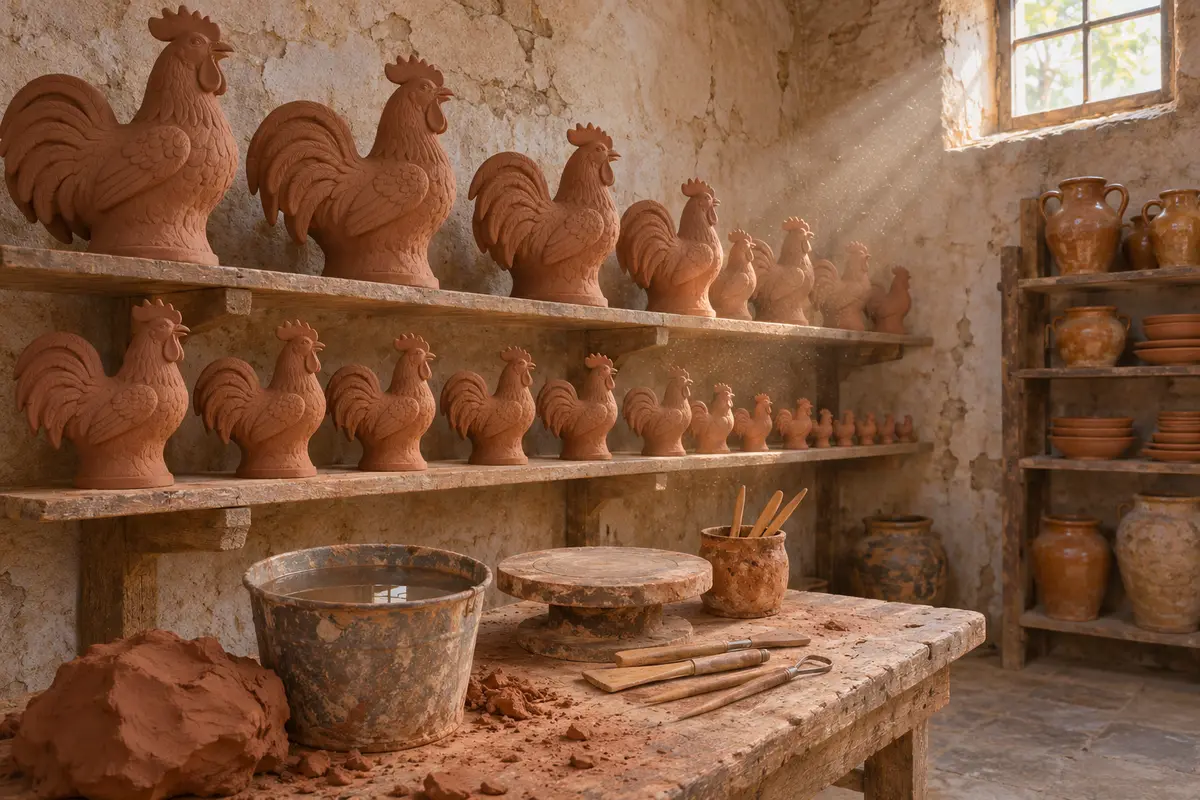
Freshly modelled clay roosters are left to dry slowly on shelves before firing. According to the Barcelos pottery file, careful drying is one of the decisive phases for a sound firing.
The maker shapes the trunk first from a ball of kneaded clay and leaves it to rest for some hours. Only when it has stiffened are the smaller parts, such as head, arms and legs, modelled and joined on with slip, after the contact areas are scored with a wooden tool. Drying itself is judged by eye and experience, because figure makers do not use drying ovens, and the specification calls it a fundamental stage if firing is to succeed. Some roosters, the galos de roda, start as a hollow shape raised on the wheel and are finished by hand.
In the twenty years before the specification was revised, figure makers swapped wood kilns for electric and gas ones, a choice influenced by how many pieces they make. In a wood kiln the colour of the flame tells the potter whether the target temperature has been reached, which demands many consecutive hours of watching and a gradual rise in heat. Gas and electric kilns have controllers that set the firing curve and the final temperature. A wooden awl pricks closed pieces so they do not burst, and at the end each piece is checked for burns, cracks, warping and stains.
Read about it: The rooster that crowed, and the potters who made Barcelos famous →
AI-generated illustration in the manner of the tradition, not a photograph of a specific object.