03 Places · Barcelos
The rooster that crowed, and the potters who made Barcelos famous
A legend of a hanged pilgrim, a craft that began in the corners of the kiln, and a town that is still trying to protect its name.
A cockerel that was not supposed to speak
The story goes like this. A pilgrim from Galicia, on the road to Santiago, is accused of theft in Barcelos and sentenced to hang. A cockerel crows to prove his innocence. The man survives because the knot was badly tied, and he later carves a cross, now in the town’s Archaeological Museum.
It is a legend, and that is how it should be read. The version we opened is a regional tourism page, and we found no document in the sources we read that dates the events or names the pilgrim or the judge. What can be checked is what the town does with the bird. UNESCO calls Barcelos the cradle of the Rooster of Barcelos, an emblem of honesty and fairness.
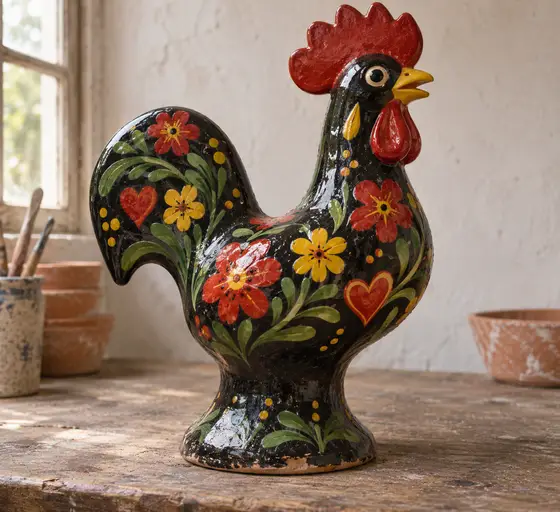
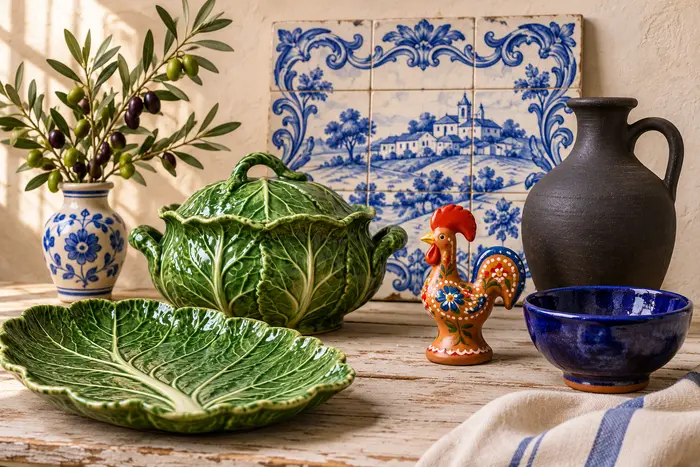
The rooster most people know, black with painted flowers, has since become a legal object. In 2021 the municipality announced that it now owns it as a national trademark: a black rooster with a yellow beak and a red comb, the body covered in colourful floral motifs.
Scraps of clay, corners of the kiln
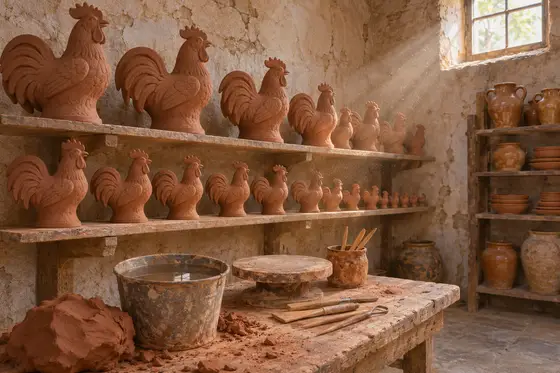
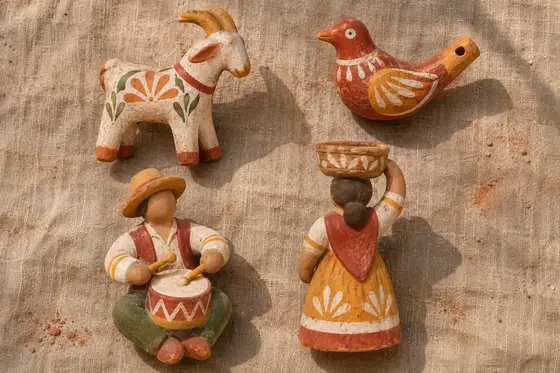
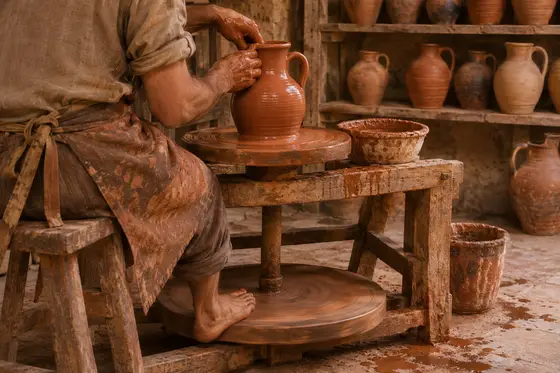
The rooster is a ceramic bird, but the craft behind it is the figurado, the small clay figures of Barcelos. By the municipality’s own account, the figurado began here, as elsewhere in Portugal, as a sideline of pottery: the potters used small portions of clay and filled the gaps left in the kiln by stacks of large pieces.
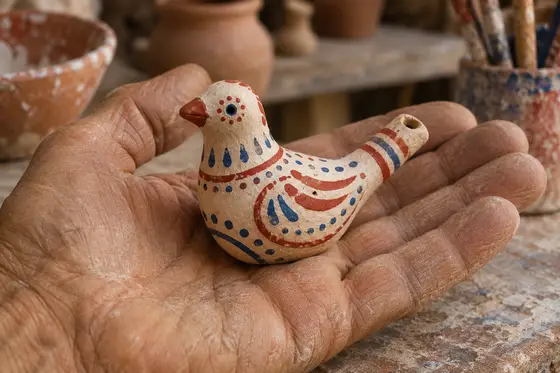
The figures were small, of people and animals, and had a whistle or a small instrument in the base: pipes, ocarinas, cuckoos. Their purpose, the text says, was only play.
Nobody can say how old this is. The specification admits there are no archaeological references to date the first small clay sculptures, though the abundance of clay explains the number of potteries in the county since early times. It cites a possible first mention in the mid-16th century, by Frei Bartolomeu dos Mártires, of crude clay figurines from Prado. That is a “possible”, not a certainty, and we leave it there.
Rosa Ramalho and the people who signed their work
The turn came in the 1950s. According to the municipality’s specification, the painter António Quadros introduced the educated public of Porto to the figurado through the work of Rosa Ramalho. A 2016 newspaper report gives the year as 1956, and says she was a widow with seven children who had turned to clay full time. She died in 1977.
What Quadros showed the city was a bestiary: lizards, goats, pigeon-houses, cockerels, four-legged birds, dragons, devils, angels, but also monsters and creatures with six legs or a human body and an animal head. The museum’s director is quoted as saying that the large volume of glazed pieces appears after she was widowed.
The specification dates a change of attitude to about the turn of the 1950s into the 1960s: the little clay pieces began to be signed, and the words figurado and barristas, the makers of clay figures, became general. Alongside Rosa Ramalho it names contemporaries such as Maria Sineta and Domingos Gonçalves Lima, called Mistério. Her granddaughter Júlia Ramalho, who started working clay with her grandmother, was celebrated in 2016 for about 60 years of work.
The pieces also grew. They became larger, around 20 cm, with hollow bodies, new moulds and sections turned on the wheel, while makers kept the techniques and styles of the past.
The museum and the title
The Museu de Olaria was created in 1963 after the ethnographer Joaquim Sellés Paes Villas Boas donated his collection. It now occupies the Casa dos Mendanhas in the historic centre, which had two major works, in 1995 and 2013, and holds nearly 10,000 objects of Portuguese and Portuguese-speaking pottery. In 2016 it staged “Geração Ramalho”, with work by Rosa, Júlia and Júlia’s children, Teresa and António.
Barcelos has been a UNESCO Creative City in the field of Crafts and Folk Art since 2017. UNESCO’s page says the craft sector has about 40 enterprises and employs roughly 8% of the county’s active workforce, and that a two-week crafts and ceramics exhibition has drawn more than 100,000 visitors in past years. This is a Creative Cities title. We found no UNESCO intangible heritage inscription for the figurado.
Status of the geographical indication: filed 2005, outcome unconfirmed by us. Check INPI before relying on it.
A name that is still being protected
On 14 July 2005 the Câmara Municipal filed a request with the national industrial property institute (INPI) to register the Geographical Indication “Figurado de Barcelos”; it was published in the industrial property bulletin in September 2005. The proposed area is the whole county of Barcelos, though the figurado is most concentrated in the parishes of Santa Maria and São Martinho de Galegos, on the right bank of the river.
Whether the indication was granted we could not confirm, because we could not read the INPI records. A 2021 news report says the municipality registered ownership of the designation in 2005 and obtained certification of the pottery and figurado in 2008. That is a report, not the register itself. The same report explains why the rooster itself is separate: INPI rejected the trademark in November 2020 because the rooster is a well-known popular symbol, and a court later ruled for the municipality.
Not confirmed: The legend is told from one tourism page; we found no historical document for it. The outcome of the 2005 geographical-indication request is unconfirmed (we could not read INPI records); the 2005 and 2008 steps are reported by a 2021 news item. The specification is a PDF whose text we extracted by hand, so a few names in the list of makers are given only where clearly legible.
Sources
- UNESCO Creative Cities: Barcelos
- Câmara Municipal de Barcelos: Caderno de Especificações para a Certificação do Figurado de Barcelos (CE.02, 3rd ed., 2014)
- Diário de Notícias: “Os mostrengos de barro caramelizado” (29 Apr 2016)
- Notícias ao Minuto (Lusa): “Galo de Barcelos já é marca registada” (18 Jun 2021)
- D’Origem Lusa: Barcelos (tourism page with the legend)
- International Academy of Ceramics: Museu de Olaria
Related plates