03 Places · Estremoz
The figures that nearly stopped being made
For thirteen years in the 20th century nobody in Estremoz made the clay figures now on UNESCO’s list. How they came back, and how they are made.
A gap of thirteen years
The municipality’s own history of the craft contains a plain, uncomfortable sentence: after the death of Gertrudes Rosa Marques there was a short period, from 1921 to 1934, when no Estremoz figures were produced at all. By the first quarter of the 20th century the tradition was, in the document’s word, moribund, and the Marques and Estopas families had stopped modelling.
It is a useful fact to hold on to, because the figures look like something that has always been there. They have not. A fragment of a Christ Child found in excavations in Estremoz in 2006 is the oldest physical trace the municipality cites, from the 17th century. Written mentions come later: books of 1718 and 1726, and a council minute of 10 November 1770 that mentions women, “boniqueiras”, who modelled clay figures and earrings.
The same text argues that the first makers were mostly women working outside the guilds, not the famous potters of the older histories, and that the first figures were saints: poorer households wanted a devotional image at home, and wood sculpture cost too much. UNESCO says only that production dates back to the 17th century.
Ball, coil, slab
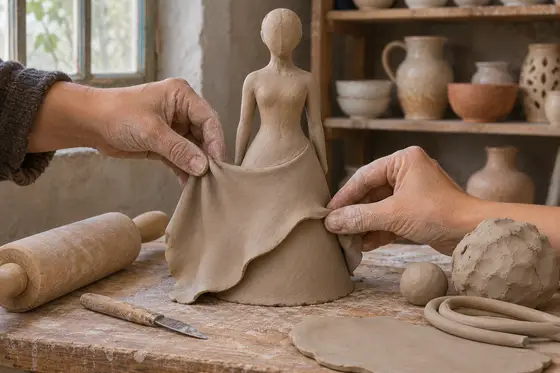
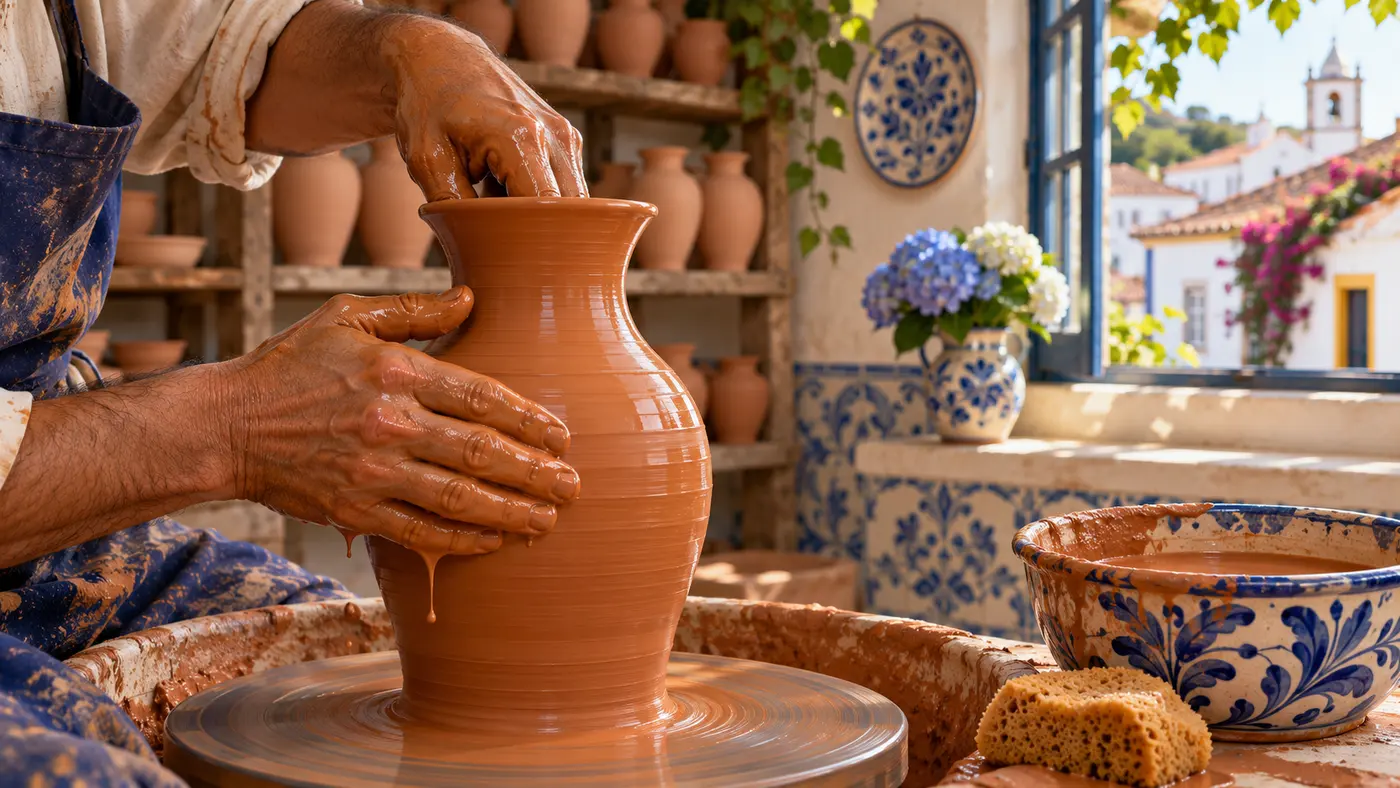
The municipality’s certification text describes the method closely. Every figure is built from three elements: the ball, the coil and the slab. The maker beats a piece of clay flat with a wooden paddle to make the base, and pierces it where the figure will stand so it will not burst in the kiln. A thick coil becomes the body; for a woman, the base of the coil is hollowed with a knife to form the skirt.
The face is made with a mould, traditionally, and is joined to the body with barbotine, the potters’ slip-glue. Arms are thin coils with fingers cut by small incisions. The clothes are what make Estremoz distinctive: a slab rolled out with a wooden pin, cut with a blade to the shape of the garment and draped on the figure. After drying, the piece is fired in an electric kiln at about 900 °C. If it warps or cracks, it is destroyed.
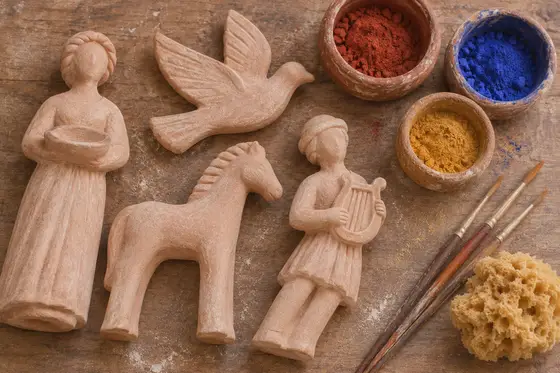
Painting comes after firing, with tempera or oxides mixed with white glue, and a colourless carpenter’s varnish to finish. The text says that figures normally stand between 10 and 40 cm tall. UNESCO’s page agrees on the outline: assembly, firing, painting, varnish, a process of several days.
Saints, farmers and carnival
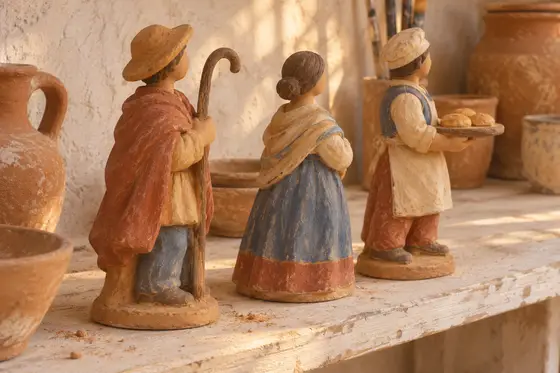
UNESCO says the figures wear either Alentejo regional dress or clothing from Christian religious iconography, and that most depict natural elements, local trades and events, popular traditions and devotions. The municipality sorts them into four themes: devotion, the rural world, the urban world, and carnival, which covers satirical and festive figures. It also lists whistles, mostly in the form of cockerels, and brooches.
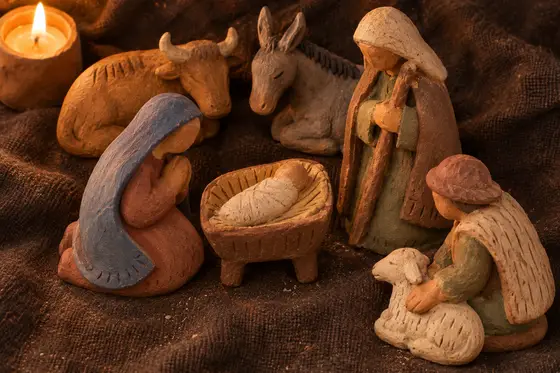
The nativity scenes grew in the second half of the 18th century. Following the reform of crib-making associated with the Mafra school, Estremoz modellers added scenes around the birth of Christ and, later, secular figures of high quality that had nothing to do with devotion. Today, says the text, most figures are decorative: a piece for a corner of the house, and the crib more an ornament of the Christmas season than an act of devotion.
Ti Ana, the sculptor and the school
The way back started in 1935 at the António Augusto Gonçalves Industrial School, whose director was the sculptor José Maria Sá Lemos. He found an old woman, Ti Ana das Peles (1870–1945), who as a girl had seen the figures made, and persuaded her to work again and to train pupils. The master potter Mariano da Conceição joined him, and from the 1940s Sá Lemos and Mariano created a Nativity scene known as the Figural Altar.
A caution on dates: the municipality gives Mariano da Conceição as 1902–1959, while the Soares dos Reis Museum gives 1893–1940. We do not know which is right, so we give none.
Who made them next
The municipal text names the generation that followed. António Lino de Sousa (1918–1983) learned at the Olaria Alfacinha, the family workshop. José Moreira, “Zé do Telhado” (1926–1991), was taken in as a boy by Ti Ana. After Mariano’s death his sister Sabina da Conceição Santos opened a workshop, and his widow Liberdade da Conceição painted and later worked on her own; the text credits her and José Moreira, through the fairs, with spreading the figures from the 1950s to the 1980s.
Later names include the Irmãos Ginja (Arlindo and Afonso, a workshop of the 1970s), the Irmãs Flores (Perpétua Sousa and Maria Inácia Fonseca, from the 1980s), Mário Lagartinho, Maria Luísa da Conceição, Quirina Marmelo, and, in the 2000s, Duarte Catela and Ricardo Fonseca. These are makers named in a document of the early 2010s. We have not checked who works today, and the municipality, not us, is the place to ask.
The museum, the centre and the list
The Museu Municipal de Estremoz holds the oldest figures the municipality cites, and Joaquim Vermelho, a director of the museum who studied the figures, supported the makers from the 1970s and set the Ginja brothers to work there. The museum began the UNESCO application in October 2012. The municipal assembly classified the craft as intangible heritage of municipal interest on 26 March 2014, and the national inventory registered it on 20 April 2015. A UNESCO Centre for the Appreciation and Safeguarding of the Estremoz Clay Figure was founded at the museum on 26 June 2015.
UNESCO inscribed “Craftsmanship of Estremoz clay figures” on the Representative List in 2017 (file 01279). The municipal text places the decision at the 12th session of the committee on 7 December 2017, in South Korea. UNESCO’s page names no workshops or individual makers. It adds that artisans pass the craft on in family workshops, and run awareness work in schools, museums and fairs.
Not confirmed: The municipal certification text is a PDF whose text we extracted by hand, so some words and a few lines are incomplete and we use only what read clearly. We did not find a museum called “Museu Municipal de Estremoz Hugo Rocha”; the sources name the Museu Municipal de Estremoz and a director, Joaquim Vermelho, and we did not open the museum’s own site, so we give no opening hours or collection figures. The birth and death dates of Mariano da Conceição are given differently by two sources and are left out.
Sources
Related plates