03 Places · Alentejo
Clay towns of the Alentejo, and what each page can prove
Quartz pressed into clay in Nisa, a pottery school from 1893 in Viana, a village the council says has over twenty workshops. What municipal and UNESCO pages say about each, and where they stop.
Nisa: soot first, then quartz
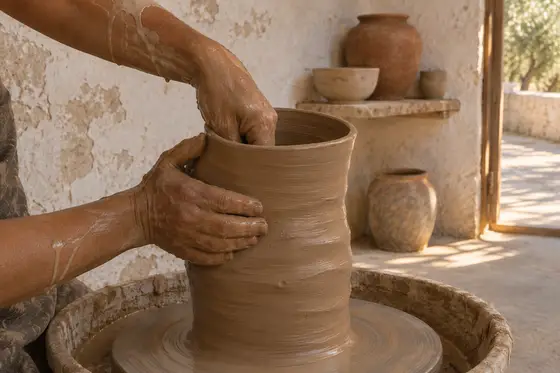
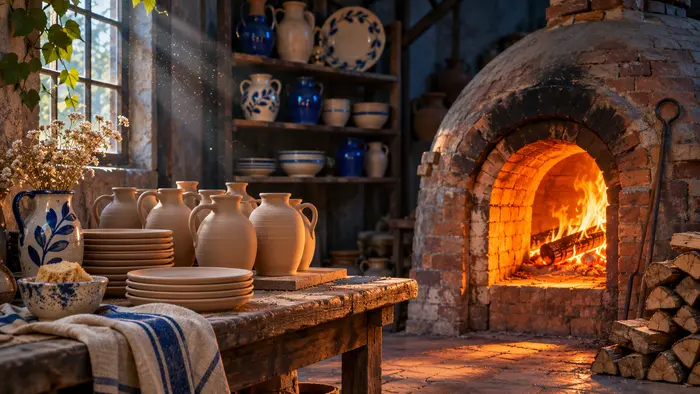
In the traditional Nisa kiln the first hour made the pots black. The potter fed thick firewood into the firebox to keep the flame low, and the museum’s account says that kind of fire produced a very thick smoke that gathered in the kiln and gave the pieces a quite black colour. That is why a second phase had to follow, called in the local speech “lavar a loiça”, washing the dishes. The description comes from the Museu do Bordado e do Barro, which belongs to the municipality of Nisa, in the Alto Alentejo.
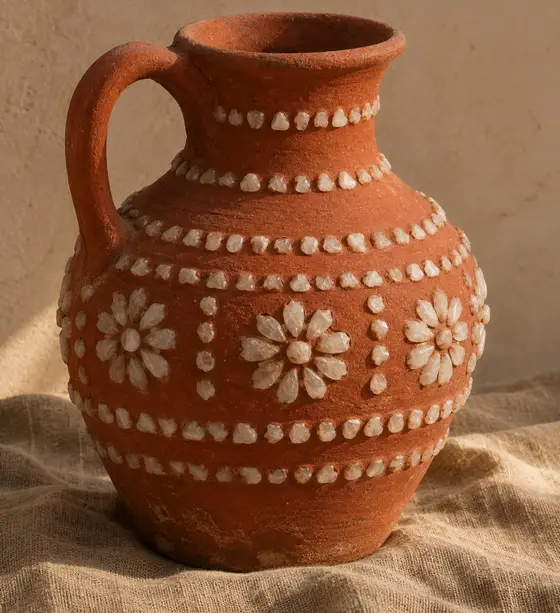
What Nisa is known for is the decoration. The paste mixes white and black clay, two parts to one, and the pieces are dipped in a red clay slip and polished by hand. Milky quartz, traditionally from the nearby Serra de S. Miguel, is fired to make it brittle, then crushed on a granite slab and sieved by size. The designer scratches the pattern into the part-dry piece with a sewing needle, using thimbles or lamp caps for the circles. The quartz bits go in point first, flat face out, pressed down with a thumbnail so that the finished surface is smooth to the hand. The work is usually done by the potter’s wife, who may direct paid workers called pedradeiras, in the workshop or at home.
A technique with no known date
The museum is frank about the limits. It calls the stone-set pottery of Nisa an old tradition closely tied to keeping water cool, then says there are no concrete studies that fix its origin in time or place. It adds that the craft has existed alongside a similar one in Estremoz, 84 km away, which also inlays clay but with somewhat different characteristics, and in the neighbouring Spanish Alta Extremadura, where the border town of Ceclavín calls it enchinado.
Today, the museum says, only the town of Nisa itself still has potters. Amieira do Tejo (storage jars and roof tiles), Montalvão (jars) and Cacheiro were once big centres. At Cacheiro the last resident potter, José Lopes, retired in the 1980s. From the 1960s demand turned decorative, helped by Nisa being a compulsory stop for anyone travelling by coach between Lisbon and the Beira Interior. Potters began to make plates, miniatures, ashtrays and small animals, and put finer stones on traditional shapes in a single line, which the museum calls the “modern type” of decoration.
São Pedro do Corval: the council’s claim
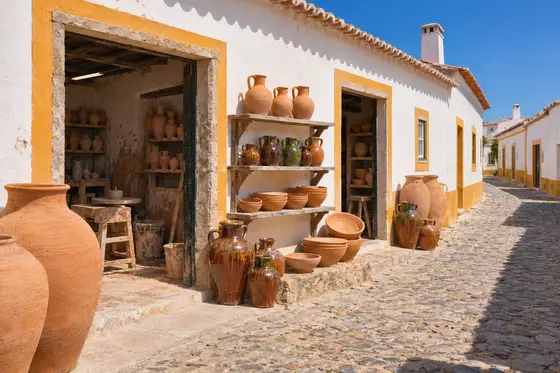
São Pedro do Corval lies in the municipality of Reguengos de Monsaraz. The council’s own page (updated June 2023) says the village’s ceramic tradition goes back to prehistoric times, thanks to clay deposits with particular characteristics in this part of the municipality. It also says that, with more than twenty workshops in constant operation, Corval is, in its words, “por excelência” the largest pottery centre in the country and one of the largest on the Iberian Peninsula.
That is a municipal claim, and we found no independent count to set beside it. The directory on the same site shows 21 entries, which include a roof-tile yard and a rustic brick works, so it is a listing, not a census. The page describes today’s work as painted ceramics in a regional style. The municipality has also made an interpretive centre, the Casa do Barro, in a former pottery on the village’s main road; its page lists two old wood-fired kilns, a vat where the clay was strained and potters’ wheels, intended to show the cycle of the clay from earth to finished piece.
Viana do Alentejo: a school in 1893
The municipality of Viana do Alentejo puts a date on a turning point. Before it, workshops were patriarchal: the trade passed from father to son, with day labour hired when orders required it. On 28 October 1893 the Escola Médico de Sousa opened, a workshop-school where almost every task of the potter, the kiln man and the ceramic painter was taught. The council calls it one of the first industrial schools in the country. It was linked to the União Vinícola e Oleícola do Sul, described as the first cooperative winery in Portugal, and named by the townspeople after the Sousa family. Among the names tied to its teaching are the painter Júlio Resende the ceramicist Armando Correia, Aníbal Alcino and Francisco Lagarto.
The decoration the page describes is rooted in country life: farm work, clothing and local landscapes, in browns, a range of blues and ochres, with naïve drawing and no perspective. The page does not say how many workshops operate today.
Redondo, Estremoz and a name we cut
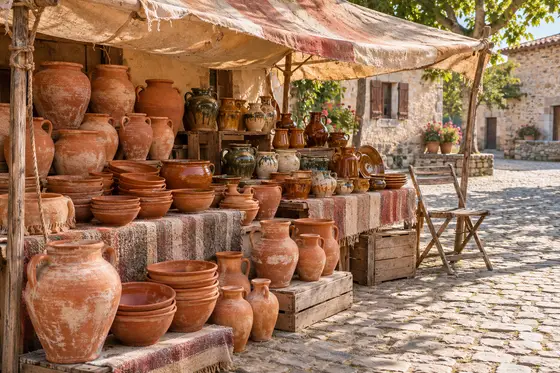
Redondo’s municipal page is short on history. It says the Museu do Barro opened in 2009 in the Convento de Santo António, shows the course of local pottery and sells pieces, and that visitors can tour the municipality’s nine workshops. A council notice for a January–February 2026 exhibition calls the alguidar, the wide clay bowl, an emblematic object of traditional Alentejo pottery. We did not find a source on what Redondo’s own pottery looks like, so we say nothing about it.
Estremoz belongs here for the figures rather than for tableware. UNESCO inscribed the craftsmanship of Estremoz clay figures on its Representative List in 2017 and says production dates back to the 17th century. Pieces are assembled, fired in an electric oven, painted and varnished, and dressed in Alentejo regional costume or Christian religious clothing.
One more name turns up. In an April 2018 announcement, the Reguengos council said that 14 councils were to found the Associação Portuguesa de Cidades e Vilas Cerâmicas, among them four in the Alentejo: Montemor-o-Novo, Redondo, Reguengos de Monsaraz and Viana do Alentejo. We opened no source on Montemor-o-Novo’s pottery, so it gets no section.
Not confirmed: Claims about Corval’s size and age are the council’s own and have no independent check. We cut Montemor-o-Novo (no source opened), the figure of 50 workshops falling to two in Viana (only seen in search summaries) and quartz grain sizes (the museum text is ambiguous). The Nisa museum page repeats a paragraph in its “lavar a loiça” section, so we do not describe that phase.
Sources
- Museu do Bordado e do Barro (Município de Nisa): Processo de fabrico
- Museu do Bordado e do Barro (Município de Nisa): História e características
- Município de Reguengos de Monsaraz: Olaria de São Pedro do Corval
- Município de Reguengos de Monsaraz: Casa do Barro
- Município de Reguengos de Monsaraz: Associação Portuguesa de Cidades e Vilas Cerâmicas (16 Apr 2018)
- Município de Viana do Alentejo: Olaria de Viana do Alentejo
- Município de Redondo: Museu do Barro
- Município de Redondo: exposição O Alguidar, Terra de Usos e Memórias
- UNESCO: Craftsmanship of Estremoz clay figures
Related plates