III Regional wares · Plate 007
Estremoz nativity figures
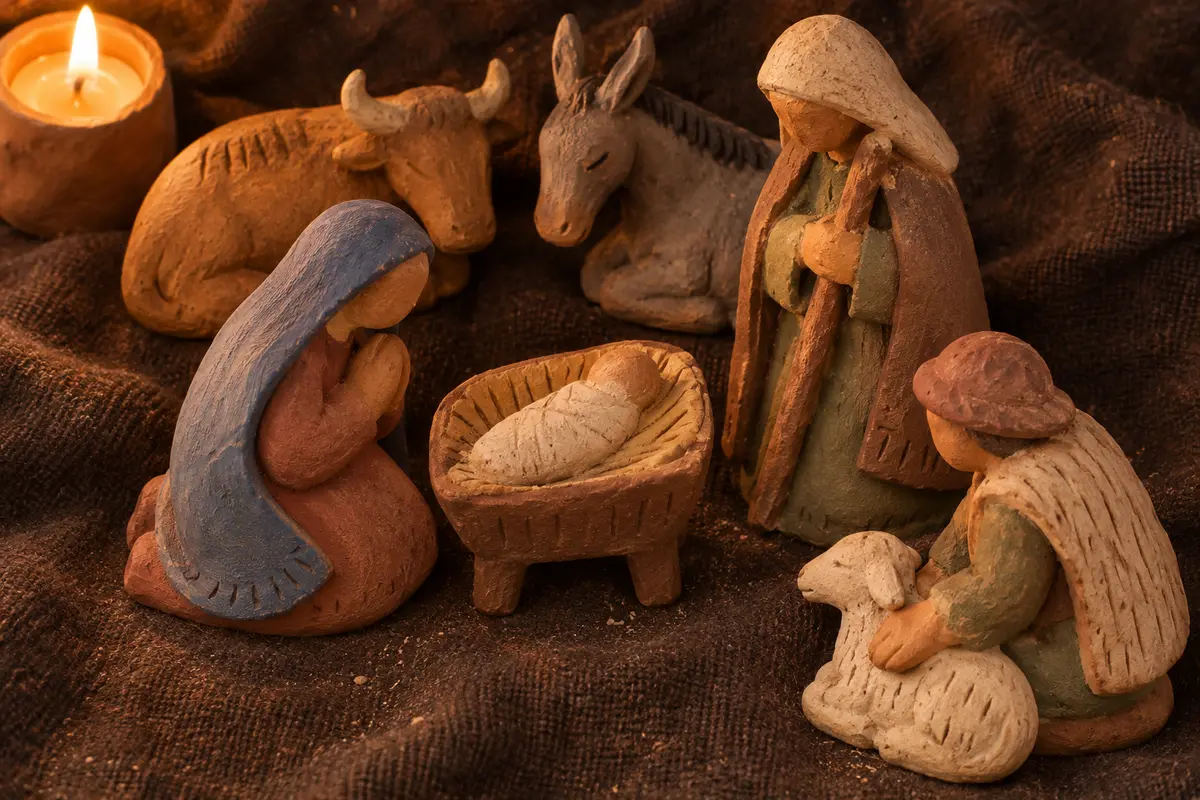
Estremoz figures began as devotional images; nativity themes grew in the later 18th century, and secular figures came after. According to the municipality's file, they usually stand between 10 and 40 cm tall.
By the specification's reading, Estremoz figures arose from a need: people with few means wanted a devotional image at home. Wooden sculpture was expensive, while clay was plentiful and easy to model, so the first known figures are saints with strong local cults. No century can be proved, but a book of 1718 and another of 1726 mention the craft, a council minute of 1770 speaks of women who model clay figures and earrings, and the oldest physical trace is a fragment of a Christ Child from the 17th century, found in a 2006 excavation.
Between about 1750 and 1807, the period the document calls golden, the repertoire grew. After the Mafra school renewed the art of the nativity scene, itself influenced by Neapolitan cribs that stood in noble and bourgeois houses and local convents, Estremoz makers copied what they saw and adapted it to local rules of modelling. Orders from devout, less wealthy clients pushed them to add secular figures around the Nativity. Between the late 18th and early 19th centuries symbolic, functional and satirical secular models also appeared, unconnected to nativity scenes.
Source: cearte.pt
Read about it: The figures that nearly stopped being made →
AI-generated illustration in the manner of the tradition, not a photograph of a specific object.