III Regional wares · Plate 035
Hand-painting
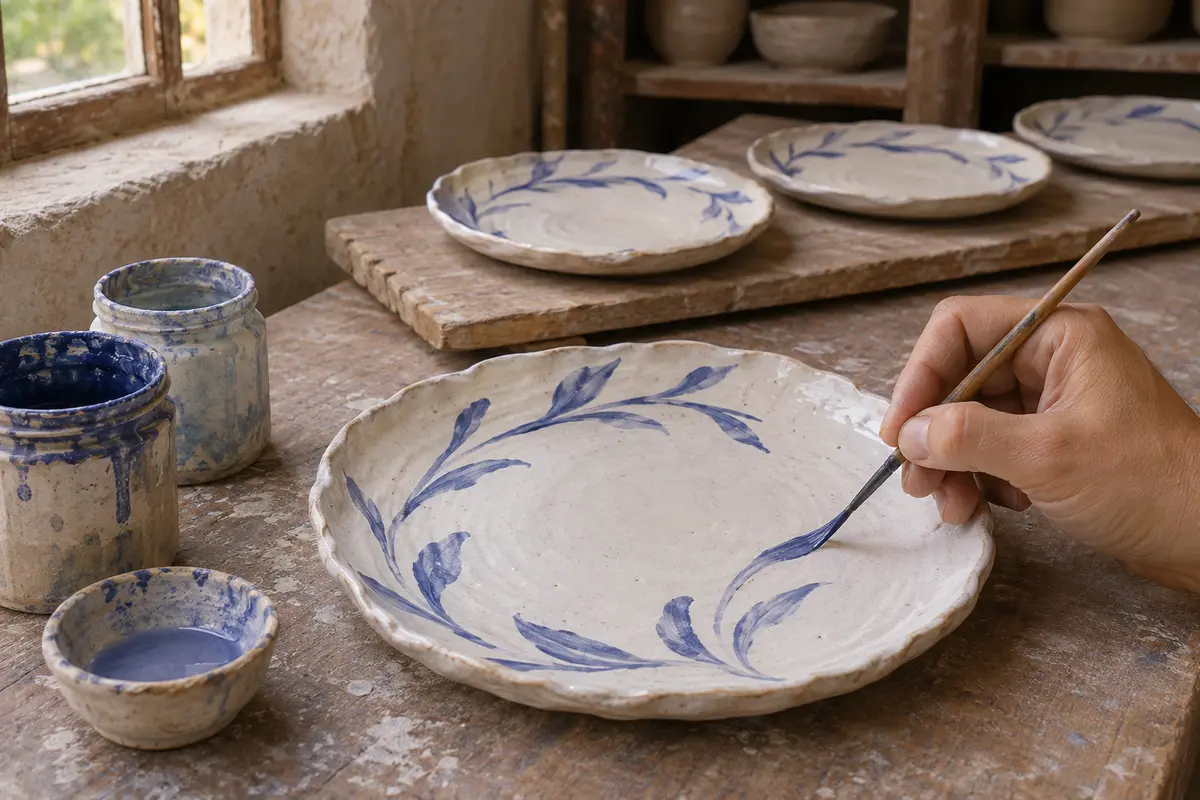
In faience, the tin glaze is coated over the first-fired piece and painted directly, followed by a second firing, according to the Museu Nacional do Azulejo glossary.
The Museu Nacional do Azulejo's catalogue describes faiança as a decoration technique: the clay body is coated with a tin-based glaze (vidrado estanífero), the decoration is applied by direct painting on it, and the piece is given a second firing. Tin glaze is lead glaze with tin oxide added, which turns the surface white, shiny and opaque, and this white surface usually serves as the ground for painted decoration. Its white was meant to imitate Chinese porcelain. The decoration is usually brushed onto the unfired glaze surface using metallic oxides.
Common oxides were cobalt, copper, iron, manganese dioxide and antimony. Later medieval wares used manganese purple, copper green, cobalt blue and antimony yellow. In Coimbra, a basin signed by Agostinho de Paiva in the 1690s is painted in blue on tin-glaze white with a manganese outline. The technique has a long history in the Iberian Peninsula: the Moors introduced tin-glazed pottery to Spain after the conquest of 711, and the Portuguese Wikipedia article on faiança lists Coimbra among the main Portuguese faience factories up to the early 20th century.
Source: raiz.museusemonumentos.pt, en.wikipedia.org, belard.pt, pt.wikipedia.org
AI-generated illustration in the manner of the tradition, not a photograph of a specific object.