III Regional wares · Plate 014
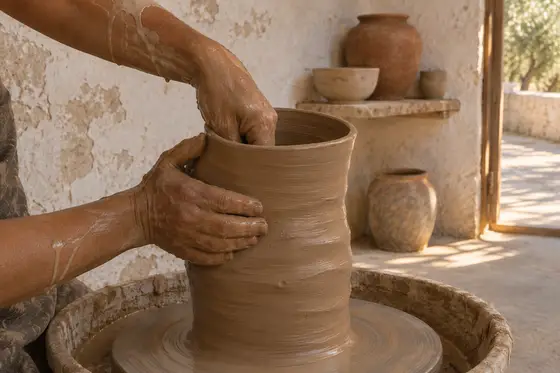
Workshop at Bisalhães
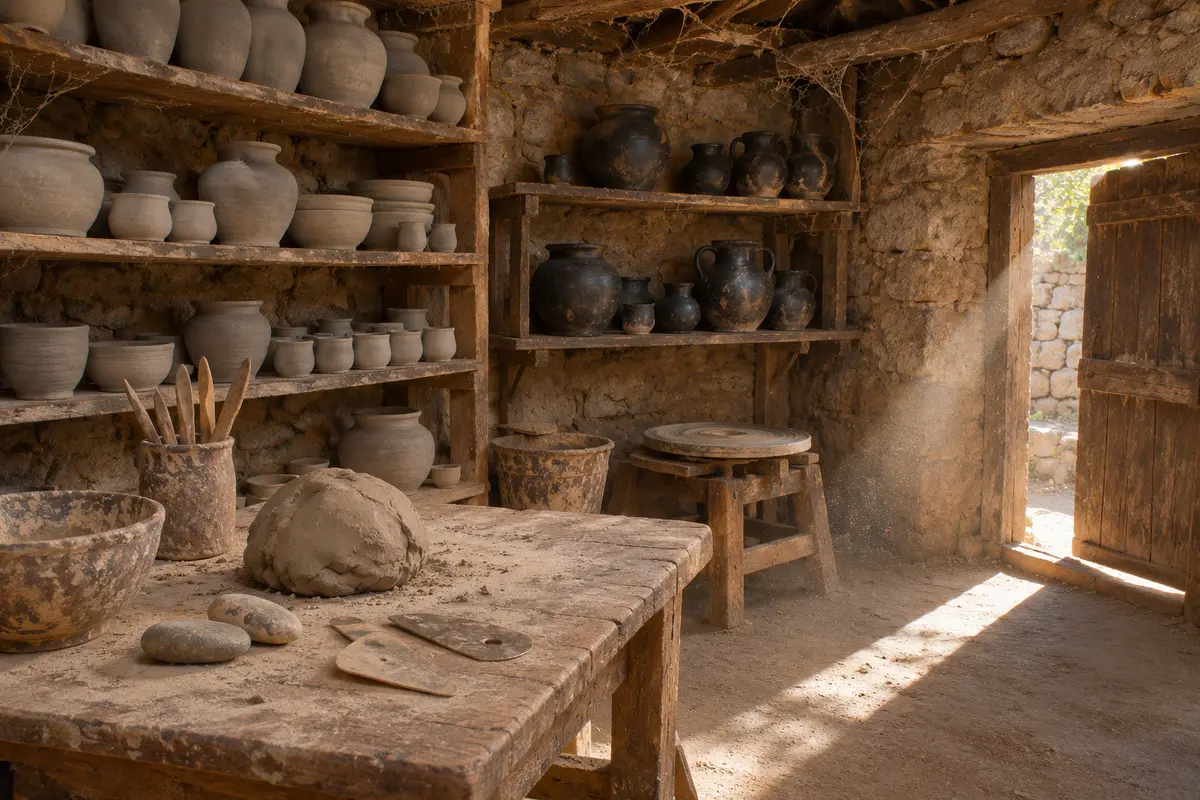
Few potters keep Bisalhães pottery going. Press reports at the 2016 listing counted five who made it their main occupation, most over 75; knowledge is passed on almost only within families.
Bisalhães is a case study in how a craft thins out. Press reports at the 2016 listing counted five potters who made it their main occupation, most over 75. The Museu do Douro, in an exhibition about the village, gives six potters with documented activity today, far fewer than the dozens recorded in the mid-twentieth century, most of them over 80, with only one of the younger ones working full time. Each potter interprets shapes and decoration in a personal way. UNESCO lists the threats as fewer bearers, waning interest among the young and demand for industrial alternatives.
The work is shared out along family lines. UNESCO records a division by gender: men now do the labour-intensive clay preparation, and women mainly decorate the pots. Knowledge is passed on almost exclusively through kinship ties, which is both the craft's strength and its fragility, since a family without a successor cannot easily hand the skill to outsiders. The exhibition Mãos que fazem Bisalhães, curated by the Museu do Douro with the Vila Real council and Museu da Vila Velha, was shown at the Museu do Vinho in São João da Pesqueira and was accompanied by a catalogue.
Source: ich.unesco.org, dn.pt, museudodouro.pt
Read about it: Black pottery, and the question of the colour →
AI-generated illustration in the manner of the tradition, not a photograph of a specific object.