III Regional wares · Plate 015
Burnishing
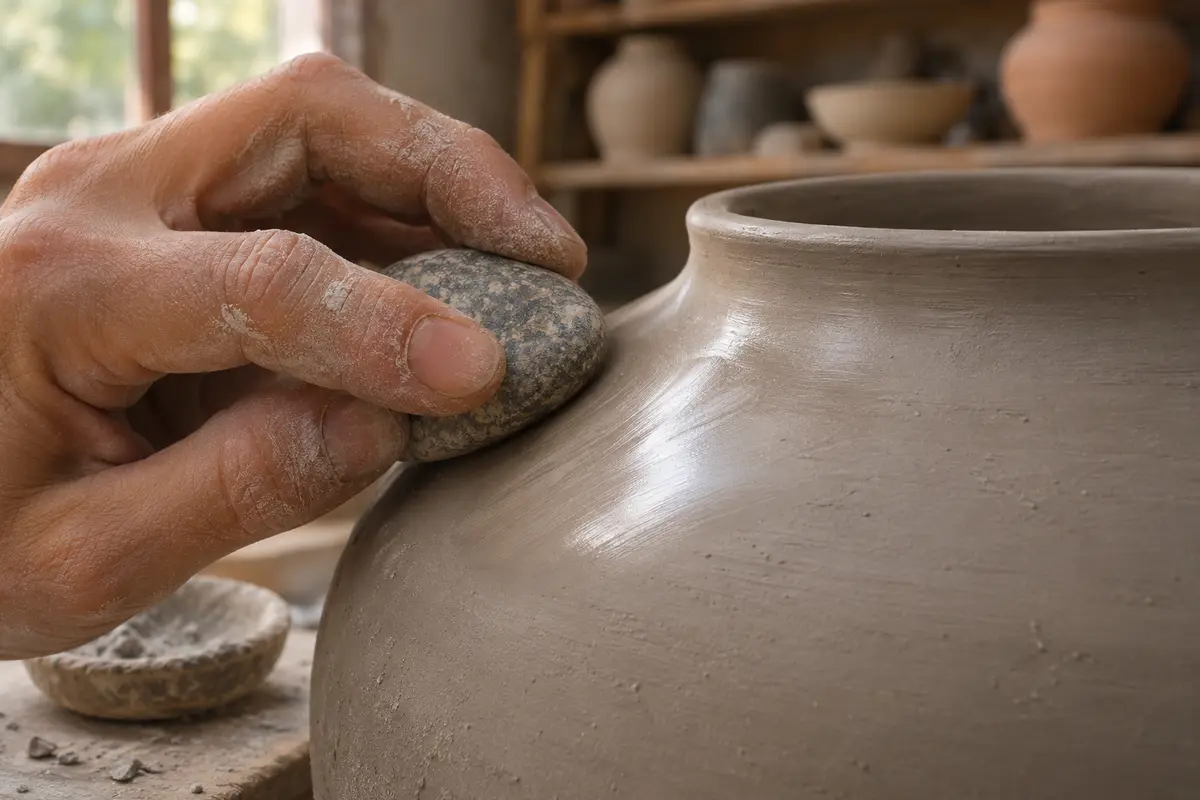
Burnishing means polishing the surface of a piece with a smooth stone. UNESCO notes that Bisalhães potters smooth pieces with pebbles, and the Molelos black ware is burnished.
Burnishing is a polishing of the surface that makes it close and shiny without any glaze. UNESCO's description of Bisalhães says surfaces are smoothed with pebbles, and the specification for Barcelos black ware describes the polished type as made by polishing on the wheel when the pieces are slightly dry, until they acquire a very uniform, glossy surface; the tools are metal or wooden knives. The polishing is done on the shaped clay before firing, so the sheen belongs to the clay surface itself and not to a glaze or coating, and it sits alongside the reducing firing that turns the ware black.
Other centres polish by hand. In Nisa, after the piece is dipped in red clay slip, it is rubbed repeatedly with wet hands before it is completely dry, a step the museum calls pulling the lustre, puxar o lustro. Barcelos sorts both its red and its black ware into matt and polished types. Matt black ware carries relief decoration, stamped circles and wavy lines, while the polished kind is meant to shine and is decorated with moulded motifs of fauna and flora applied by hand. The result in each case is a surface that works as decoration in its own right.
Source: ich.unesco.org, cearte.pt, museubordadoebarro.cm-nisa.pt
Read about it: Black pottery, and the question of the colour →
AI-generated illustration in the manner of the tradition, not a photograph of a specific object.