III Regional wares · Plate 050
Drying pots by the hearth
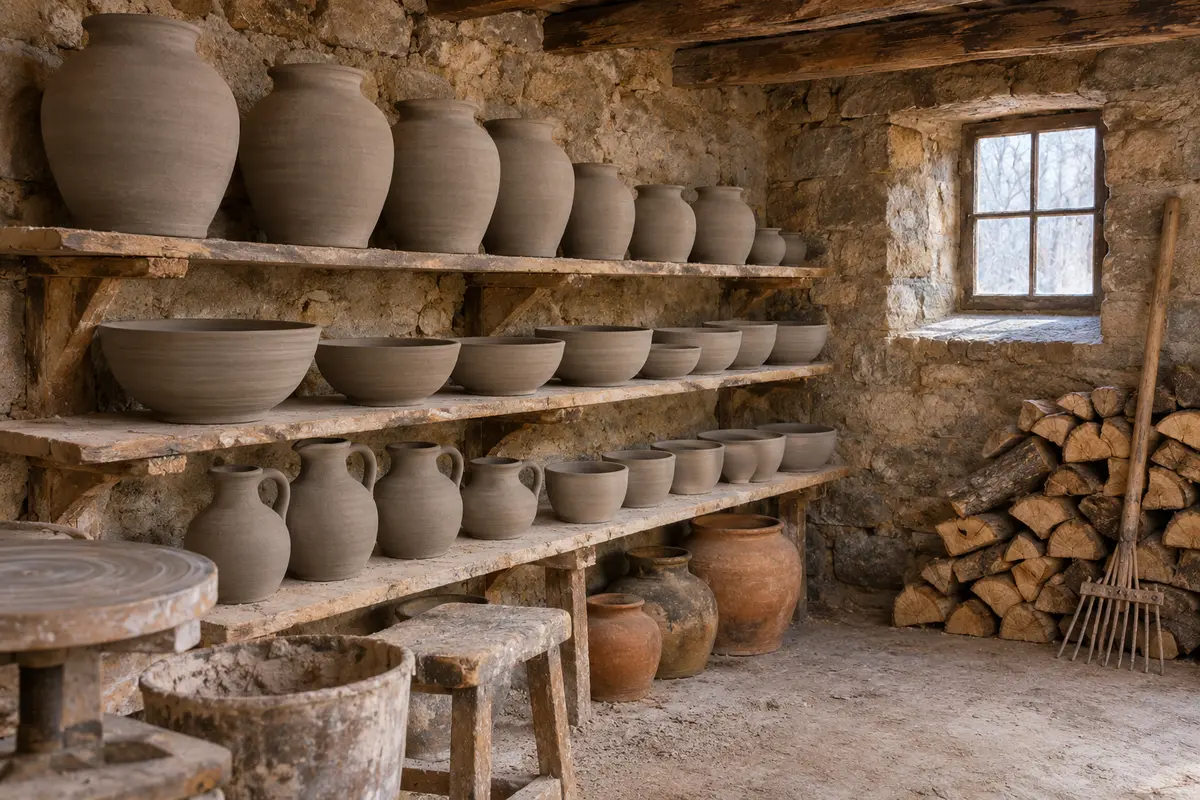
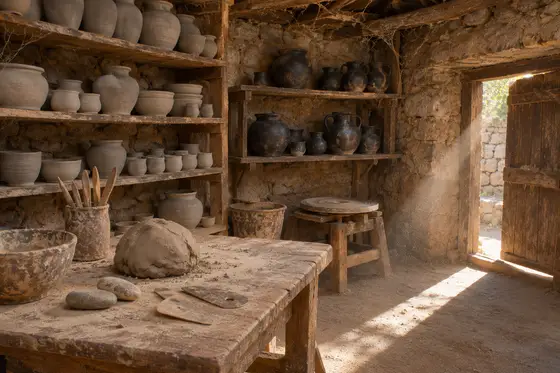
Pots need slow, even drying before firing, since uneven drying is the main cause of cracking. This room is shown in a general style.
The ceramics site Digitalfire says drying cracks are usually caused by how clay and ware are handled, and that fast drying is not the problem; uneven drying is. Causes include clay more plastic than needed, soft or poorly wedged clay, large flat forms, uneven wall thickness, sharp convex contours, unfinished edges with tiny splits and weak joins. Dry air and drafts speed uneven drying. The remedies are to wedge well, keep walls even, finish edges, make strong joins and dry evenly, covering ware with cloth and plastic.
The Museu do Barro de Nisa describes the same care in a Portuguese setting. The piece is left for a few days indoors, away from light, to reach the consistency needed to withstand firing. The museum adds that the clay cracks easily at high temperatures. Digitalfire's examples show that material matters: terracotta with 7.5% shrinkage cracks less than white porcelain with 6%, because its dry strength is roughly two to three times higher. Neither source ties drying to a hearth, so this page cannot say how Beira potters did it.
This is a general description, not confirmed to a single source.
Source: digitalfire.com, museubordadoebarro.cm-nisa.pt
AI-generated illustration in the manner of the tradition, not a photograph of a specific object.