IV Craft, clay and kiln · Plate 045
Oxide pigments
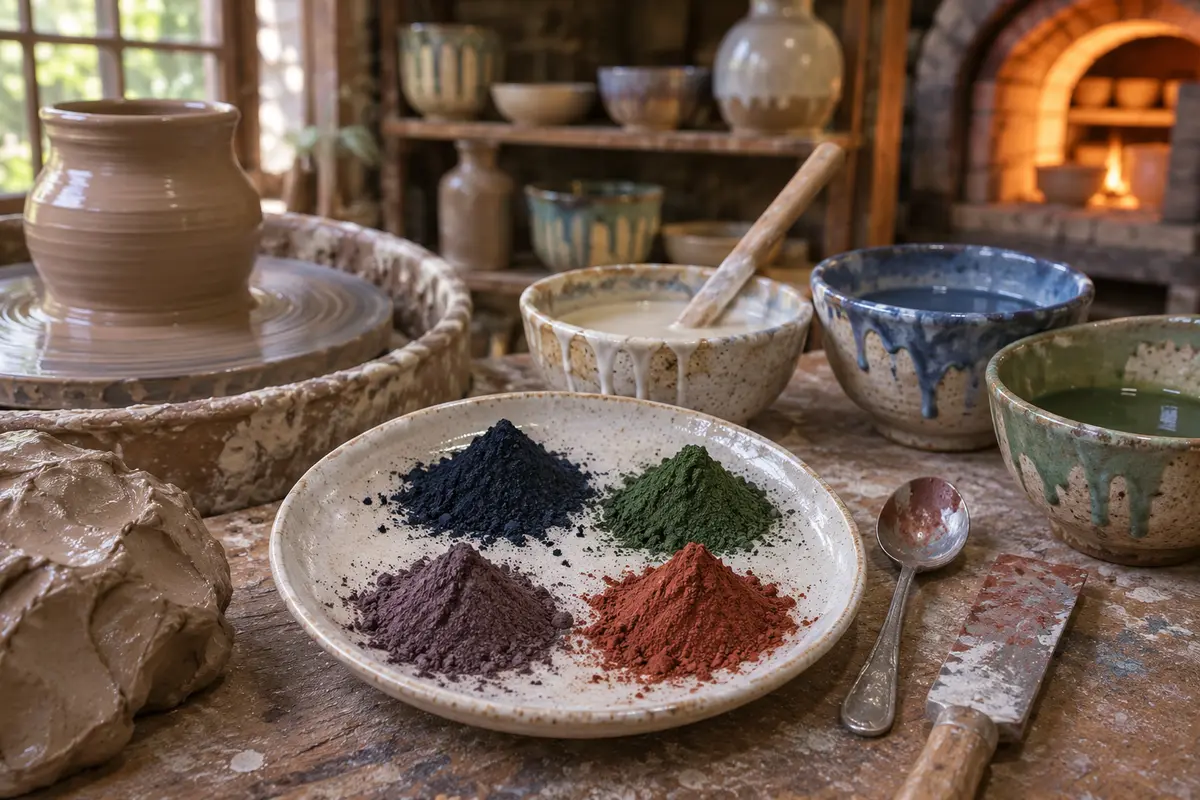
Ceramic colours come largely from metal oxides: cobalt gives blue, copper green, manganese purplish brown and iron brown. Results shift with the glaze and the firing.
A Brazilian ceramics laboratory guide explains that small amounts of metal oxides colour glazes, though the result depends on glaze thickness, the colour of the biscuit, firing temperature and kiln atmosphere. Cobalt is the most powerful: 1.5% gives dark blue, and it also acts as a strong flux. Cobalt oxide leaves blue specks, while the finer carbonate gives a more even colour. Copper up to 5% gives green in lead glazes, 2% gives bright turquoise in alkaline glazes, and 5 to 10% gives a metallic black. Iron is perhaps the most used oxide, giving amber, reddish brown, green, blue, grey and black.
Other oxides follow their own rules. Manganese dioxide is very fluxing and gives brown in most glazes, with purple possible in alkaline ones. About 2% chromium gives green, and with tin it can turn pink, even in neighbouring white pots, because a little volatile chromium is enough. Antimony in lead glazes gives the traditional Naples yellow. Cadmium red is thermally stable only to about 1000 °C and cadmium is carcinogenic. Digitalfire adds that some oxides give intense colour at under 1%, and that manganese dioxide and copper carbonate can decompose during firing and cause glaze defects.
Source: ufrgs.br, digitalfire.com
AI-generated illustration in the manner of the tradition, not a photograph of a specific object.