IV Craft, clay and kiln · Plate 046
Kaolin, quartz and feldspar
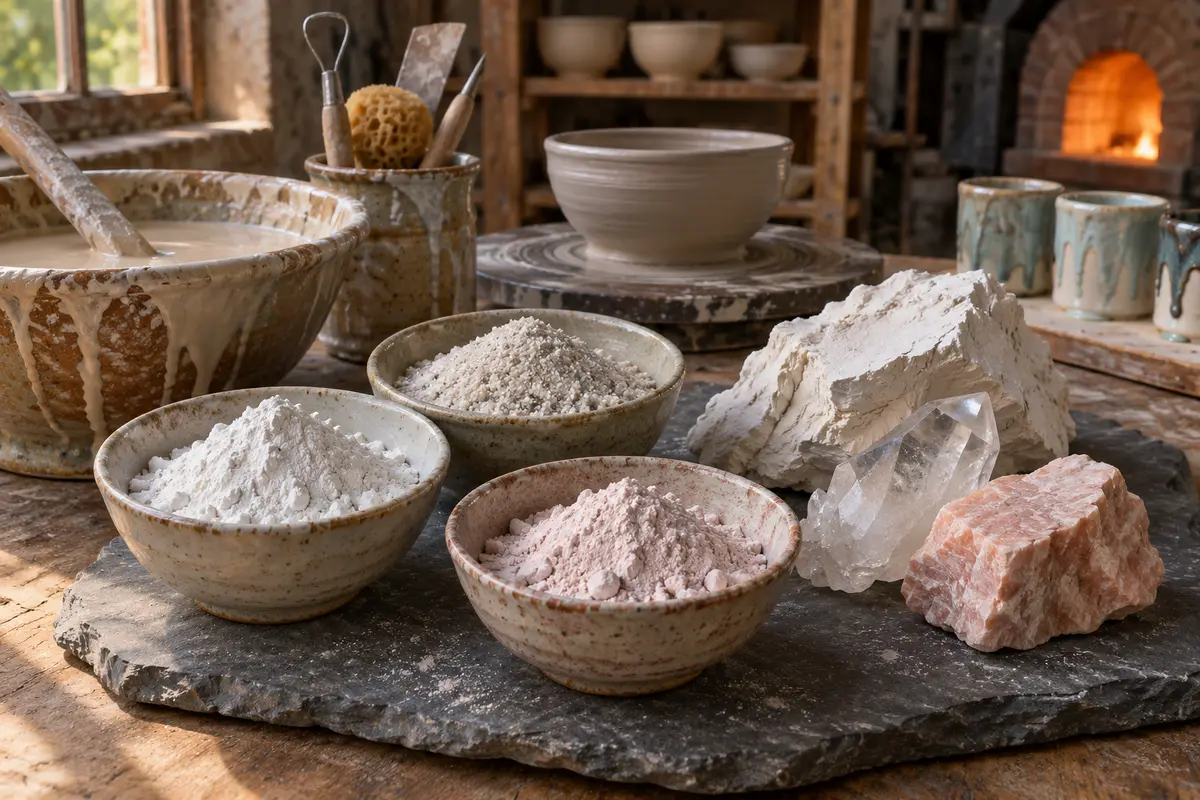
Kaolin is the white clay of white bodies, quartz supplies silica and feldspar acts as a flux. Many glazes and bodies combine these materials, depending on the recipe.
Kaolin, also called China clay, is a white or off-white clay and a key raw material of many pottery bodies. It is the clay of choice for bodies that must be clean and white, and many porcelains contain only kaolin as their clay. Its plasticity is relatively low, so plastic bodies usually add ball clays or bentonite. In glazes, kaolin keeps silica, feldspar and frit particles from settling and is the main source of alumina. Kiln wash is often a 50:50 mix of kaolin and silica, because kaolin is very refractory.
Feldspar is the flux. It is crushed rock of sodium and potassium aluminium silicates, usually with 10 to 15% alkali, and melts well at medium and high temperatures. In bodies it promotes vitrification by forming a glassy phase; Digitalfire cites about 25% feldspar in vitreous bodies at cone 10. Quartz supplies the silica: it is nearly pure silicon dioxide and does not melt at common ceramic temperatures, so it must be dissolved by other materials that have already melted. As a filler, finely milled quartz also reduces drying shrinkage, and in glazes small-grain silica helps prevent crazing.
Source: digitalfire.com, digitalfire.com, digitalfire.com, en.wikipedia.org
AI-generated illustration in the manner of the tradition, not a photograph of a specific object.