IV Craft, clay and kiln · Plate 041
Painter's palette
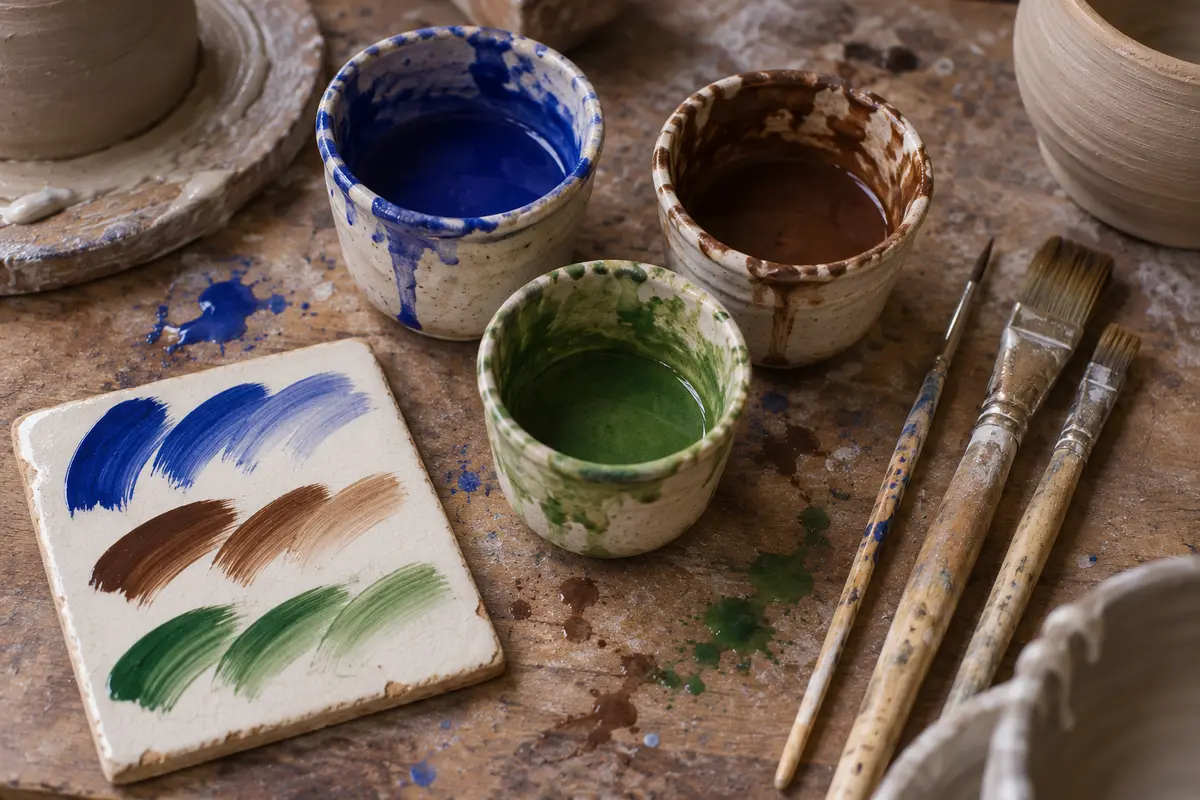
Tile painters keep pigments mixed with water in small pots, and use brushes of different sizes for outline and fill.
Portuguese Wikipedia describes the majolica palette as five scales of colour from soluble metal oxides: cobalt blue, bronze green, manganese brown, antimony yellow and iron red. The red, being hard to apply, appears little in the early examples. In the same article, the oxide of tin gives the white. In Portugal, single-figure tiles in cobalt blue became widespread in the 18th century, with decorative elements in the corners helping the eye join separate tiles.
These single-figure tiles were placed above all in kitchens and stairwells, and are also found in religious architecture and, under the Estado Novo, with popular themes. Other ways of putting colour on coexisted with majolica. Decoration at the great fire is painted over the glaze and fired again at above 1200 °C. Decoration with a third fire paints colour on the chacota or the glaze and fires it at a moderate temperature. The printed tile carries the decoration on a decal, transferred to the glazed surface.
This is a general description, not confirmed to a single source.
Source: pt.wikipedia.org
Read about it: A surface that drinks the paint: how a hand-painted tile is made →
AI-generated illustration in the manner of the tradition, not a photograph of a specific object.