01 Tiles · Making
A surface that drinks the paint: how a hand-painted tile is made
Fire the clay, dip it in white glaze, paint on the dry glaze, fire again. Each step is simple, and none can be undone.
The painter cannot rub anything out
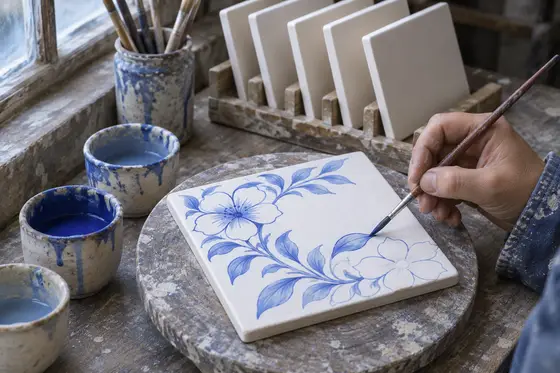
The V&A, describing tin-glazed earthenware in general, puts the central problem in one line: the unfired glaze is fragile and very absorbent, so a painted mistake cannot be erased. The brush goes down once. The surface takes the pigment at once, the way blotting paper does.
Everything else about the way a hand-painted azulejo is made follows from that. The order of the steps and the skill of the painters are organised around a surface that forgives nothing. What follows is the sequence as museums and researchers describe it, with the places where they say nothing marked as such.
Clay, and a first firing with no glaze
The body of the tile starts as clay. Viúva Lamego, founded in 1849, mentions that its early production included tiles in white clay alongside red-clay utility ware. Sant’Anna, founded in 1741, began as a pottery making unglazed red-clay utilitarian pieces. Neither page says how the tile body is formed today, and we have not found a museum source that says how Portuguese workshops shaped theirs. Sant’Anna’s history page lists modelling and tile slabs among its handcraft steps, and nothing more.
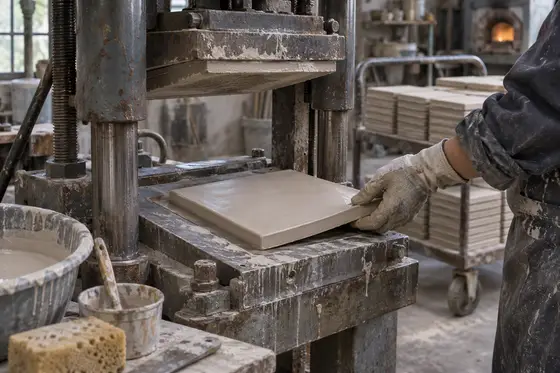
One date from outside Portugal is useful as a contrast. The Tiles and Architectural Ceramics Society credits Richard Prosser with the discovery, in 1840, that clay dust could be compacted in a press, which made drier tiles that warped less in the kiln. That is the industrial route. It tells us nothing about the hand-painted tradition except what it replaced.
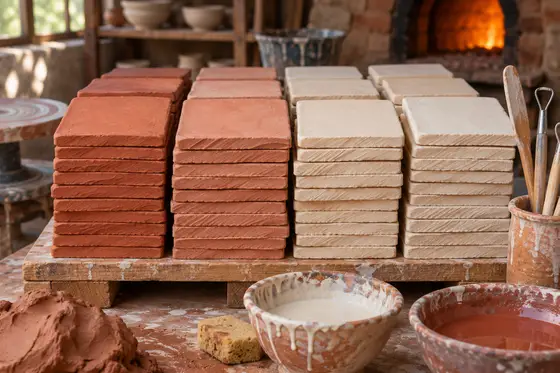
The first firing comes before any glaze or decoration. The V&A says it leaves a body that is hard but still slightly porous. The Museu Nacional do Azulejo calls this fired, unglazed piece the chacota, in its definition of faiança: the technique of coating the chacota with tin glaze, painting directly on it, and firing a second time.
The white bath
Next the tile is dipped in glaze. The V&A’s account of tin-glazed earthenware says the pieces were dipped and then set on boards to dry. Tin oxide is what makes the glaze white and opaque, as the V&A’s note on tin-glazed tiles puts it. That blank, dry, fragile coat is what the painter will work on.
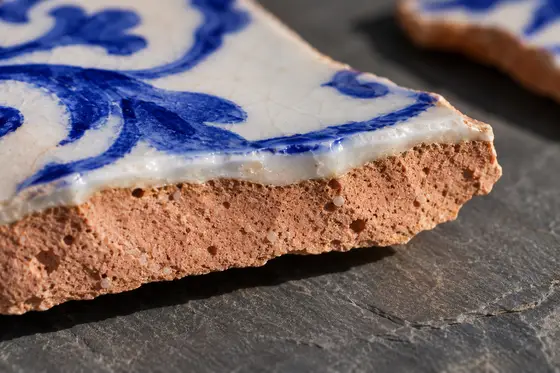
The Museu Nacional do Azulejo’s own definition says the glaze is tin-based ("vidrado estanífero"). For 17th-century Portuguese tiles, researchers at LNEC and the Museu Nacional do Azulejo describe the white glaze as not quite uniform: it holds crystals, probably quartz and feldspar, and gas bubbles trapped inside.
Tracing, then the brush
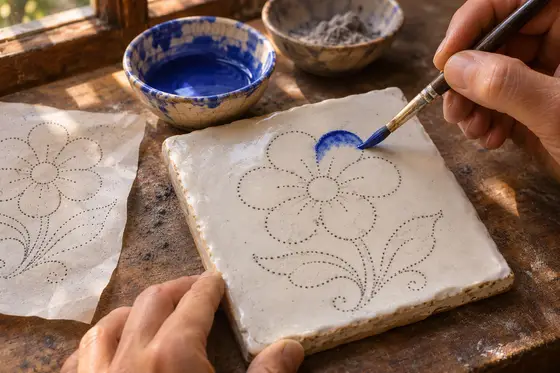
Because nothing can be corrected, a painter needs a guide. The V&A describes the method for tin-glazed delftware tiles: a paper outline pricked with holes is laid on the tile and dabbed with a bag of charcoal, leaving dotted lines to paint over. We do not have a Portuguese source that says every workshop here did the same, so read this as the method for that tradition. The outline is then filled with coloured pigment using a fine brush.
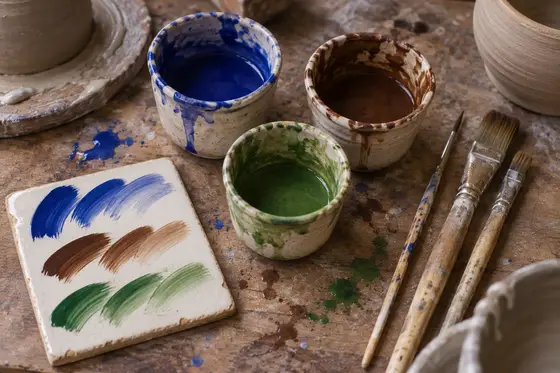
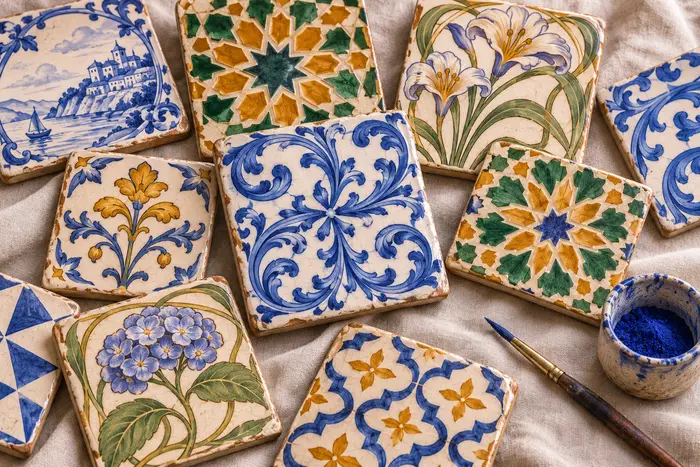
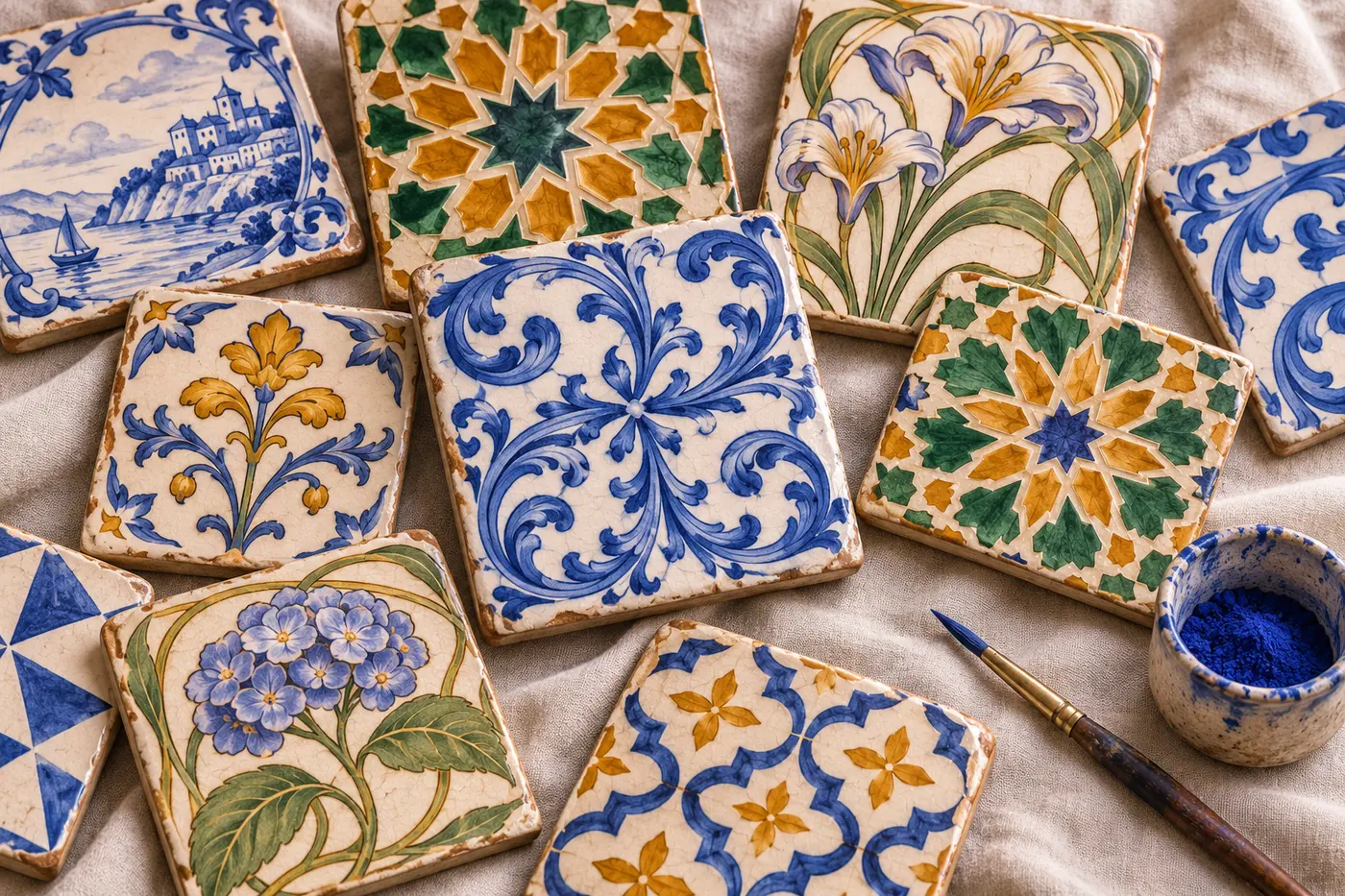
The palette is mineral. Researchers who analysed 17th-century tiles describe a range that went well beyond the later blue-and-white: blue, yellows, oranges, greens, purple, browns and a near-black used for outlines. Another team found that, until well into the 19th century, the blue in azulejos came only from cobalt, and that from at least 1520 the cobalt came from the Erzgebirge on the Saxony–Bohemia border.
Today the work is still done by hand at Sant’Anna, where the standard patterns are painted by hand and the company says that variation in size and colour between pieces is part of the character of its work.
The second firing, and where the cobalt goes
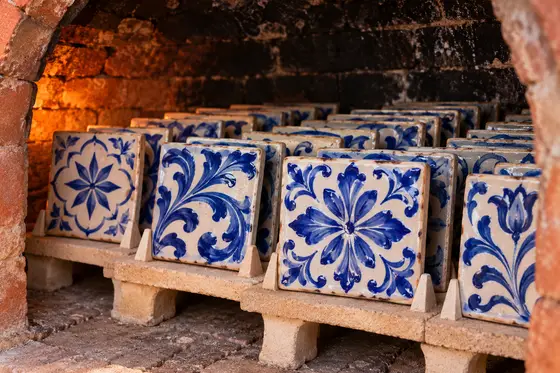
Once the decoration is done, the tile is fired a second time, and the glaze and colours fuse. What happens to the pigment is the most interesting part, and researchers have looked at it in cross-section. In a study of 17th-century Portuguese tiles, lead-based yellows, and the oranges and fern-greens made from them, stayed mainly at the surface of the glaze. Cobalt blue and copper green sank into it and often dispersed through it. The same abstract notes that colours laid over one another did not mix.
That is an observation, not an explanation. The sources we opened do not say why cobalt sinks while yellow stays up. A reasonable reading is that the pigment dissolves into the glaze as it melts, but that is our inference, not a quotation. It explains why a cobalt line looks soft-edged and slightly blurred on an old tile. Blue also varies from tile to tile: the researchers write that the hue may come from the pigment’s composition, from the glaze, or from firing conditions. Cobalt ore in this period was largely unrefined, and carried iron, nickel, arsenic and bismuth with it. One analysis found a distinct group the authors call "Nickel Blue", which in strong concentration turned blue-black.
There is even some doubt about the count. The same team noticed layering in the yellow that could mean painting over a first glaze before re-firing, and said they would test whether a single firing could reproduce what they saw. So "two firings" is the standard description, not a settled fact about every tile.
What can go wrong
- A slip of the brush stays. There is no step between painting and firing where it can be fixed.
- The dry glaze is fragile. It has to be handled before firing with that in mind.
- Warping. The Tiles and Architectural Ceramics Society says dust-pressed tiles warped less in the kiln. A craft potter writing for Ceramic Arts Network says tiles pressed in a plaster mould warp less than hand-rolled ones, and that a tile which is bent before firing will most likely warp in the last firing.
- Crawling. A general potters’ reference describes crawling as a glaze fault in which the molten glaze pulls back into islands and leaves bare clay. It is a glaze problem in general, not documented for azulejos in the sources we opened.
- Colour you did not plan. Because blue sinks and yellow stays, and because the cobalt itself varies, the fired colour can differ from the painted one.
What differs between workshops
The sources we opened say almost nothing that compares one workshop with another, so we will not invent differences. One real distinction does appear: the Hispano-Moresque tiles in one LNEC study were not made by the majolica technique at all. Their colours were laid as coloured glaze into compartments on the surface, rather than painted over a white glaze. The blue pigment in those tiles also carries tin, which the researchers link to their hazy appearance.
The Tile Lab on this site lets you work through the sequence step by step.
Not confirmed: We found no museum or factory source for how Portuguese workshops form the tile body, for firing temperatures, or for how a Portuguese workshop traces the design. The pouncing method comes from the V&A’s page on delftware tiles. The abstract on 17th-century pigments is a conference abstract from 2010, not a full paper. The explanation that cobalt dissolves in the melting glaze is our inference.
Sources
- V&A: Tea tray (how tin-glazed earthenware was fired twice)
- V&A: Delftware, tin-glazed earthenware tiles
- Museu Nacional do Azulejo, collection record for a jar (glossary entry for faiança)
- Coentro et al.: Multi-analytical study of the pigments in 17th century Portuguese azulejos (SEM 2010 abstract)
- Fares et al.: Azulejo blues, an analytical study of the blue colours in Portuguese azulejos (LNEC and Museu Nacional do Azulejo)
- Tiles and Architectural Ceramics Society: about tiles
- Fábrica Sant’Anna: Nossa história
- Fábrica Sant’Anna: Azulejos padrão
- Viúva Lamego: A nossa história
- Ceramic Arts Network: Press-molded tiles
- Digitalfire: Crawling (glaze fault)
Related plates