IV Craft, clay and kiln · Plate 040
Painting a tile
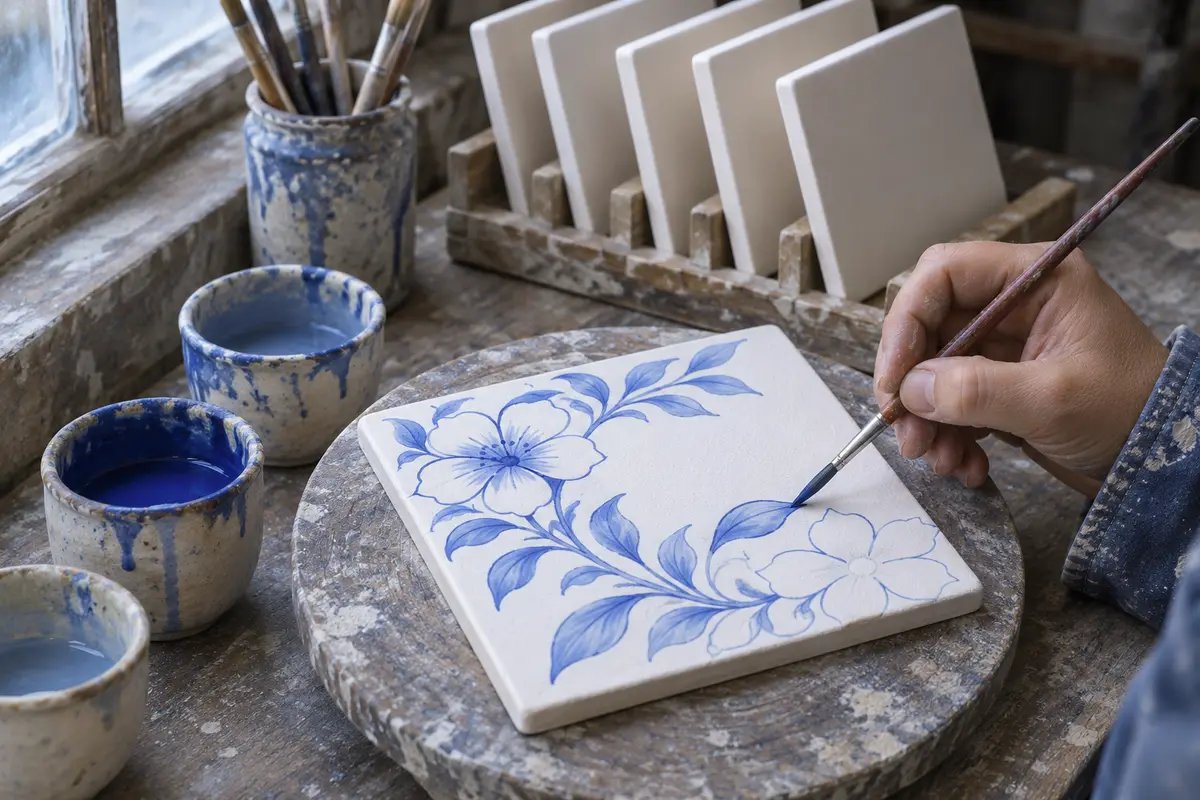
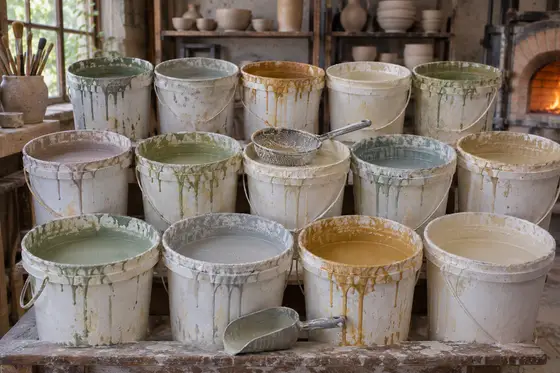
In tin-glaze tile painting, colours are brushed onto a raw white glaze surface that cannot be corrected. Pigment sinks in as the glaze fuses, so each stroke must be sure.
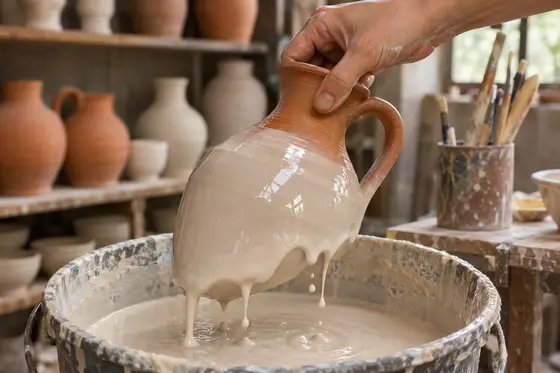
Portuguese Wikipedia explains why majolica was a revolution: coming from Italy, it replaced painting on the already fired piece, which was glazed afterwards. The Museu Nacional do Azulejo's catalogue uses the word faiança for a jar from the Aveiro production centre, dated 1940 to 1950, decorated by painting directly on the tin glaze. After the first firing a thick, opaque white tin glaze is laid on the plate, and the soluble metal-oxide pigments are applied directly on it. The pigments are absorbed at once, and the colours actually used appear only after the second firing.
To repeat a design, tile painters transferred it. The V&A describes pouncing: an outline drawn on paper was pricked with small holes, laid on the tile and tapped with a porous bag of charcoal, leaving the outline on the glaze. It was then painted over in coloured pigment with a fine brush and fired once more. The V&A holds 17th-century stencils for Dutch tiles with the pricked outlines from this use. From the 19th century semi-industrial methods appeared, such as the estampilha, a metal stencil with the motif cut out, through which colour was applied with a brush.
Source: raiz.museusemonumentos.pt, pt.wikipedia.org, vam.ac.uk
Read about it: A surface that drinks the paint: how a hand-painted tile is made →
AI-generated illustration in the manner of the tradition, not a photograph of a specific object.