IV Craft, clay and kiln · Plate 039
Tile biscuits (chacota)
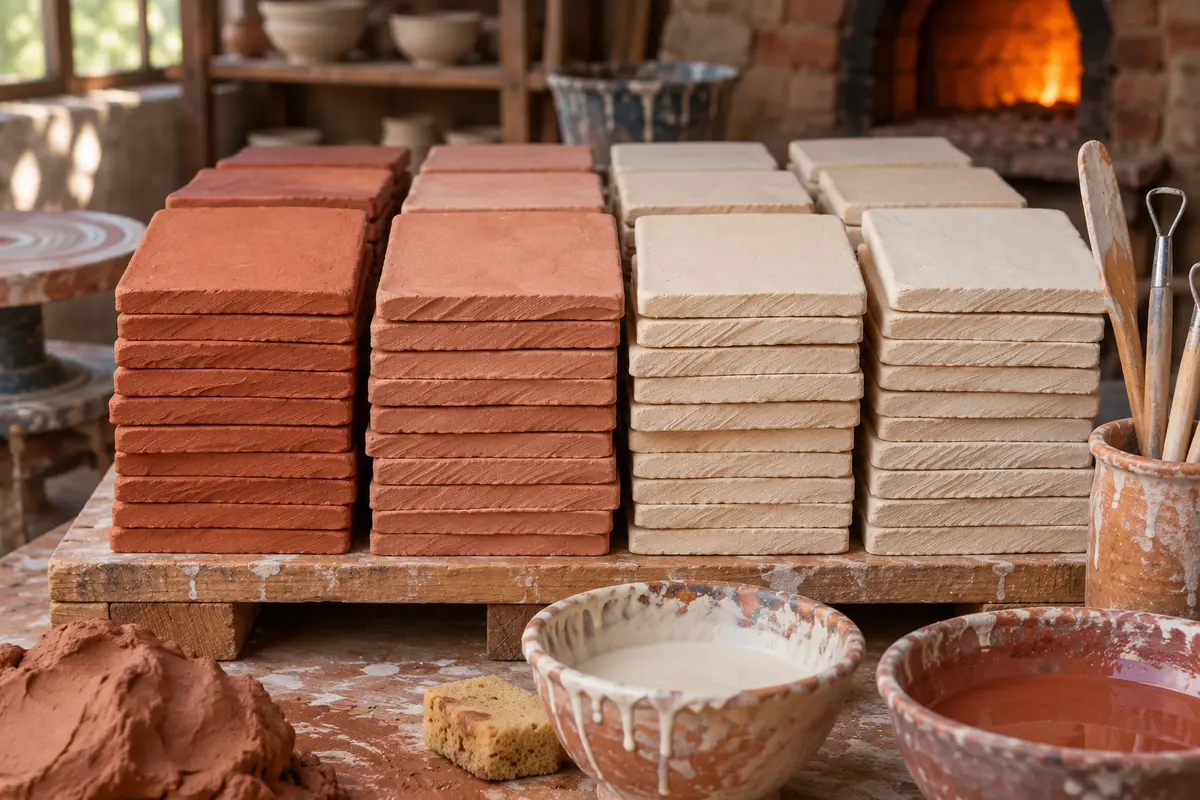
A tile fired once, before glazing, is called a biscuit, or chacota. Only one face is glazed afterwards.
Portuguese Wikipedia defines the azulejo as a thin piece of ceramic, generally square, with one face glazed. Its vocabulary names each part. The biscoito, or chacota, is a tile fired only once, before glazing. The tardoz is the side opposite the glaze, which is applied directly to the surface it covers. From the 16th century, tiles in Portugal had a square size varying between 13.5 and 14.5 cm, a situation that lasted until the 19th century. Before that there was no standard size.
The shaping of the clay can carry the decoration. In the aresta technique, colours are kept apart by raised ridges that appear when a wood or metal negative of the pattern is pressed into soft clay, a simpler process that lowers the price. The biscuit is also a working surface. In azulejo esgrafitado, the decoration is opened in the glaze by scraping with a stylus until the biscuit shows, and the grooves can be filled with putty or lime of the colour wanted. Another method paints in colour on the chacota or on the glaze and fires it again at a moderate temperature, the third fire.
Source: pt.wikipedia.org
Read about it: A surface that drinks the paint: how a hand-painted tile is made →
AI-generated illustration in the manner of the tradition, not a photograph of a specific object.