I Tile types and patterns · Plate 054
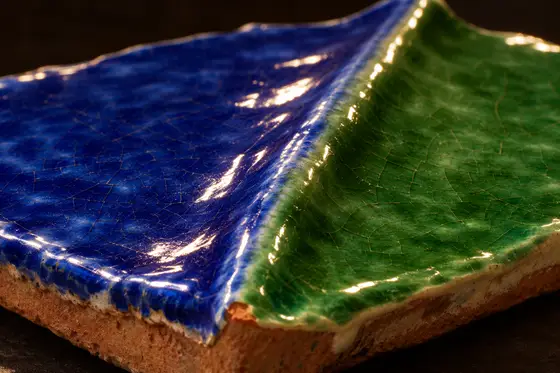
Tile cross-section
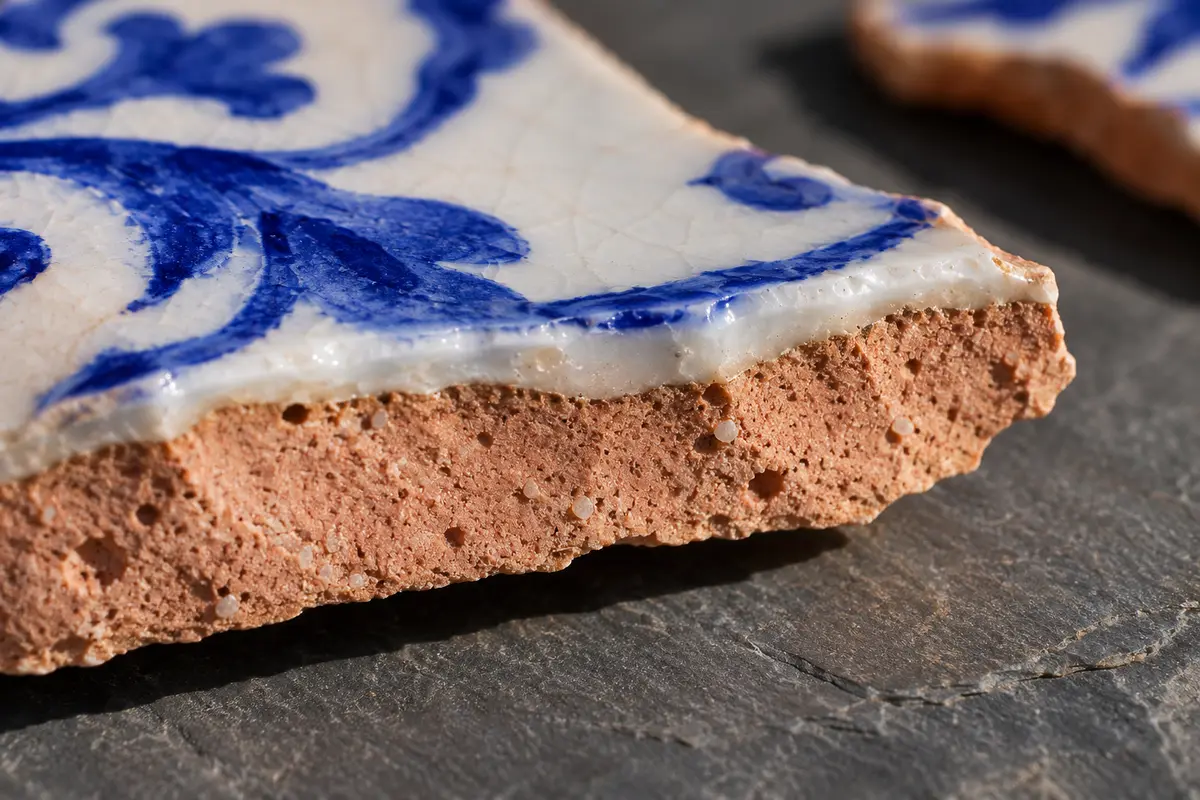
A broken tile shows its layers: the clay body, a layer of white tin glaze and, on top, the painted decoration. Clay colour varies from beige to pink.
A majolica tile is a layered object. After the first firing, which leaves the biscuit (chacota), a thick, opaque white base of tin enamel is applied to it; Portuguese Wikipedia lists its ingredients as tin, lead oxide, quartz-rich sand, salt and soda. The V&A explains the role of the tin: it makes the glaze opaque white, and the pigments are then painted on that white surface. The Museu Nacional do Azulejo defines faiança as exactly this sequence: tin glaze over the chacota, painting directly on it, then a second firing.
Under analysis the white layer is not empty. LNEC researchers found that the white glaze of 17th-century tiles holds crystals, probably quartz and feldspar, and trapped gas bubbles. The body can differ too: Viúva Lamego's early production included white-clay tiles alongside red-clay utilitarian wares, and Sant'Anna began in 1741 with unglazed red-clay utilitarian ware, so a broken tile may show a red or a pale body. Portuguese Wikipedia adds that the glazed face is the side vitrified in firing, impermeable and shiny.
This is a general description, not confirmed to a single source.
Source: pt.wikipedia.org, vam.ac.uk, repositorio.lnec.pt, viuvalamego.com
Read about it: A surface that drinks the paint: how a hand-painted tile is made →
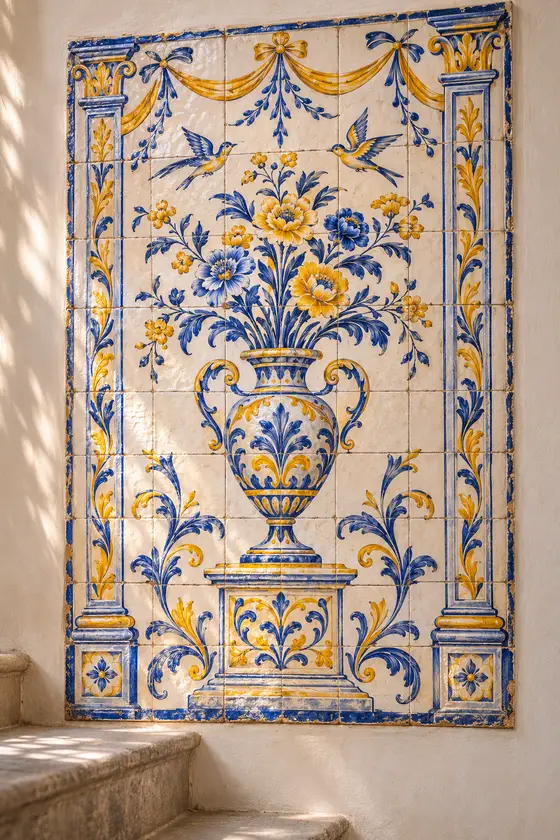
AI-generated illustration in the manner of the tradition, not a photograph of a specific object.