01 Tiles · Origins
From alicatado to azulejo: how Moorish tilework reached Portugal
In 1508 a record shows 10,146 tiles arriving at Sintra. Where they were made, and where the word “azulejo” comes from, are both still argued.
Ten thousand tiles in one year
In 1903 the Conde de Sabugosa published an account of the palace at Sintra. The Spanish art historian Alfonso Pleguezuelo, of the Universidad de Sevilla, picks out one line from it: in 1508 numerous tiles are arriving at Sintra, 10,146 in that year alone. He is careful with it. The entry does not say exactly where the tiles were meant to go, so it cannot be tied to one room. But the figure is large enough that it could account for much of what is still on the walls of the Palácio Nacional de Sintra, and the tiles came in by way of the port of Belém, which suggests they travelled by sea.
The palace itself says that King Manuel I (1469–1521) gave it the decoration that still defines it, “particularly to the fore” in the Hispano-Moresque tile finishings. One of the motifs is the armillary sphere, Manuel’s personal emblem, which is why Pleguezuelo limits the tiles to his reign, 1495 to 1521, and more likely its early years.
A word that is not about blue
Azulejo looks like a diminutive of azul, blue, and the Oxford English Dictionary gives azul as its origin. The Spectator’s language columnist points out that this entry has not been revised since 1885, and that the earliest tiles were closer to mosaic pieces and not necessarily blue at all. Other sources trace the word to Arabic, and they do not agree on the exact form. Priberam gives Spanish azulejo from Hispanic Arabic al-zuléig. Saudi Aramco’s magazine says al-zillij, small polished stone. The Spectator says zulug, polished stones.
So an Arabic origin is the common view across these sources, and the exact Arabic word is unsettled.
Cut, outlined, moulded
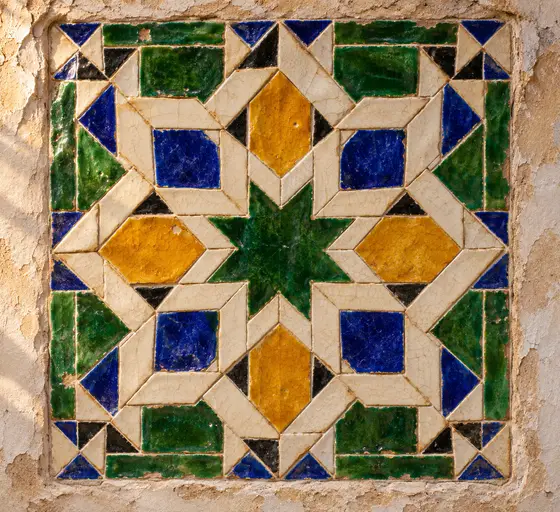
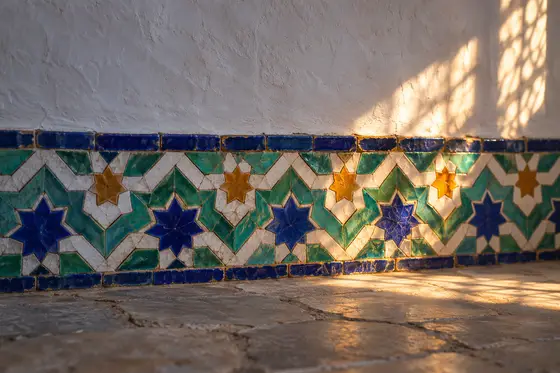
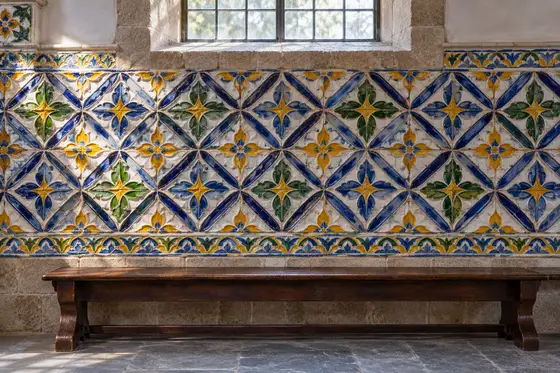
The Islamic tradition that Portugal borrowed from had three ways of building a pattern. In alicatado, tiles were painted and fired, then cut into pieces and pressed into mortar to form a mosaic. It was painstaking work. In cuerda seca, “dry cord”, lines of wax or grease kept neighbouring colours apart on a single tile; the V&A notes that sometimes the wax melted in the kiln and the colours ran together.
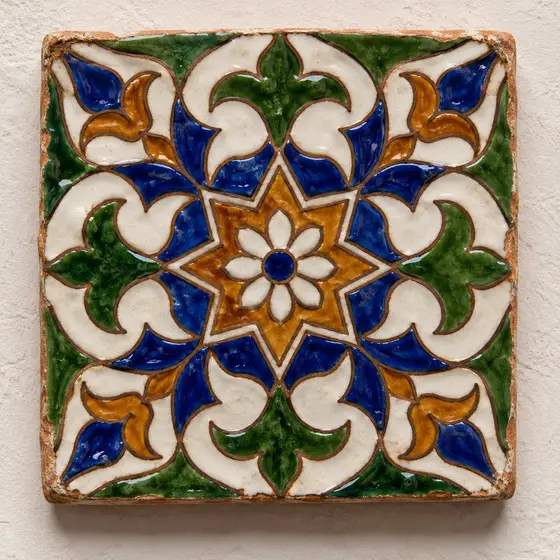
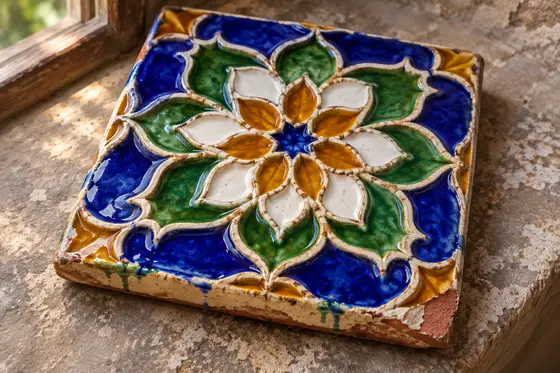
The third method used a mould. A mould pressed into a slab of clay left a raised outline with hollows between the lines, and the hollows, called cuenca in Spanish, “bowls”, were filled with coloured glaze. The V&A says the method grew out of cuerda seca. Aramco’s account has it replacing alicatado because pressing clay into moulds was far quicker than assembling a mosaic. Pleguezuelo calls the 16th-century moulded tiles azulejos de arista (aresta in Portuguese), and treats the relief tiles at Sintra as a separate type.
What came from Seville
Pleguezuelo’s survey of tilework in Portuguese monuments sorts the Sevillian imports by date. Alicatado is the earliest and the rarest, from the 14th and 15th centuries. Cuerda seca and relief tiles come around 1500. Arista tiles, from the 16th century, are the latest and the most common. He adds that in the late 15th and early 16th centuries the traffic ran from Seville to Portugal in bulk, before Portugal developed a production of its own that eventually outdid the Spanish one. Sintra, he says, holds the most extraordinary Portuguese set of the cuerda seca and relief tiles, and the doorframes of the Sala dos Árabes use one of the relief types.
The popular story is shorter: the king visited Seville, saw Moorish tiles, and brought the craft home. Aramco World and Visit Lisboa both tell it, and the year is not settled: the Aramco article and Visit Lisboa say 1498, while a lesson page on Aramco’s site gives 1498 in one place and 1492 in another. Aramco adds that Manuel then had Moriscos, Moors forced to convert or face exile, make tiles for the walls of Sintra. Pleguezuelo does not build on the trip. His case rests on trade, and on the tiles themselves.
Made in Seville, or made here?
Here the historians split. Pleguezuelo says that Rui Alves Trindade, in a study published in 2007, gave a Portuguese origin to almost all the Sintra tiles, relief, cuerda seca and arista alike, while earlier researchers had generally taken the cuerda seca and arista tiles to be Sevillian. Pleguezuelo sides with Seville. For the relief tiles, which have no direct documentation, his evidence is a baptismal font in the church of San Pedro in Carmona, near Seville, which is documented and dated. Some of its motifs, he says, match Sintra tiles in design, size and method, down to a small spray of reticulated leaves that is identical.
He then offers a hypothesis, flagged as one: the relief tiles may have been conceived by a Portuguese mind and made by Sevillian potters, who used the same moulds and motifs for baptismal fonts. And he says the surest test is not yet done, an analysis of the Sintra clay with Portuguese and Sevillian clays. A University of Lisbon master’s report, written during a placement at the Museu Nacional do Azulejo, notes that more recent studies defend Mudéjar tile production in Portugal, against the traditional view that domestic production began only in the middle of the 16th century with majolica.
Becoming a Portuguese thing
The Lisbon report suggests the Portuguese understood the idea of the azulejo probably through tiles imported from Andalusia at the end of the 15th century. Local production of the Italian-Flemish majolica kind, painted on a white tin glaze, followed. Visit Lisboa credits Flemish ceramists settling in Lisbon with starting Portuguese production, and Aramco says majolica, developed in the mid-16th century, was a much quicker and cheaper way to make a tile.
The Museu Nacional do Azulejo, whose collection begins in the mid-15th century, calls azulejo an art that in Portugal “never left the walls”. The building is partly closed for works, with part of the collection shown elsewhere in Lisbon. For the question this essay began with, the sources leave it open: nobody has yet shown, by analysis of the clay, who made the tiles of 1508.
Not confirmed: Dates for Manuel I’s Seville trip differ between sources (1492 and 1498 both appear on Aramco World’s own pages), so we give none as fact. Zellige is not covered, as no source we opened treats it; the Spanish Academy entry for azulejo and the Met Museum pages on Hispano-Moresque tiles could not be opened. Pleguezuelo’s paper is undated in the copy we read and its argument against Trindade is his own, not a settled view.
Sources
- Alfonso Pleguezuelo (Universidad de Sevilla): Sevilla y los azulejos de relieve del Palacio Nacional de Sintra
- Parques de Sintra: The History of the National Palace of Sintra
- Aramco World: Portugal’s enduring love of tilemaking
- Aramco World learning center: Tracing the history and geography of Portuguese tile making
- V&A: Tile, Seville, 16th century (cuenca)
- Priberam: azulejo
- The Spectator: Dot Wordsworth on azulejos
- Visit Lisboa: Rota do Azulejo
- Susana Valente, A Azulejaria Portuguesa e Holandesa (Universidade de Lisboa, 2018/19)
- Museu Nacional do Azulejo: o museu
- Museu Nacional do Azulejo: início
Related plates