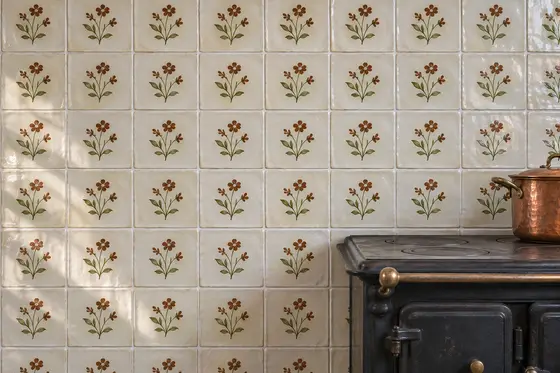
I Tile types and patterns · Plate 002
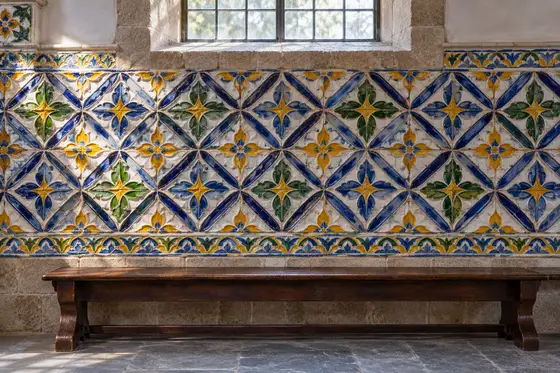
Alicatado dado band
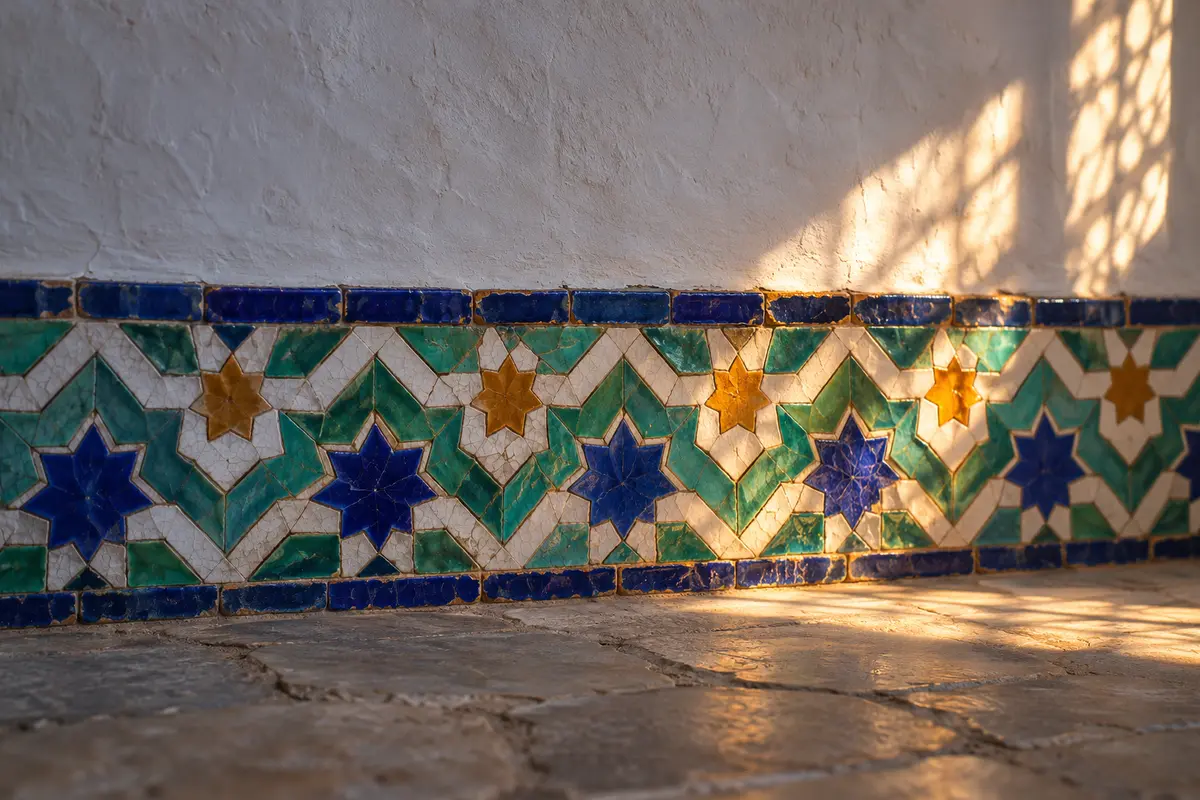
Alicatado is made of monochrome glazed ceramic pieces cut into geometric shapes and grouped like a mosaic. Here the pieces form a band along the foot of a wall.
A dado, in Portuguese a silhar, is a tile covering that rises from the floor to a set height, normally ten to twelve tiles. At the Sintra National Palace the Sala dos Árabes has walls and door surrounds in alicatado, aresta, corda seca and relief tiles side by side, and the Sala dos Cisnes is covered in a chequer-and-lozenge scheme. The palace shows how the early Portuguese court used tile as architecture.
The palette came from metal oxides in the glaze: cobalt for blue, copper for green, manganese for brown and black, iron for yellow and tin for white. For the second firing the glazed pieces lay flat in the kiln on small ceramic tripods called trempes, which left three tiny marks on the finished piece; today those marks help judge whether a Hispano-Moorish tile is authentic. Portuguese sources also note that an alicer or tacelo is the small single-colour piece from which such compositions are assembled.
Source: pt.wikipedia.org, en.wikipedia.org, visitlisboa.com
Read about it: From alicatado to azulejo: how Moorish tilework reached Portugal →
AI-generated illustration in the manner of the tradition, not a photograph of a specific object.