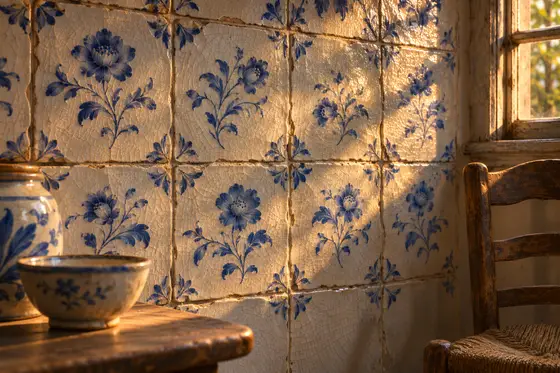
I Tile types and patterns · Plate 016
Single patterned tile
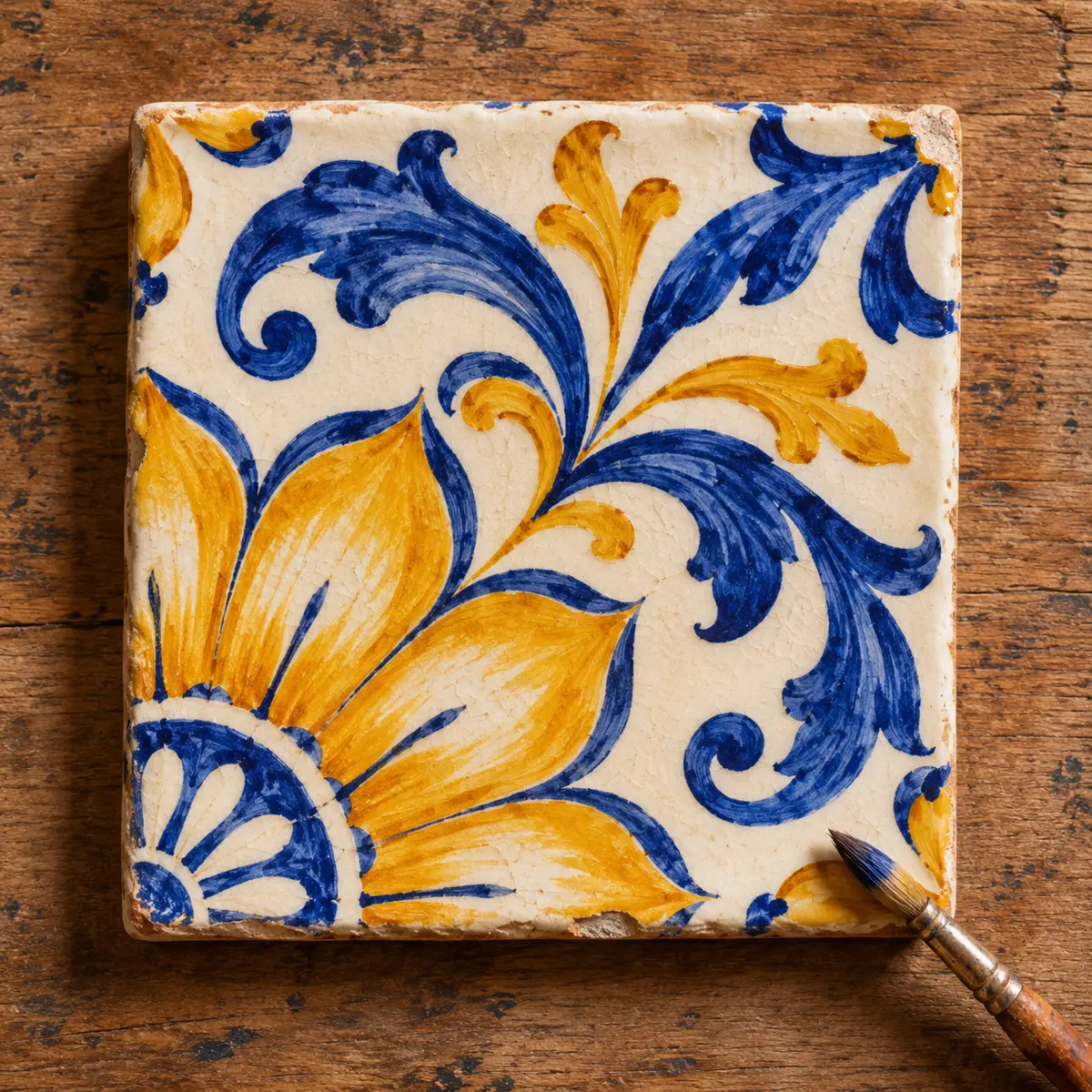
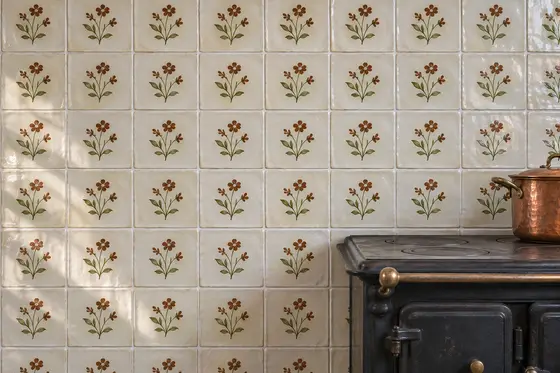
A single pattern tile is only part of the design: its edges are drawn so that, beside copies of itself, it forms the whole composition.
A single pattern tile has a physical identity worth knowing. Portuguese sources say early tiles had no standard size, but from the 16th century, as orders multiplied, Portuguese azulejos came to a square measure between 13.5 and 14.5 cm; this lasted until the 19th century. The back, the tardoz, is the side opposite the glaze, fixed directly to the wall. Finished tiles can carry three small marks left by the tripods, the trempes, used in the second firing.
The Netherlands offer a contrast. The V&A says Dutch makers once copied the elaborate polychrome designs of Italian maiolica floor tiles by repeating a pattern across four tiles. By about 1600, tiles became smaller and thinner, ornament decreased, and patterns repeated on single tiles, with the central and corner motifs shrinking to leave more plain white glaze. Portuguese sources, by contrast, describe pattern tiles in groups from 2x2 up to 12x12 that form one composition when repeated.
Source: pt.wikipedia.org, vam.ac.uk
AI-generated illustration in the manner of the tradition, not a photograph of a specific object.