01 Tiles · The blue century
Why Portuguese tiles turned blue and white
Chinese porcelain, Dutch painters on Portuguese commission and a local answer by named masters: what the museums and a Lisbon master’s report say about the switch to cobalt.
A music room in blue
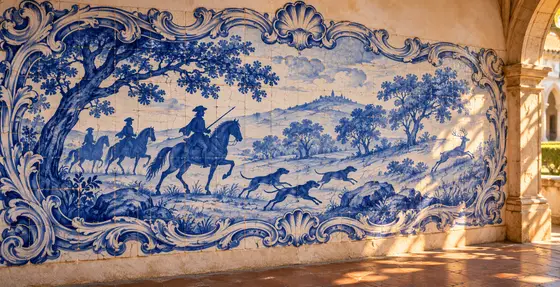
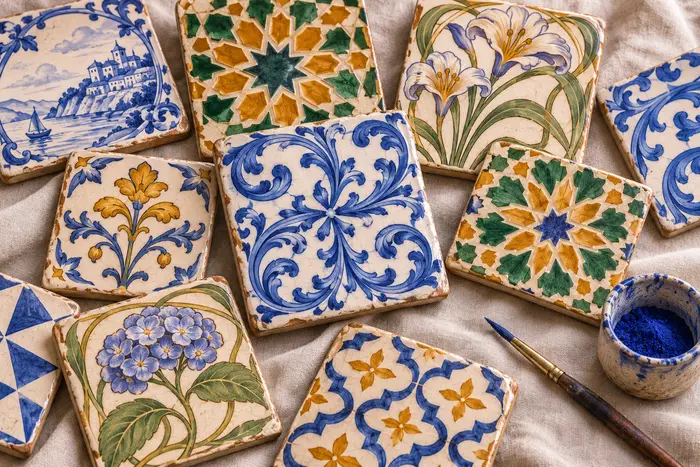
The Victoria and Albert Museum owns a panel of 120 tiles, 140 centimetres high and almost four metres long, made in Lisbon around 1720 to 1730. Musicians and dancers stand in front of painted pilasters, caryatids and other architecture, and everything is painted in a single colour, blue on white. The museum’s record says it came from the Music Room of the Quinta Formosa, a country house in or near Lisbon; that provenance rests on what the dealer who sold it told the museum.
The V&A adds that Portugal produced many large tiled schemes in the 17th and 18th centuries for churches, convents and palaces, usually painted in blue. Getting to that single colour involved at least three countries.
Before blue
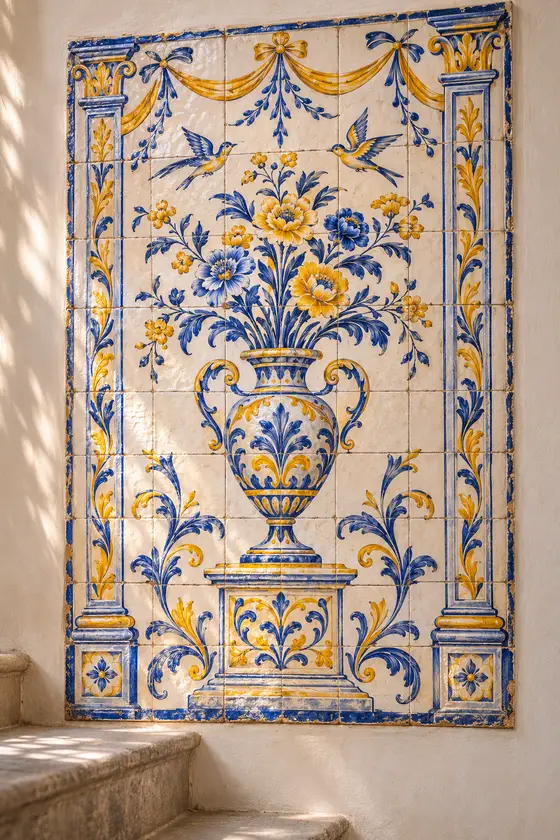
The first tiles in Portugal were the coloured Hispano-Moresque kind imported from Seville. Local production, in the traditional account, began around the middle of the 16th century with majolica, the Italian method of painting on a white tin glaze. Visit Lisboa says it began after Flemish ceramists settled in Lisbon. In the late 16th and early 17th century, the same tourism board says, chequerboard walls of plain coloured tiles were popular, and they were slow and costly to lay, which led to their gradual abandonment.
The Dutch commissions
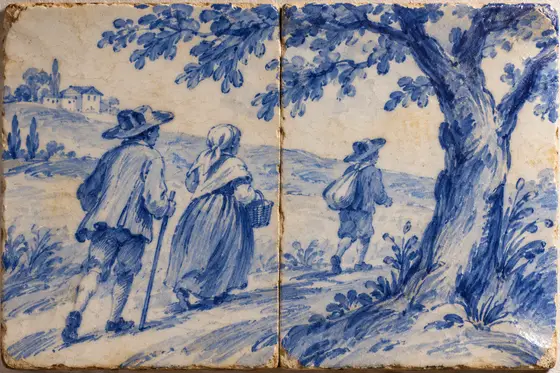
The turn to blue, a Lisbon master’s report on Portuguese and Dutch tiles argues, came with the Dutch. In the second half of the 17th century, Dutch tile painters began to receive commissions from the Portuguese nobility and clergy for large panels for their houses and churches, work that Dutch potteries had never done for their own buildings. The report, written during a placement at the Museu Nacional do Azulejo, names two painters as the ones with most impact: Jan van Oort and Willem van der Kloet. Their panels can still be seen at the Convento dos Cardais and the Convento da Madre de Deus in Lisbon, and at the sanctuary of Nossa Senhora da Nazaré. Van der Kloet carried on exporting after Van Oort died at the end of the 17th century.
Dutch tiles were also thinner and more carefully made than Portuguese ones, painted only in blue or purple, and expensive. The report’s author also notes research on trade between Lisbon and Amsterdam in the last quarter of the 17th century that points to tiles possibly being swapped for salt. And not every Dutch tile in Portugal is “Delft”: the report attributes a large set of single-figure tiles, from the Casa do Paço in Figueira da Foz and from the Palácio Melo in Lisbon, to the Delftsevaart pottery in Rotterdam, begun around 1640 by Carel Wijtmans.
Why blue: porcelain, and a price
Why blue, then? The sources give the same chain in different words. The Lisbon report says Portuguese makers began to adopt blue and white under Dutch influence, which was in turn influenced by oriental porcelain. It quotes the art historian Santos Simões to say that a piece only had to be blue to gain value in the eyes of buyers, because blue imitated porcelain. Visit Lisboa puts it in three clauses: Spain for influence, China for the blue, the Netherlands for refinement of the materials. Aramco’s magazine says that Flemish artists made Portuguese tiles in white and cobalt blue, a palette that Chinese porcelain had made popular.
Portugal knew that porcelain well. In 2019–20 the Museu Nacional de Arte Antiga ran an exhibition on the influence of Ming porcelain of the 16th and 17th centuries on Portuguese faience, and on Lisbon’s role in receiving goods from the East. None of the pages consulted says where the cobalt itself came from, or dates the first Portuguese blue-and-white tile. The sources also differ on timing. The Lisbon report puts the change in the last quarter of the 17th century; Aramco’s lesson page places the white-and-blue tiles it discusses in the 18th.
The Portuguese masters answer
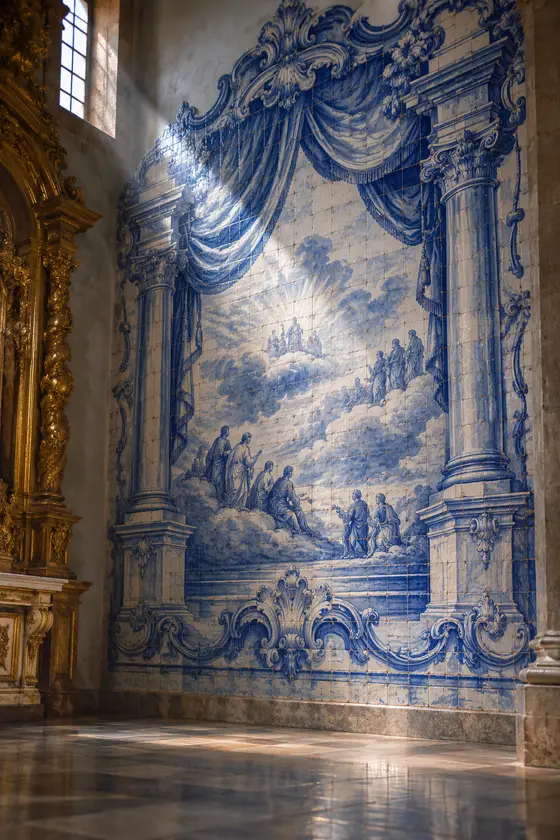
The report identifies three periods: a transition around 1675 to 1700, the Cycle of the Masters around 1700 to 1725, and the Joanine great production around 1725 to 1750. In the first, the painter Gabriel del Barco (born 1648) led a movement that sought to counter the import of Dutch tiles, which meant that Portuguese masters had to improve their painting. In the Cycle of the Masters it names António Pereira (died 1712), Manuel dos Santos, António de Oliveira Bernardes (1662–1732) and his son Policarpo (1695–1778). The museum’s own room text, on Google Arts & Culture, says the tile painter of this period took on the status of an artist and often signed his panels, names António de Oliveira Bernardes as an outstanding figure, and mentions a monogrammist, P.M.P., active between 1714 and 1725. Visit Lisboa calls Del Barco, a Spanish immigrant, the pioneer of painters signing their work, and says P.M.P. stayed anonymous until his death.
Another Museu Nacional do Azulejo item on Google Arts & Culture shows what that work looks like: the martyrdom of Saint Lawrence, blue on white, attributed to the workshop of Oliveira Bernardes and dated 1710/1730, from the nave of the church of São Lourenço in Carnide, Lisbon. The museum calls Policarpo de Oliveira Bernardes one of the most representative figures of the Cycle of the Masters.
The competition worked. By the early 18th century, the report says, Dutch imports fell off; it puts this down to competition from Portuguese tiles, and says quality had nothing to do with it. The V&A adds that an embargo on imported Dutch tiles helped Portuguese factories to grow, and that tiles suited the warm climate better than the textile wall hangings used in wealthy homes elsewhere in Europe. In the Joanine period, the report says, pure cobalt gave way to a more diluted tone.
Not confirmed: The Met Museum pages on Portuguese tiles could not be opened (rate-limited), and the Instituto Camões text on Dutch imports could not be read. The chain from porcelain to Dutch tiles to Portuguese blue and white rests on a Lisbon master’s report, a tourism board and a magazine, not on a museum catalogue. Dates and birth years of the painters come from the report alone. The Grande Panorama de Lisboa panel is left out because its date and authorship were not confirmed. Where the cobalt came from is unknown to us.
Sources
- Alfonso Pleguezuelo (Universidad de Sevilla): Sevilla y los azulejos de relieve del Palacio Nacional de Sintra
- V&A: Tile panel, Lisbon, c.1720–30 (C.48-1973)
- V&A: Panel, Lisbon, c.1720–30 (C.49:1 to 4-1973)
- Susana Valente, A Azulejaria Portuguesa e Holandesa (Universidade de Lisboa, 2018/19)
- Museu Nacional do Azulejo on Google Arts & Culture: The Cycle of the Master’s room
- Aramco World learning center: Tracing the history and geography of Portuguese tile making
- Visit Lisboa: Rota do Azulejo
- Aramco World: Portugal’s enduring love of tilemaking
- Visit Lisboa: Asian Luxury, porcelain, lacquer and silk (Museu Nacional de Arte Antiga)
- Museu Nacional do Azulejo on Google Arts & Culture: St. Lawrence’s martyrdom
- Museu Nacional do Azulejo: início
Related plates