01 Tiles · History
After the earthquake: a royal factory and the pattern tile
After 1755 Lisbon needed tiles that were quick and cheap. A royal factory, a pattern named for a minister, and a question mark on a museum label.
A label with a question mark
In the Museu Nacional do Azulejo in Lisbon, two records for “pombalino” pattern tiles name the maker as the Real Fábrica de Louça ao Rato, followed by a question mark. One set of panels is dated 1750 to 1780, the other 1780 to 1816. The first range begins seventeen years before the factory existed. The museum is telling us that the tiles belong to the Pombal era while admitting that it cannot say for certain who made them.
That is a good place to begin, because the story is usually told more neatly: an earthquake, a minister, a factory, a city tiled in blue. Parts of it hold up. Parts we can only half confirm.
The morning of 1 November 1755
The United States Geological Survey, which keeps a list of the world’s great earthquakes by calendar day, files Lisbon under 1 November. It was All Saints’ Day, and many of the city’s 250,000 inhabitants were in church. Stone buildings swayed and then collapsed on the people inside; those who ran to the riverfront were drowned by a tsunami, and fire ravaged what was left. The USGS prints a figure of 70,000 deaths and says a quarter of Lisbon’s population perished. Other counts differ, and we cite only this one.
The rebuilding of the Baixa followed an orthogonal grid, with the Praça do Comércio as the symbol of the plan. A 2023 newspaper essay by Guilherme de Oliveira Martins says the regularity of that chessboard plan governed the “austere” design of the buildings, and that its originality owed much to urgency. It also mentions the anti-seismic timber “cage” system, the gaiola. A Lisbon tile workshop, Sant’Anna, founded in 1741, says on its own website that it made azulejos for the rebuilding. None of these sources says the new facades were tiled.
A factory founded by policy
The museum of the Paço dos Duques, in Guimarães, holds a tureen it believes came from the Rato factory, and its label gives a short history. A Royal Factory was established in 1767 to produce earthenware, and took its name from its place in Lisbon. Its concept, the label says, rested on a protectionist campaign by the Marquis of Pombal. At first it made luxurious models, some for the Marquis himself; later blue and white prevailed. It prospered until 1818, when bad management began the decline that ended in closure in 1835.
The Grão Vasco museum in Viseu names the factory’s first master: Tomás Brunetto, born in Turin and invited by Pombal, in post from 1767 to 1771. The museum calls his short time there “one of the most extraordinary periods in the history of Portuguese ceramics.” Note what both museums are describing: tureens and amphorae. Neither mentions tiles.
What “pombalino” means on a tile
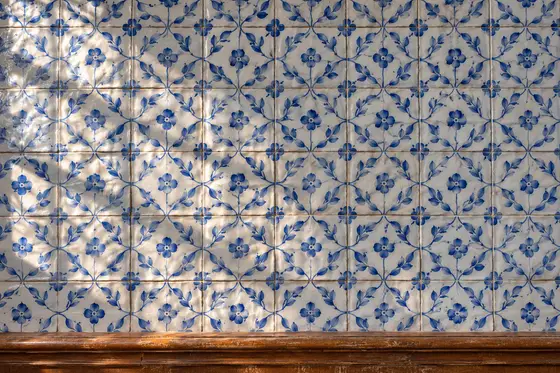
The Museu Nacional do Azulejo gives the clearest definition we found. Covering walls with pattern azulejos had been common in the 16th and 17th centuries and rare in the first half of the 18th. It came back in the rebuilding of Lisbon, and the patterns are named after Sebastião José de Carvalho e Melo, the Marquis of Pombal, who was Secretary of State to King José I. The museum calls them “an efficient and low-cost solution,” still used under Queen Maria I, whose reign ended in 1816.
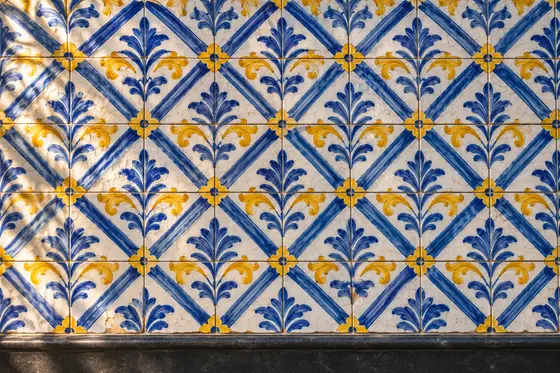
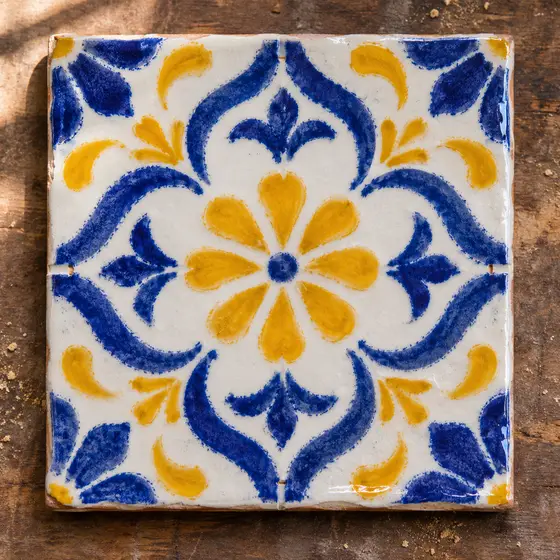
The design itself was a rhythm of repetition. The museum describes schemes with rotating forms and diagonal movement, borrowed from 17th-century azulejos, generally made by alternating a tile with a radial motif, a crocket and a tile in a grid shape. The clients were changing too: commissions once tied to the Church and nobility now also came from a rising middle class that Pombal promoted.
Inside first, the street later
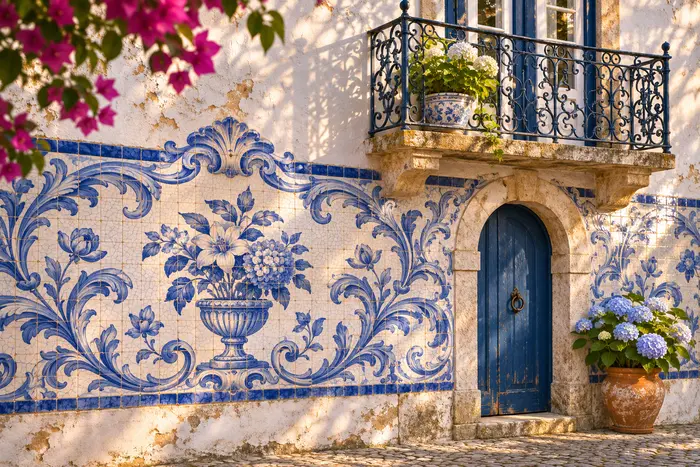
Here is the detail that is easiest to lose. The museum’s own wording is that after the earthquake pattern azulejos were used on the interior of new buildings. The Pombaline tile went on indoor walls. The tiled street front belongs to a later chapter: the museum says that production moved towards what it calls “total democratisation,” which led, in the second half of the 19th century, to exterior tile cladding on ordinary buildings. It adds that industrial manufacture between the mid-19th and early 20th centuries is what let tiles settle on facades and mark urban space. The order of events, as the museum tells it, runs like this: a disaster in 1755, cheap pattern tiles for the inside of new houses, a middle class ordering them, and more than a century later the same idea moving out into the street.
What we could not establish is the link people most want. Did the Rato factory turn out pombalino patterns in quantity, and by what methods? The two museum records give the attribution with a question mark and no more. We found two academic articles that seemed to address the factory and its tile production, but both were PDFs we could not read, so we leave their claims out. Until someone opens them, “the Rato factory industrialised the pattern tile” is a plausible sentence and not a documented one.
The next essay follows the pattern tile where the museum says it went: out onto the street.
Not confirmed: Death tolls for 1755 vary; we give only the USGS figure. We could not read two academic PDFs on the Rato factory, so we say nothing about its tile output. The Paço dos Duques label says the factory “remained successful up to 1818” and closed in 1835; we have not checked those dates against a second source.
Sources
- USGS: Today in Earthquake History, 1 November (Lisbon 1755)
- Diário de Notícias: “A Baixa Pombalina”, Guilherme de Oliveira Martins (17 Jan 2023)
- Sant’Anna: A nossa história
- Paço dos Duques de Bragança: tureen PD0140, Rato Factory
- Museu Nacional Grão Vasco (Google Arts & Culture): Amphora, Tomás Brunetto, Real Fábrica do Rato
- Museu Nacional do Azulejo (Google Arts & Culture): Ashlars of “pombalino” pattern tiles (1750/1780)
- Museu Nacional do Azulejo (Google Arts & Culture): Painel de azulejos de padrão pombalino (1780/1816)
- Museu Nacional do Azulejo (Google Arts & Culture): O azulejo em Portugal
Related plates