01 Tiles · History
Tiles in the street: from the factory sample book to the metro
Façade tiles, an Art Nouveau bakery, a station hall in Porto and a metro station in Lisbon. How Portugal’s tiles came outdoors and what is happening to them now.
A sample book under the window sills
In Lisbon there is a block of flats called the Casa das Bolas, after the trompe-l’oeil spheres on the tiles of its ground-floor façade. A member of the Roseira family owned it and put it up in 1871 and 1872 out of parts of an earlier building. Inside, under the window sills and in service areas, the tiles are laid in apparently random order, and there are more than fifty different patterns. Researchers at LNEC, the national civil engineering laboratory, call it a showcase of what the factory made, and an important reference for the first decades of façade tiles.
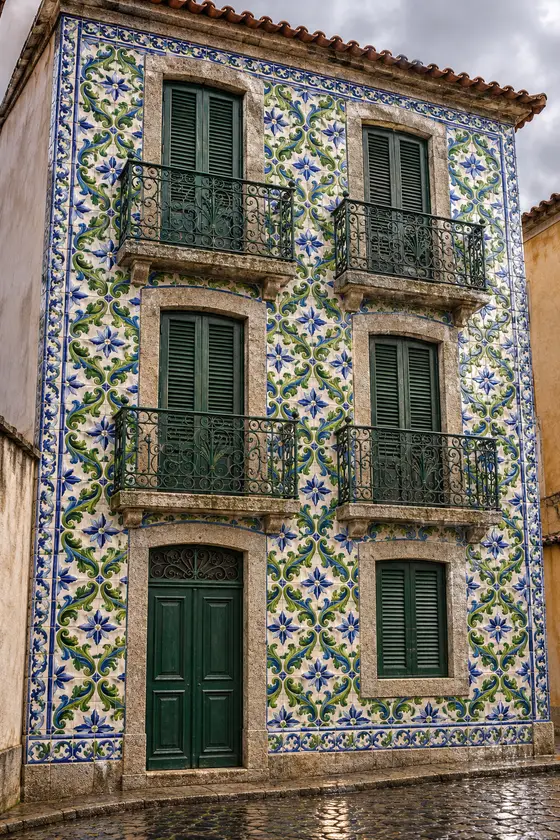
The same paper says the Roseira factory was one of the most important makers of façade tiles “used both in Portugal and in Brazil” in the second half of the 19th century, and possibly the first to make them in Lisbon. That is the only evidence of a Brazilian link we opened, and it says nothing about how the trade worked. The museum’s own record for a Roseira tile, dated 1833 to 1880 and made of stamped faience, says that from the mid-19th century the taste for covering façades with azulejos gave colour and rhythm to the austere urban landscape.
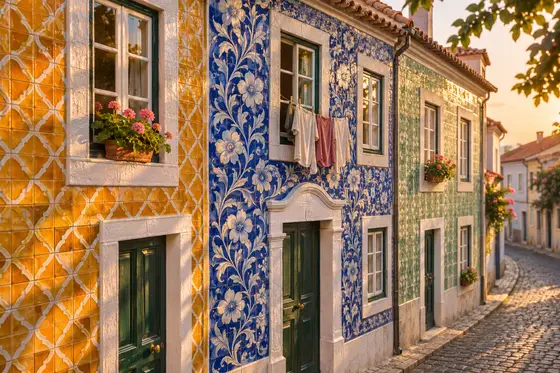
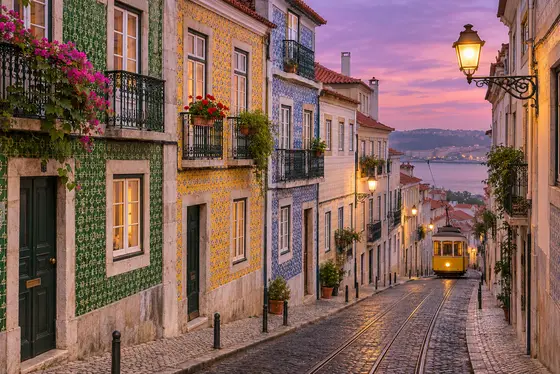
The Museu Nacional do Azulejo gives reasons. Cities were growing and new districts were opening; a more individualist, status-minded outlook made owners want to tell otherwise similar buildings apart, and the tile did that. It adds that some factories in the north of the country began to stand out for relief forms, which give sharper effects of light and shadow than the tiles found in Lisbon. Lisbon’s tourism board puts the scale simply: the cheaper pattern tile covered “thousands of façades.”
Art Nouveau on a bakery counter
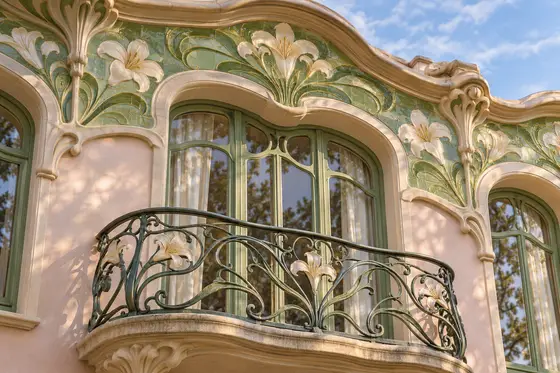
In 1902 Rafael Bordalo Pinheiro designed a tile pattern for a bakery in Campo de Ourique, Lisbon, the Panificação Mecânica, where it decorated the sales counter. A grasshopper lies diagonally across two ears of wheat among winding leaves in the Art Nouveau manner, in relief. The Museu Bordalo Pinheiro, which holds a panel dated 1905 or 1906, says that after a visit to Paris in 1900 Bordalo explored Art Nouveau fully in his tile designs, and that this border and its “butterfly and ear” companion were “considered pioneering” in Portugal for the style. Of such commercial decorations by him, only two survive in Lisbon: the bakery and the Tabacaria Mónaco in the Rossio.
The Museu Nacional do Azulejo ties this to the wider shift. Industrial manufacture, it says, made ceramics ordinary in Portuguese homes and put tiles on façades; alongside that came author-led production with a mainly decorative aim, and Bordalo is named as the forerunner of the taste in Portuguese tilework.
Jorge Colaço and the hall at São Bento
Jorge Colaço was born in Tangier on 26 February 1868, according to the Infraestruturas de Portugal route guide to his work. He met James Gilman, a partner in the Sacavém factory, in 1902, and made his first experiments in painting on tile there in 1903. He left Sacavém in 1923 and worked from 1924 to 1942 at the Lusitânia ceramic factory.
Porto’s São Bento station, designed by the Porto architect José Marques da Silva, was inaugurated on 5 October 1916 on the site of the old São Bento de Avé Maria convent. Its entrance hall is covered with more than 20,000 tiles that Infraestruturas de Portugal says were designed by Colaço, mixing episodes of Portuguese history with scenes of everyday life, work and customs, and a picture of how transport developed. We did not find a source that says when the panels were painted and fitted, so we do not give dates for them. The station has been classified as a Property of Public Interest since December 1997, and a project to rehabilitate its tile panels won the 2013 SOS Azulejo conservation prize and a 2014 Brunel Award.
Maria Keil underground
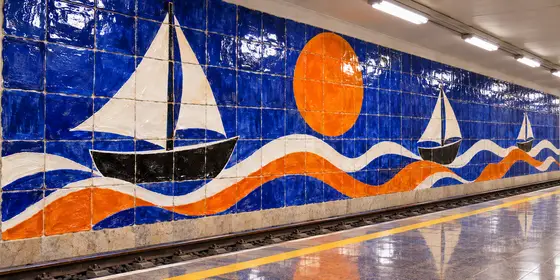
Underground, the tile found another kind of client. Metropolitano de Lisboa says its stations received a series of tile cladding between 1957 and 1982. Intendente station, on the Green Line, was officially inaugurated on 28 September 1966, and the metro says some authors consider its tilework by Maria Keil the most notable of the whole series. It quotes António Rodrigues, in the catalogue of a 1989 Maria Keil exhibition at the Museu Nacional do Azulejo, calling it “a masterpiece of contemporary azulejo.”
Visit Lisboa calls Keil one of the few pioneers of the public art movement in the years up to the early 1970s, and lists others who followed her into the stations, among them Almada Negreiros, Vieira da Silva with Arpad Szenes, Júlio Pomar and António Antunes. The Museu Nacional do Azulejo, for its part, says that from mid-century tilework became hard to describe in one word, with abstraction, geometry, figures, calligraphic signs and pure colour all in play, and that it was tied above all to transport networks and the metro.
Theft, neglect and a law about façades
SOS Azulejo was officially created on 28 February 2007. It is led by the Polícia Judiciária’s museum, and Infraestruturas de Portugal describes its purpose as fighting a serious, growing and alarming loss of Portuguese tile heritage through theft, vandalism and neglect. On 28 October 2014 the railway body signed a protocol with the police; the most visible result was information plaques at stations and halts warning against stealing tiles, receiving them and vandalism.
A proposal from SOS Azulejo to Parliament in February 2016 lay behind Lei 79/2017 of 18 August. It amends the national urban building regime so that operations removing façade tiles need a licence, whether or not the façade faces the street, and so that demolishing tiled façades or removing their tiles is grounds to refuse a licence, unless the town council authorises it in a justified case because the tiles have little or no heritage value. We read the text from a transcription on a legal-information site and a trade-press summary, not from the Diário da República, which would not load for us.
Whether it works is disputed. In June 2024 the Lisbon citizens’ association Fórum Cidadania Lx wrote to the ministry, as reported by Time Out Lisboa, calling the law “short” because it forgets interior tiles, and “innocuous” because enforcement runs into the councils’ lack of means and will. The group says illegal sales continue, with no inspection and no penalties. That is one advocacy group’s account. We found no official count of thefts, and we do not repeat a percentage that we could only see in a search summary.
Not confirmed: Lei 79/2017 is read from a secondary transcription, not the Diário da República, and may have been amended since. The Brazil link rests on one sentence in a conference abstract. The theft claims after 2014 come from an advocacy group as reported by Time Out. We found no source for when the São Bento panels were made, so none is given.
Sources
- LNEC: An unlikely catalogue of the production of azulejos by Fábrica Roseira of Lisbon circa 1870 (Mimoso et al., 2015)
- Museu Nacional do Azulejo (Google Arts & Culture): Pattern azulejos, Fábrica Roseira
- Museu Nacional do Azulejo (Google Arts & Culture): O azulejo em Portugal. Uma arte identitária
- Turismo de Lisboa: Azulejo Route
- Museu Bordalo Pinheiro (Google Arts & Culture): Painel “Gafanhoto e espiga”
- Infraestruturas de Portugal: Rota Autoria Jorge Colaço
- Infraestruturas de Portugal: Estação de Porto-São Bento celebra 110 anos
- Infraestruturas de Portugal: Estação de São Bento, preservação do património
- Metropolitano de Lisboa: press release on Intendente station
- Infraestruturas de Portugal: Projeto SOS Azulejo
- Lei 79/2017 (transcription, Informador)
- Imojuris: Alteração legislativa protege património azulejar (15 Sep 2017)
- Time Out Lisboa: Fórum Cidadania Lx on three buildings and the azulejo law (24 Jun 2024)
Related plates