I Tile types and patterns · Plate 032
Yellow-tiled street
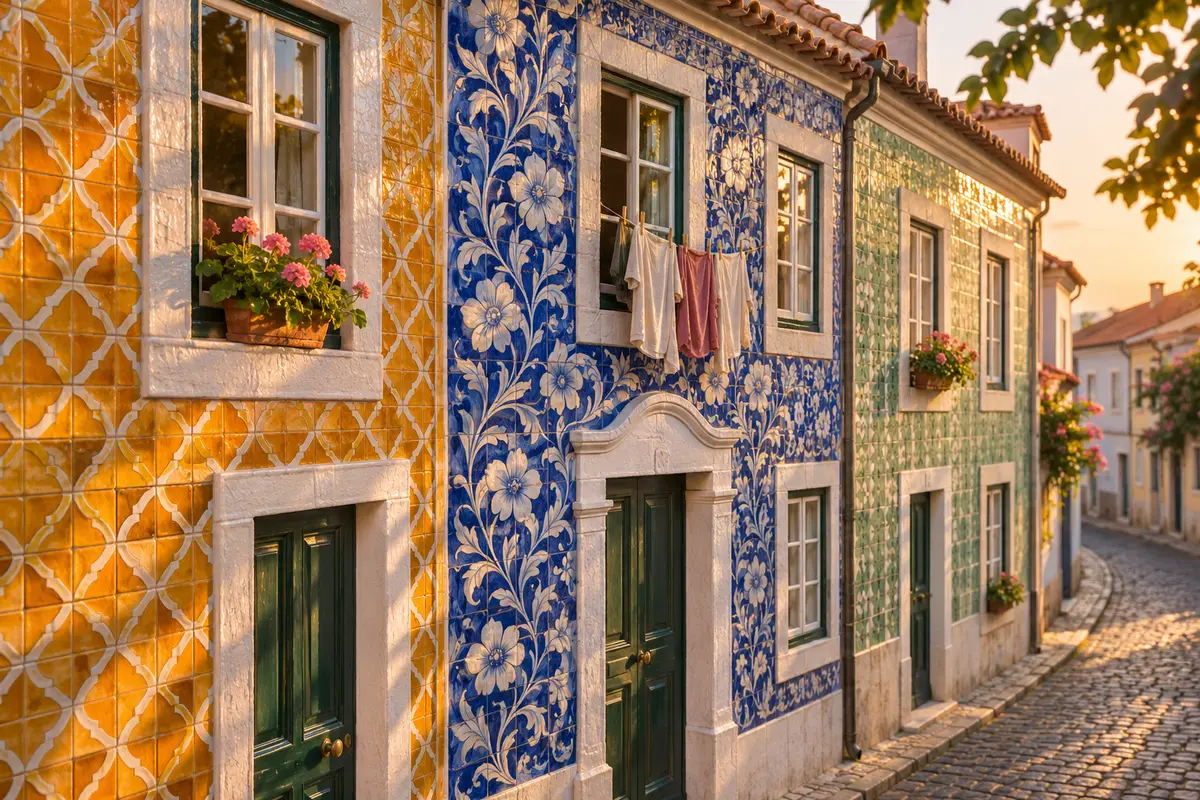
In several Portuguese towns there are streets of houses faced with tiles of different patterns and colours, each facade with its own design.
English Wikipedia says tile production stagnated in the first half of the 19th century, first with the Napoleonic invasion and then with social and economic change. Around 1840 Brazilian immigrants began industrialised production in Porto, and the Portuguese then adopted the Brazilian practice of covering house façades with azulejos. São Luís in Maranhão has the largest urban ensemble of 18th- and 19th-century tiles in Latin America, a UNESCO World Heritage Site since 1997. Santos Simões blamed climate for early full façade tiling in Brazil, an idea Portuguese Wikipedia says has since been challenged.
In the second half of the century the main factories were, in Lisbon, Roseira, Calçada do Monte and Viúva Lamego, and in Porto and Vila Nova de Gaia, Santo António do Vale da Piedade, Massarelos, Carvalhinho and Devesas. Lisbon was the largest market for façade tiling, which Portuguese Wikipedia calls an urban phenomenon rather than a regional one centred on Porto. Façades were decorated above the tiles too: balustrades and parapets carried balusters, vases, allegorical statues and arabesques, and decorative eave tiles (calões) were made but are now rare. Luís Ferreira built a house at Rua da Trindade, Lisbon, in 1849-1865 faced with trompe-l'oeil tiles.
This is a general description, not confirmed to a single source.
Source: en.wikipedia.org, pt.wikipedia.org
Read about it: Tiles in the street: from the factory sample book to the metro →
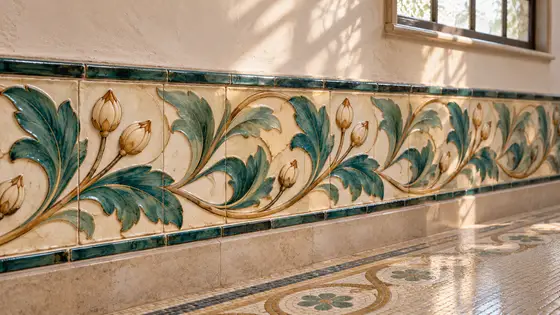
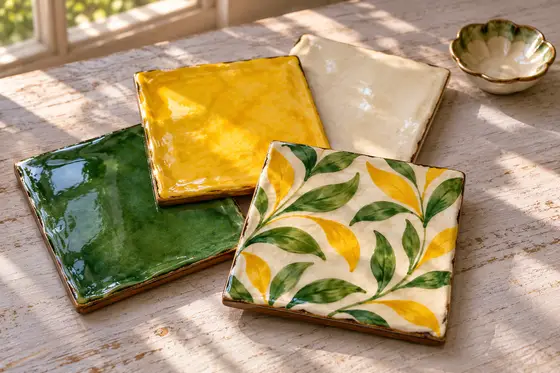
AI-generated illustration in the manner of the tradition, not a photograph of a specific object.