I Tile types and patterns · Plate 046
Modular modernist tiles
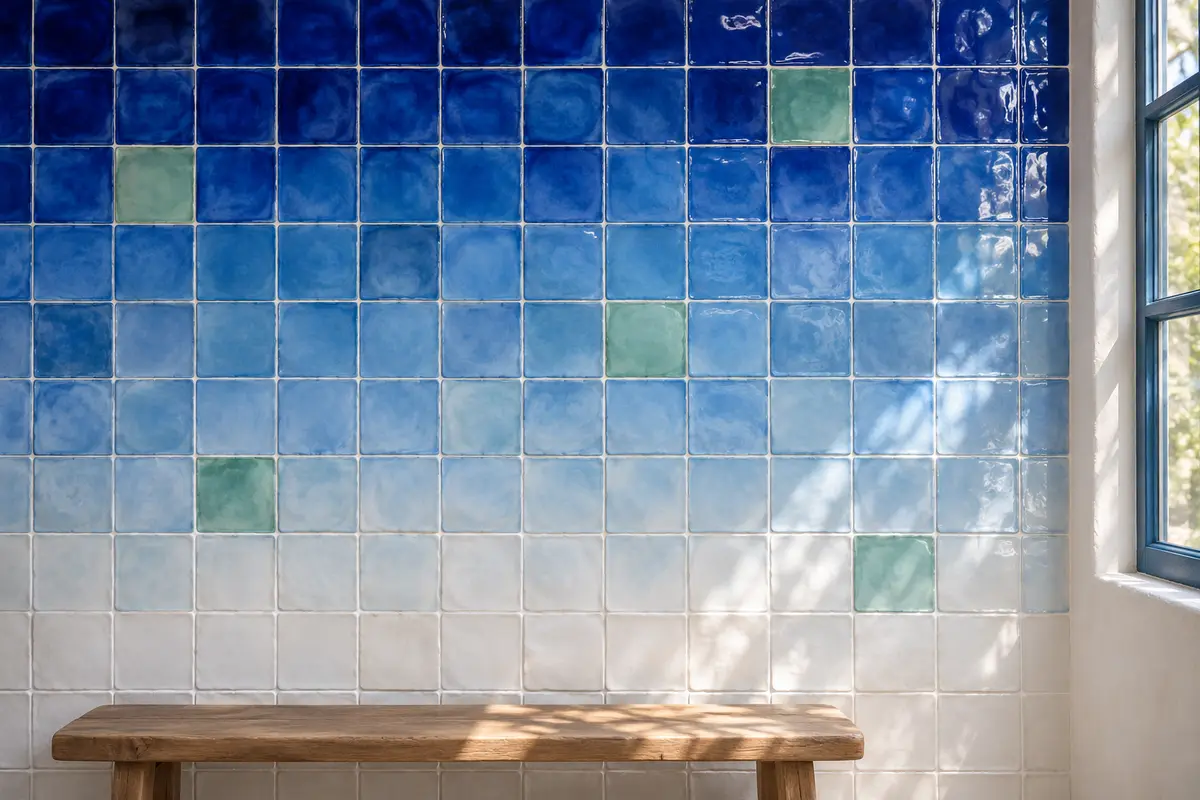
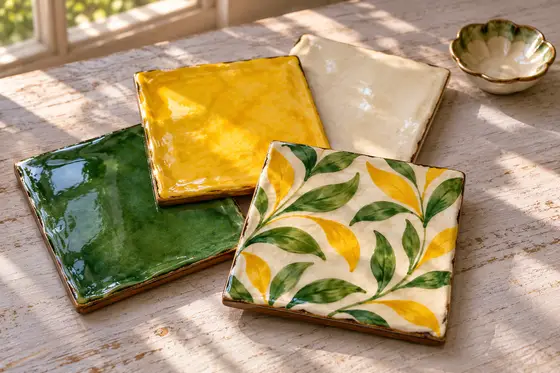
Modern tile panels sometimes use plain square tiles arranged in a grid, with colour fields in gradation. The pattern lies in the arrangement, not in painting on each tile.
Portuguese Wikipedia describes Maria Keil's language as modernist, combining sensitive figuration with simplified, geometric forms. Her graphic work was influenced by Fred Kradolfer, and overlapping planes, which she used in her painting, became compositional structure. In azulejo she worked with abstract forms, with some influence from Neoplasticism, and with spatial-optical effects rather than simply updating the traditional vocabulary. The Museu Nacional do Azulejo says that from the mid-20th century tile production is hard to characterise at all, a time of diversity in which individual approaches multiplied.
The Museu Nacional do Azulejo lists the languages in play: abstract or geometric work, figurative elements, calligraphic signs and purely chromatic elements. It also ties tile to modern urban life, especially the transport network and the Metro. The same museum links as an example of contemporary tile language the Oceanário de Lisboa tiles of 1998 by Ivan Chermayeff, which use pixelated, digital-style imagery, and a 2006 repeating ceramic relief panel by Manuel Cargaleiro made in Vietri sul Mare, part of the series Sete Propostas para Arquitetura.
This is a general description, not confirmed to a single source.
Source: pt.wikipedia.org, artsandculture.google.com
AI-generated illustration in the manner of the tradition, not a photograph of a specific object.