I Tile types and patterns · Plate 021
Baroque panel border
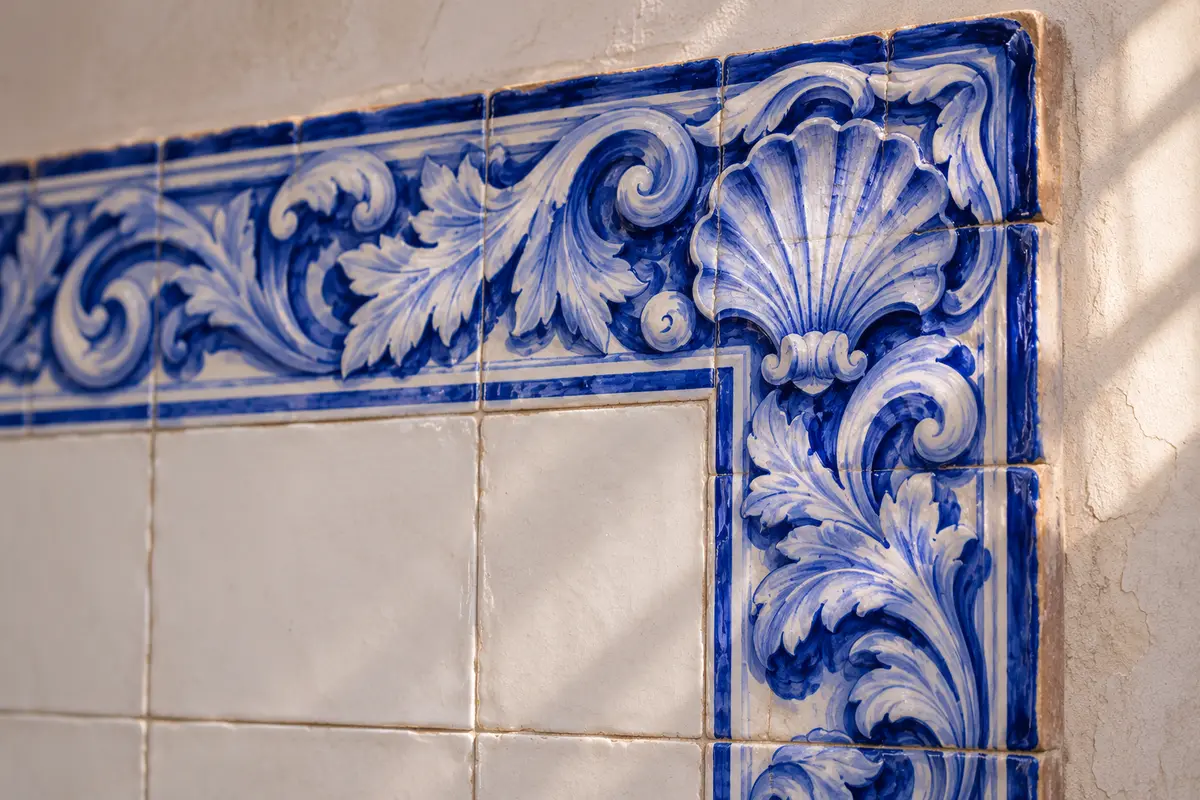
Baroque narrative panels often have painted frames with scrolls and shells, which set the scene within an architectural border.
Portuguese sources describe the baroque frames of the Grande Produção as exuberant, sometimes almost as heavy as the scene they surround. The ornament came from books of ornament by designers such as Jean Bérain I, Claude Audran III, Gilles Marie Oppenord, Nicolas Pineau and Pierre Lepautre. It uses concave and convex forms, shells, flowers, fruit, cartouches, putti, a baldachin, illusionistic architecture such as balustrades, and light and dark to suggest volume. A cartela is the scroll- or shield-shaped ground that sets a scene apart.
In churches the tile covers every surface, even ceilings and vaults, and Portuguese writers observe an aesthetic match between the gilded woodcarving of the period and the undulating frames of the tiles. About the 1740s, English Wikipedia says, taste turned from monumental narrative panels to smaller, more delicate Rococo ones; Portuguese sources add that frames then lose much of their volumetric mass and asymmetry appears. The frame is therefore a way of dating a panel, from heavy baroque to light Rococo.
This is a general description, not confirmed to a single source.
Source: pt.wikipedia.org, en.wikipedia.org
AI-generated illustration in the manner of the tradition, not a photograph of a specific object.