I Tile types and patterns · Plate 045
Modernist figurative mural
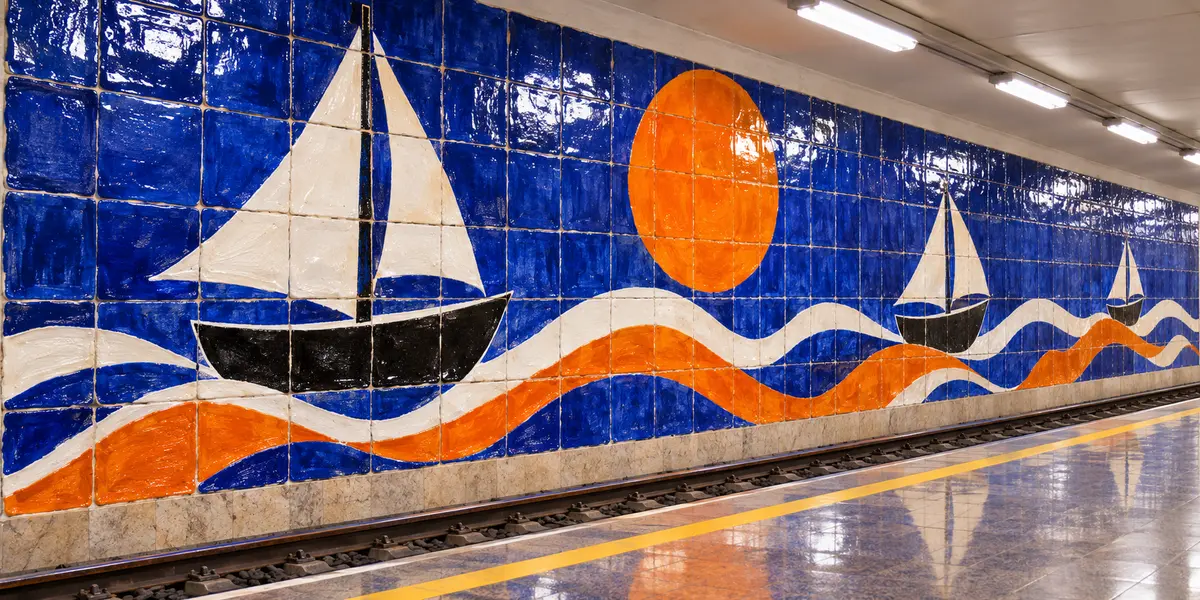
Azulejos appear in almost every Lisbon Metro station. This image is an illustration in the spirit of such 20th-century murals.
After Maria Keil's first stations, the Lisbon Metro went on commissioning artists. English Wikipedia lists the 1988 expansion: Rolando Sá Nogueira at Laranjeiras, Júlio Pomar at Alto dos Moinhos, Manuel Cargaleiro at Colégio Militar/Luz and, at Cidade Universitária, a transposition of a painting by Maria Helena Vieira da Silva. Portuguese Wikipedia adds that Pomar's Alto dos Moinhos work, from about 1989, takes Fernando Pessoa as its theme, that Eduardo Nery worked at Campo Grande between 1987 and 1991 and that Jorge Martins made the tiles at Chelas.
The Oriente station, from 1998, brought in artists from abroad, among them Hundertwasser, Yayoi Kusama and Zao Wou Ki, according to English Wikipedia. Lisbon's tourist board names others who contributed to the city's public transport art: Almada Negreiros, Vieira da Silva and Arpad Szenes, Querubim Lapa, Júlio Pomar, Júlio Resende and António Antunes. In Porto, Júlio Resende's Painel da Ribeira Negra, a 40-metre panel made of 40 ceramic pieces, depicts the history of the Ribeira's riverside population at the entrance to the Ribeira tunnel.
Source: en.wikipedia.org, pt.wikipedia.org, visitlisboa.com
Read about it: Tiles in the street: from the factory sample book to the metro →
AI-generated illustration in the manner of the tradition, not a photograph of a specific object.