I Tile types and patterns · Plate 013
Tapete (carpet) panel
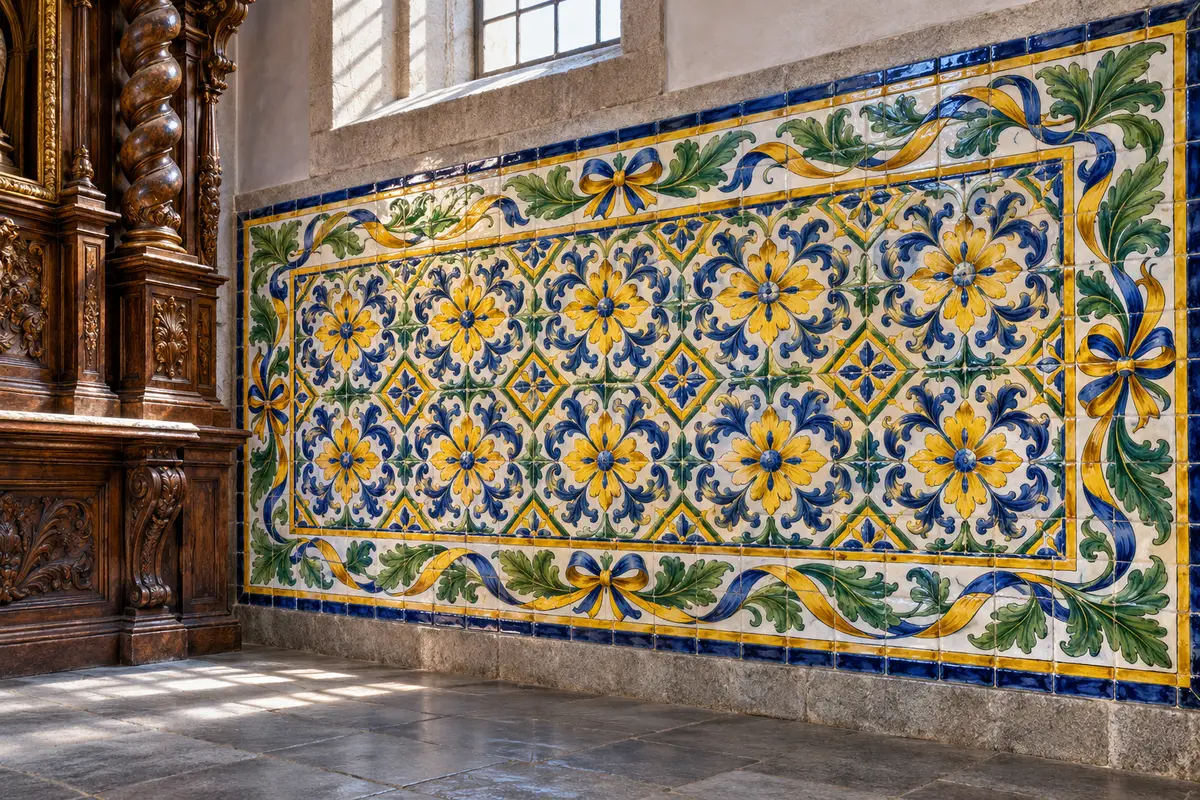
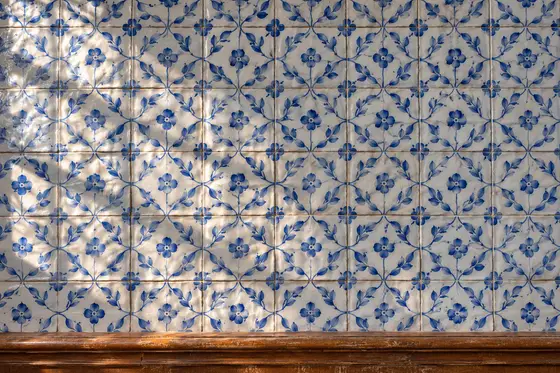
In the 17th century, large groups of repeated tiles formed a polychrome pattern like a carpet, often with a wide border. They are called azulejos de tapete.
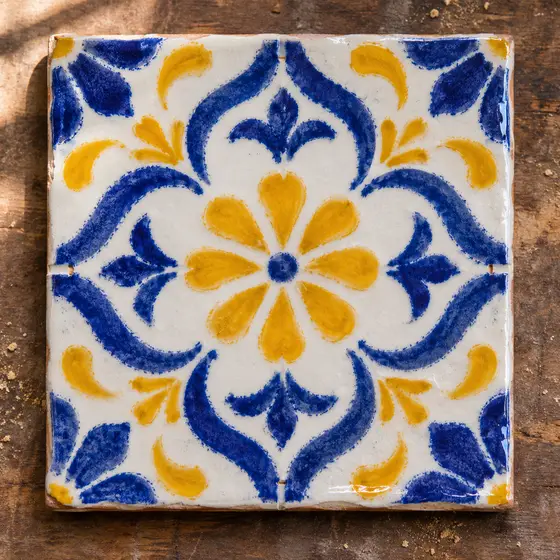
The azulejo de tapete is defined in Portuguese sources as a large number of tiles on a wall whose repeated models produce a polychrome pattern; framed by friezes, bars and borders, the whole looks like a carpet. Portuguese writers place its rise in the 17th century, after the loss of independence and the Restoration War, and describe it as patterned tile inspired by printed Indian textiles and Persian carpets. Its colours are blue, yellow and green, and its motifs are flowers, lobes and fantastic or paradise-like scenes.
English Wikipedia gives the best-known places to see carpet-style tilework: the Igreja do Salvador in Évora, the church of São Quintino at Sobral de Monte Agraço, the church of São Vicente in Cuba, and the university chapel in Coimbra. Small figurative panels called registos, showing saints or scenes from the life of Christ, were set into the pattern as accents. Carpet compositions, elaborately framed with friezes and borders, were produced in great numbers during the 17th century.
Source: pt.wikipedia.org, en.wikipedia.org
AI-generated illustration in the manner of the tradition, not a photograph of a specific object.