I Tile types and patterns · Plate 018
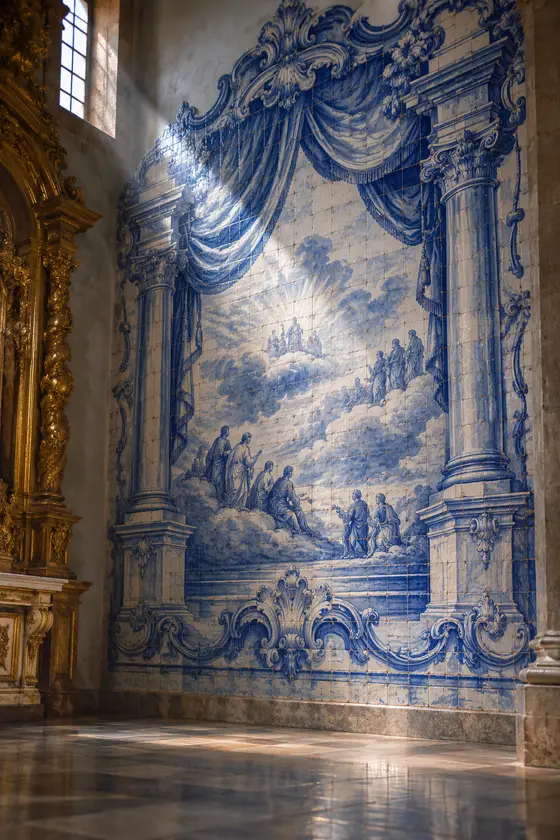
Blue-and-white narrative panel
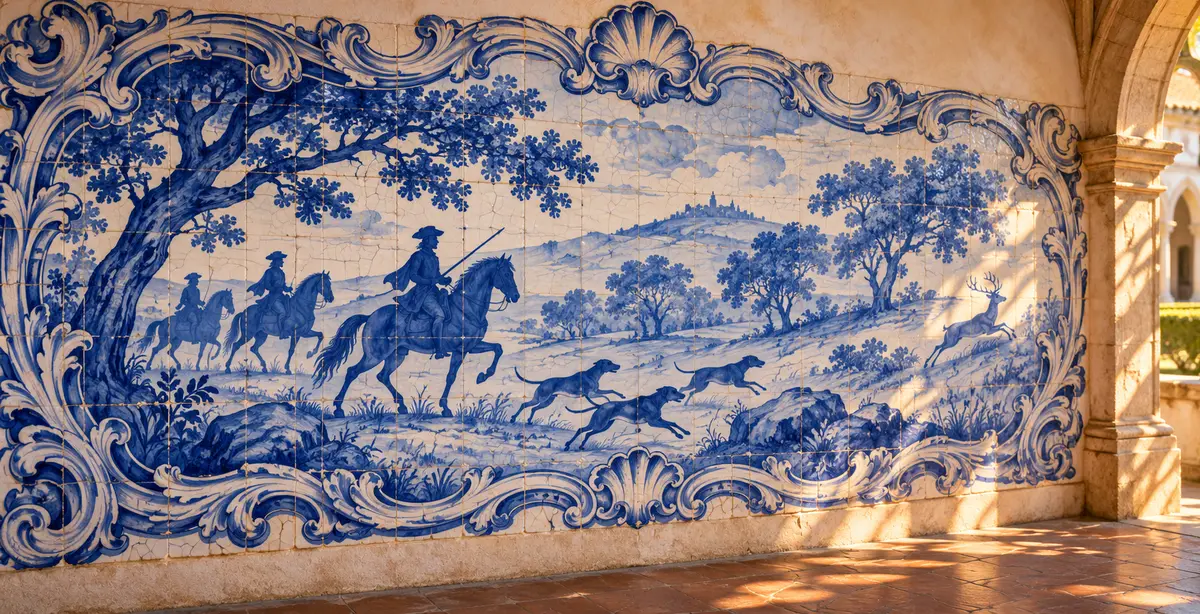
From the late 17th century, the Ciclo dos Mestres brought large narrative panels in blue and white to churches and palaces.
The blue-and-white narrative panel is a 17th-century import. Portuguese sources say that using a single colour, blue on a white ground, allowed a greater concentration on the painting, and that Dutch examples, notably by Willem van der Kloet and Jan van Oort, showed a technical superiority of line. Portuguese workshops reacted to this competition, and national production grew in the period called the Ciclo dos Mestres, driven by the Spanish-born Gabriel del Barco. English Wikipedia says King Peter II stopped imports from 1687 to 1698.
The masters who followed were Lisbon painters: António Pereira, António de Oliveira Bernardes and his son Policarpo, Manuel dos Santos, and the monogrammist P.M.P. English Wikipedia says the last major delivery from Holland came in 1715, after which large home-made blue-and-white figurative panels, designed by academically trained Portuguese artists, became the dominant fashion over repeated patterns. Large orders from Brazil also pushed production up. Visit Lisboa notes that in the 17th century the tile painter took on the status of an artist and began to sign work.
Source: pt.wikipedia.org, en.wikipedia.org, visitlisboa.com
Read about it: Why Portuguese tiles turned blue and white →
AI-generated illustration in the manner of the tradition, not a photograph of a specific object.