III Regional wares · Plate 017
Quartz detail
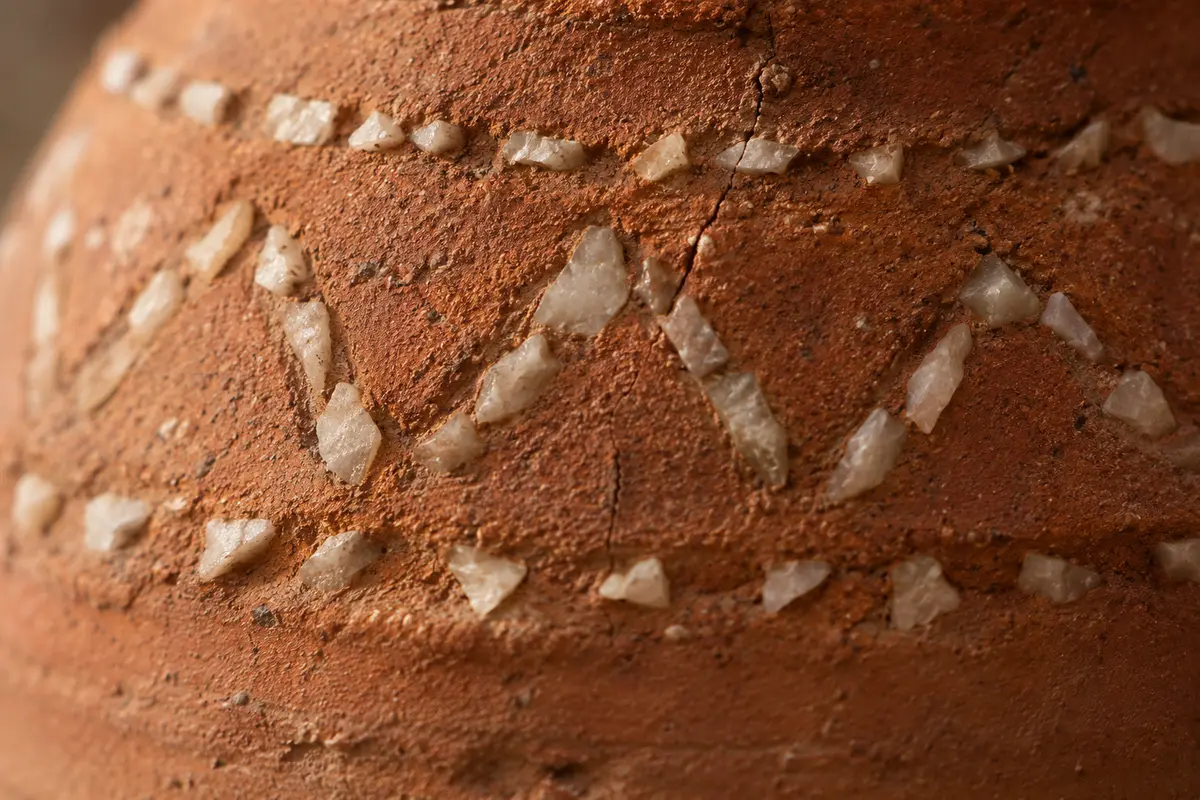
In Nisa the milky quartz is pressed in by hand, pointed end inward and flat face outward, after the design is scratched on. The pieces are dipped in a red clay slip.
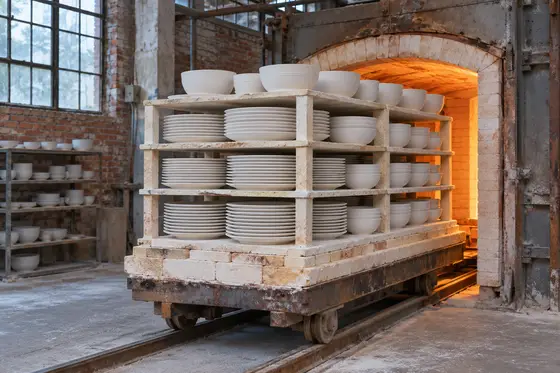
The white stone is milky quartz, taken from the nearby Serra de São Miguel. It is very hard, so it is first baked in a kiln at high temperature (formerly with thick logs, now electric) to make it friable, and the heat also fixes its final white. Once cool, women crush it with a granite block on a floor slab and sift it into three sizes: pedra de 1ª, 2ª and 3ª (or grossa), with diameters of roughly 1/2, 2/3 and 3/4 mm. The size chosen decides the look, and the finest suits the modern single-line decoration.
The decorating is a woman's job, usually the potter's wife, who may supervise paid workers, the pedradeiras, who set the stones in the workshop or at home. She first scratches the design with a sewing needle, using thimbles and lamp caps to mark circles, and the museum says the drawing largely sets the artistic quality of the finished piece. Round pieces are stoned on the lap, flat plates and platters on a table. Afterwards some motifs are filled with an incised cross-hatch made with the needle, and a second line is often drawn around them.
Source: museubordadoebarro.cm-nisa.pt
AI-generated illustration in the manner of the tradition, not a photograph of a specific object.